4EPQ | pdb_00004epq

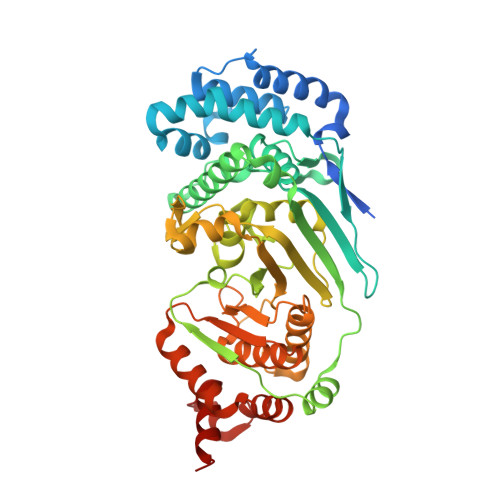
canonical poly(ADP-ribose) glycohydrolase RBPI inhibitor complex from Tetrahymena thermophila


Experimental Data Snapshot

  • Method: X-RAY DIFFRACTION
  • Resolution: 2.40 Å
  • R-Value Free: 
    0.231 (Depositor), 0.227 (DCC) 
  • R-Value Work: 
    0.165 (Depositor), 0.166 (DCC) 
  • R-Value Observed: 
    0.168 (Depositor) 

Starting Model: experimental
View more details

wwPDB Validation 3D Report Full Report

Validation slider image for 4EPQ

Ligand Structure Quality Assessment 


This is version 1.2 of the entry. See complete history

Literature

Structure and mechanism of a canonical poly(ADP-ribose) glycohydrolase.

Dunstan, M.S.Barkauskaite, E.Lafite, P.Knezevic, C.E.Brassington, A.Ahel, M.Hergenrother, P.J.Leys, D.Ahel, I.

(2012) Nat Commun 3: 878-878

  • DOI: https://doi.org/10.1038/ncomms1889
  • Primary Citation Related Structures: 
    4EPP, 4EPQ

  • PubMed Abstract: 

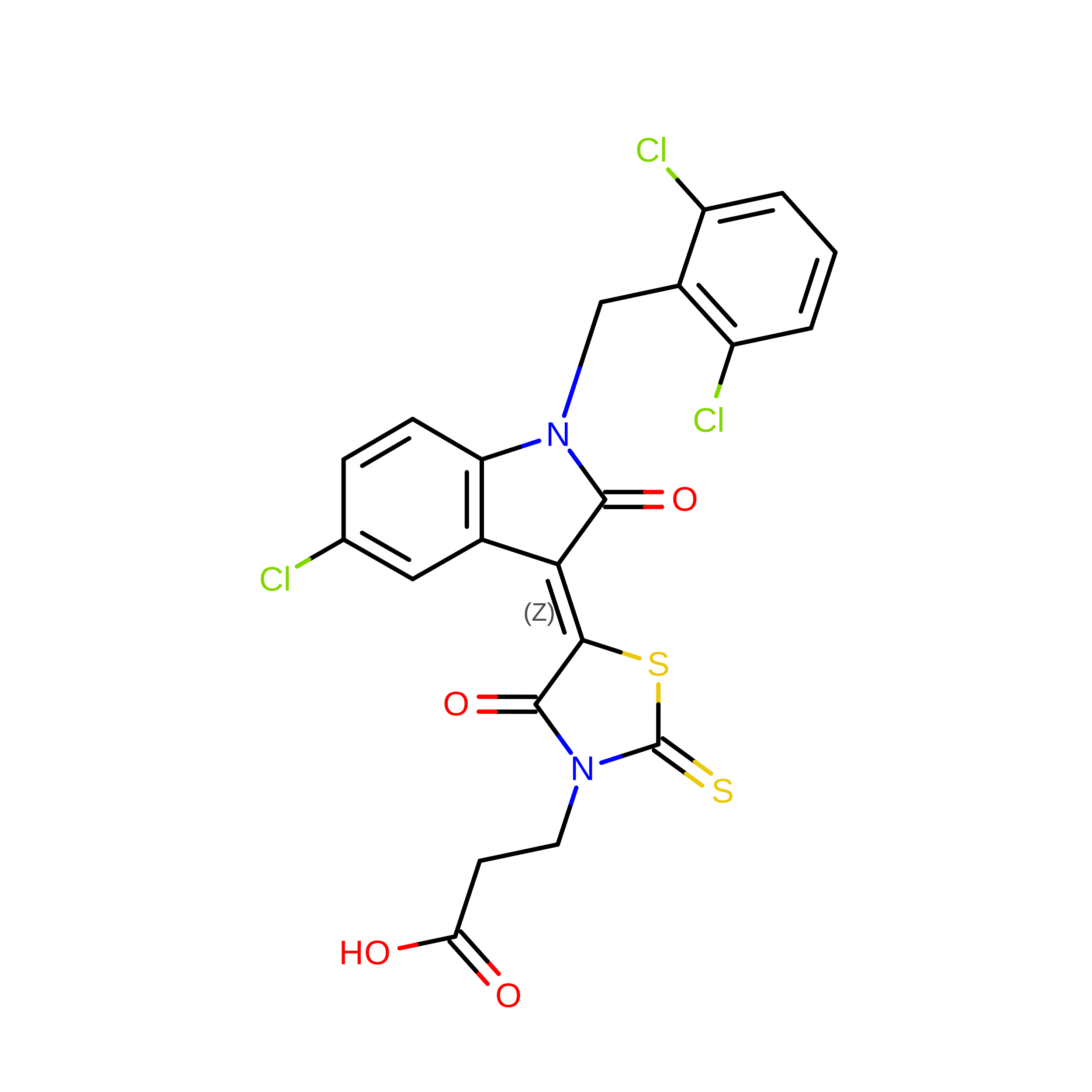
    Poly(ADP-ribosyl)ation is a reversible post-translational protein modification involved in the regulation of a number of cellular processes including DNA repair, chromatin structure, mitosis, transcription, checkpoint activation, apoptosis and asexual development. The reversion of poly(ADP-ribosyl)ation is catalysed by poly(ADP-ribose) (PAR) glycohydrolase (PARG), which specifically targets the unique PAR (1''-2') ribose-ribose bonds. Here we report the structure and mechanism of the first canonical PARG from the protozoan Tetrahymena thermophila. In addition, we reveal the structure of T. thermophila PARG in a complex with a novel rhodanine-containing mammalian PARG inhibitor RBPI-3. Our data demonstrate that the protozoan PARG represents a good model for human PARG and is therefore likely to prove useful in guiding structure-based discovery of new classes of PARG inhibitors.


  • Organizational Affiliation
    • Manchester Interdisciplinary Biocentre, Princess Street 131, M1 7DN, Manchester, UK.

Macromolecule Content 

  • Total Structure Weight: 56.4 kDa 
  • Atom Count: 3,718 
  • Modeled Residue Count: 439 
  • Deposited Residue Count: 477 
  • Unique protein chains: 1

Macromolecules

Find similar proteins by:|  3D Structure
Entity ID: 1
MoleculeChains  Sequence LengthOrganismDetailsImage
Poly(ADP-ribose) glycohydrolase477Tetrahymena thermophilaMutation(s): 0 
EC: 3.2.2 (UniProt), 3.2.1.143 (UniProt)
UniProt
Find proteins for I6L8L7 (Tetrahymena thermophila)
Explore I6L8L7 
Go to UniProtKB:  I6L8L7
Entity Groups
Sequence Clusters30% Identity50% Identity70% Identity90% Identity95% Identity100% Identity
UniProt GroupI6L8L7
Sequence Annotations
Expand
Reference Sequence

Small Molecules

Ligands 1 Unique
IDChains Name / Formula / InChI Key2D Diagram3D Interactions
0RR

Query on 0RR


Download:Ideal Coordinates CCD File
B [auth A]3-{(5Z)-5-[5-chloro-1-(2,6-dichlorobenzyl)-2-oxo-1,2-dihydro-3H-indol-3-ylidene]-4-oxo-2-thioxo-1,3-thiazolidin-3-yl}propanoic acid
C21 H13 Cl3 N2 O4 S2
YESAJFJEXWEXAO-ZCXUNETKSA-N

Experimental Data & Validation

Experimental Data

  • Method: X-RAY DIFFRACTION
  • Resolution: 2.40 Å
  • R-Value Free:  0.231 (Depositor), 0.227 (DCC) 
  • R-Value Work:  0.165 (Depositor), 0.166 (DCC) 
  • R-Value Observed: 0.168 (Depositor) 
Space Group: P 41
Unit Cell:
Length ( Å )Angle ( ˚ )
a = 80.68α = 90
b = 80.68β = 90
c = 89.42γ = 90
Software Package:
Software NamePurpose
PHENIXrefinement

Structure Validation

View Full Validation Report


Ligand Structure Quality Assessment 


Entry History 

Deposition Data

Revision History  (Full details and data files)

  • Version 1.0: 2012-06-13
    Type: Initial release
  • Version 1.1: 2012-08-29
    Changes: Database references
  • Version 1.2: 2023-09-13
    Changes: Data collection, Database references, Derived calculations, Refinement description