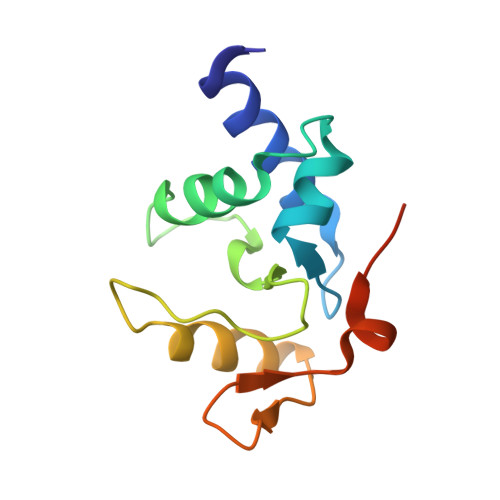
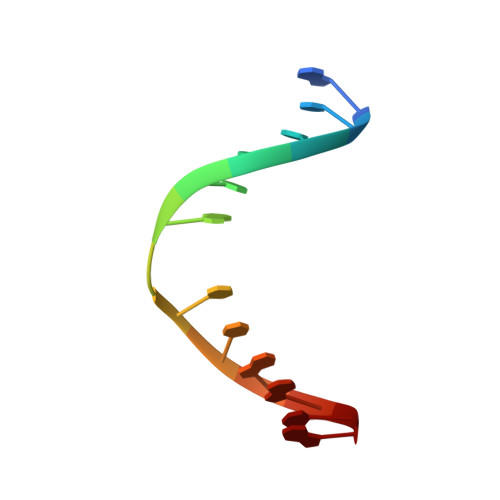
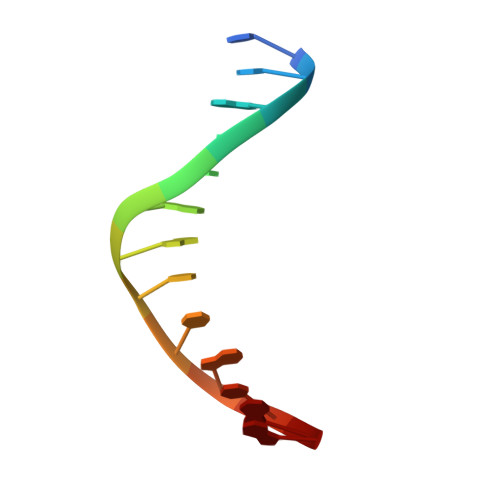
4ENM | pdb_00004enm

Crystal structure of S. pombe Atl1 in complex with damaged DNA containing O6-benzylguanine


Experimental Data Snapshot

  • Method: X-RAY DIFFRACTION
  • Resolution: 2.84 Å
  • R-Value Free: 
    0.253 (Depositor), 0.248 (DCC) 
  • R-Value Work: 
    0.173 (Depositor), 0.182 (DCC) 
  • R-Value Observed: 
    0.181 (Depositor) 

Starting Model: experimental
View more details

wwPDB Validation 3D Report Full Report

Validation slider image for 4ENM

This is version 1.2 of the entry. See complete history

Literature

Atl1 Regulates Choice between Global Genome and Transcription-Coupled Repair of O(6)-Alkylguanines.

Latypov, V.F.Tubbs, J.L.Watson, A.J.Marriott, A.S.McGown, G.Thorncroft, M.Wilkinson, O.J.Senthong, P.Butt, A.Arvai, A.S.Millington, C.L.Povey, A.C.Williams, D.M.Santibanez-Koref, M.F.Tainer, J.A.Margison, G.P.

(2012) Mol Cell 47: 50-60

  • DOI: https://doi.org/10.1016/j.molcel.2012.04.028
  • Primary Citation Related Structures: 
    4ENJ, 4ENK, 4ENM, 4ENN

  • PubMed Abstract: 

    Nucleotide excision repair (NER) has long been known to remove DNA lesions induced by chemical carcinogens, and the molecular mechanism has been partially elucidated. Here we demonstrate that in Schizosaccharomyces pombe a DNA recognition protein, alkyltransferase-like 1 (Atl1), can play a pivotal role in selecting a specific NER pathway, depending on the nature of the DNA modification. The relative ease of dissociation of Atl1 from DNA containing small O(6)-alkylguanines allows accurate completion of global genome repair (GGR), whereas strong Atl1 binding to bulky O(6)-alkylguanines blocks GGR, stalls the transcription machinery, and diverts the damage to transcription-coupled repair. Our findings redraw the initial stages of the NER process in those organisms that express an alkyltransferase-like gene and raise the question of whether or not O(6)-alkylguanine lesions that are poor substrates for the alkyltransferase proteins in higher eukaryotes might, by analogy, signal such lesions for repair by NER.


  • Organizational Affiliation
    • Cancer Research UK Carcinogenesis Group, Paterson Institute for Cancer Research, University of Manchester, Manchester M20 4BX, UK.

Macromolecule Content 

  • Total Structure Weight: 21.7 kDa 
  • Atom Count: 1,424 
  • Modeled Residue Count: 134 
  • Deposited Residue Count: 142 
  • Unique protein chains: 1
  • Unique nucleic acid chains: 2

Macromolecules


Find similar proteins by:|  3D Structure
Entity ID: 1
MoleculeChains  Sequence LengthOrganismDetailsImage
Alkyltransferase-like protein 1116Schizosaccharomyces pombe 972h-Mutation(s): 0 
Gene Names: atl1SPAC1250.04c
UniProt
Find proteins for Q9UTN9 (Schizosaccharomyces pombe (strain 972 / ATCC 24843))
Explore Q9UTN9 
Go to UniProtKB:  Q9UTN9
Entity Groups
Sequence Clusters30% Identity50% Identity70% Identity90% Identity95% Identity100% Identity
UniProt GroupQ9UTN9
Sequence Annotations
Expand
Reference Sequence
Find similar nucleic acids by:  Sequence
Entity ID: 2
MoleculeChains LengthOrganismImage
DNA (5'-D(*GP*CP*CP*AP*TP*GP*(BZG)P*CP*TP*AP*GP*TP*A)-3')13synthetic construct
Sequence Annotations
Expand
Reference Sequence
Find similar nucleic acids by:  Sequence
Entity ID: 3
MoleculeChains LengthOrganismImage
DNA (5'-D(*CP*TP*AP*CP*TP*AP*GP*CP*CP*AP*TP*GP*G)-3')13synthetic construct
Sequence Annotations
Expand
Reference Sequence

Experimental Data & Validation

Experimental Data

  • Method: X-RAY DIFFRACTION
  • Resolution: 2.84 Å
  • R-Value Free:  0.253 (Depositor), 0.248 (DCC) 
  • R-Value Work:  0.173 (Depositor), 0.182 (DCC) 
  • R-Value Observed: 0.181 (Depositor) 
Space Group: P 61 2 2
Unit Cell:
Length ( Å )Angle ( ˚ )
a = 59.9α = 90
b = 59.9β = 90
c = 237.051γ = 120
Software Package:
Software NamePurpose
HKL-2000data collection
PHASERphasing
PHENIXrefinement
HKL-2000data reduction
HKL-2000data scaling

Structure Validation

View Full Validation Report


Entry History 

Deposition Data

Revision History  (Full details and data files)

  • Version 1.0: 2012-06-20
    Type: Initial release
  • Version 1.1: 2012-08-01
    Changes: Database references
  • Version 1.2: 2023-09-13
    Changes: Data collection, Database references, Refinement description