4E29 | pdb_00004e29

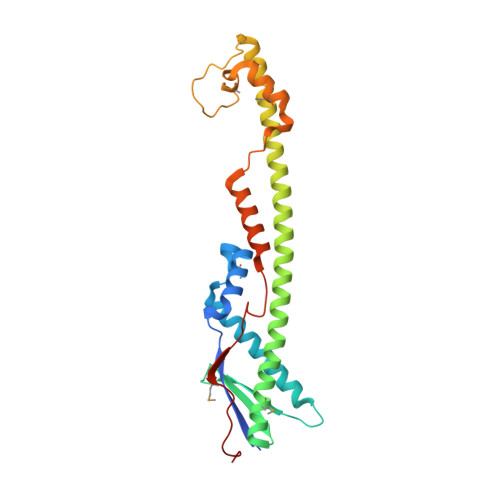
Periplasmic domain of the chimeric WzzB chain length regulator protein


Experimental Data Snapshot

  • Method: X-RAY DIFFRACTION
  • Resolution: 1.60 Å
  • R-Value Free: 
    0.237 (Depositor), 0.235 (DCC) 
  • R-Value Work: 
    0.218 (Depositor), 0.218 (DCC) 
  • R-Value Observed: 
    0.219 (Depositor) 

wwPDB Validation 3D Report Full Report

Validation slider image for 4E29

This is version 1.5 of the entry. See complete history

Literature

Structural Characterization of Closely Related O-antigen Lipopolysaccharide (LPS) Chain Length Regulators.

Kalynych, S.Yao, D.Magee, J.Cygler, M.

(2012) J Biological Chem 287: 15696-15705

  • DOI: https://doi.org/10.1074/jbc.M112.354837
  • Primary Citation Related Structures: 
    4E29, 4E2C, 4E2H, 4E2L

  • PubMed Abstract: 

    The surface O-antigen polymers of gram-negative bacteria exhibit a modal length distribution that depends on dedicated chain length regulator periplasmic proteins (polysaccharide co-polymerases, PCPs) anchored in the inner membrane by two transmembrane helices. In an attempt to determine whether structural changes underlie the O-antigen modal length specification, we have determined the crystal structures of several closely related PCPs, namely two chimeric PCP-1 family members solved at 1.6 and 2.8 Å and a wild-type PCP-1 from Shigella flexneri solved at 2.8 Å. The chimeric proteins form circular octamers, whereas the wild-type WzzB from S. flexneri was found to be an open trimer. We also present the structure of a Wzz(FepE) mutant, which exhibits severe attenuation in its ability to produce very long O-antigen polymers. Our findings suggest that the differences in the modal length distribution depend primarily on the surface-exposed amino acids in specific regions rather than on the differences in the oligomeric state of the PCP protomers.


  • Organizational Affiliation
    • Department of Biochemistry, McGill University, Montreal, Quebec H3G 0B1, Canada.

Macromolecule Content 

  • Total Structure Weight: 56.65 kDa 
  • Atom Count: 4,304 
  • Modeled Residue Count: 463 
  • Deposited Residue Count: 496 
  • Unique protein chains: 1

Macromolecules

Find similar proteins by:|  3D Structure
Entity ID: 1
MoleculeChains  Sequence LengthOrganismDetailsImage
Chimeric WzzB chain length determinant protein
A, B
248Shigella flexneriSalmonella enterica subsp. enterica serovar Typhimurium str. LT2
This entity is chimeric
Mutation(s): 0 
Gene Names: cldrolS2210SF2089wzzBSTM2079
UniProt
Find proteins for P37792 (Shigella flexneri)
Explore P37792 
Go to UniProtKB:  P37792
Find proteins for Q04866 (Salmonella typhimurium (strain LT2 / SGSC1412 / ATCC 700720))
Explore Q04866 
Go to UniProtKB:  Q04866
Entity Groups
Sequence Clusters30% Identity50% Identity70% Identity90% Identity95% Identity100% Identity
UniProt GroupsP37792Q04866
Sequence Annotations
Expand
Reference Sequence

Small Molecules

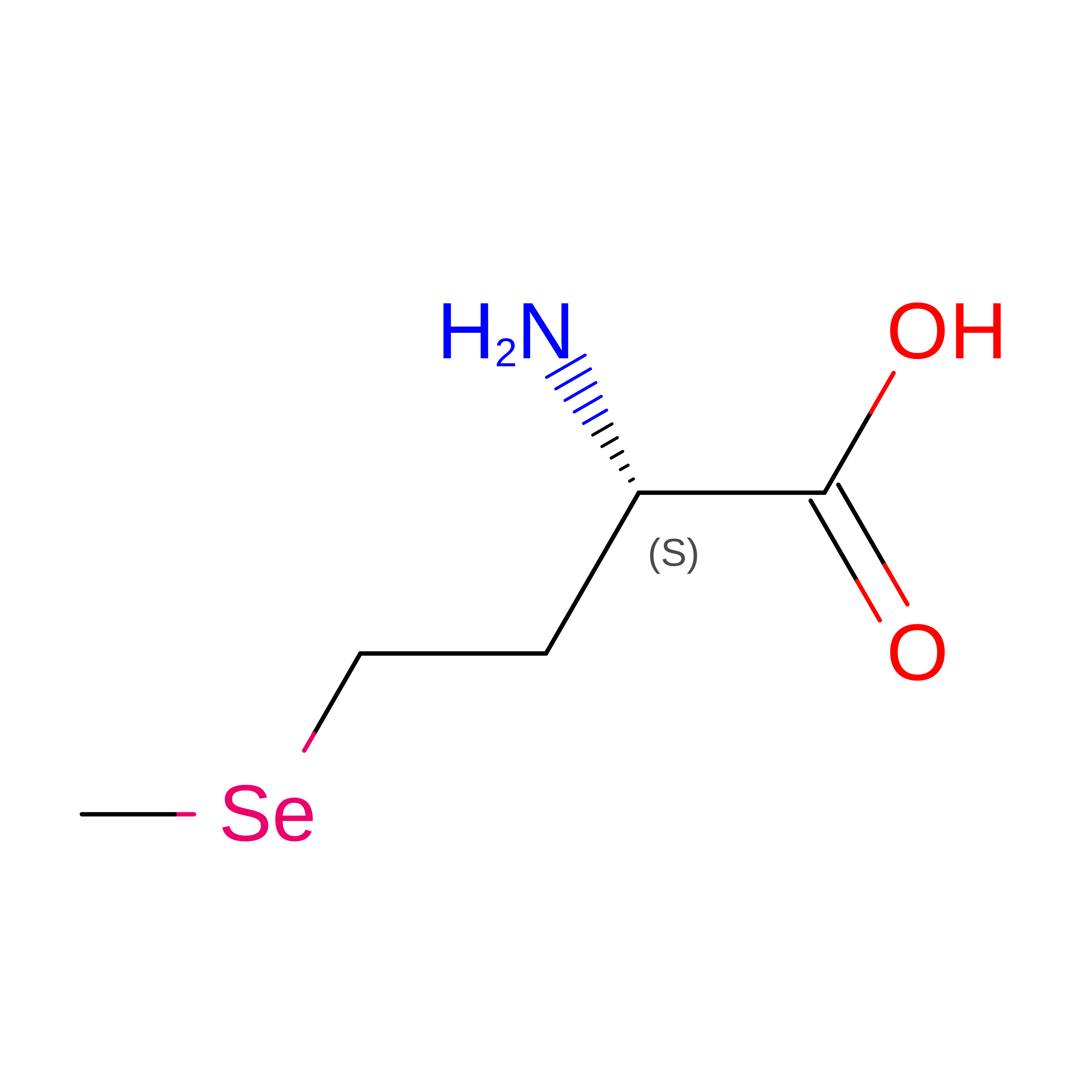
Modified Residues  1 Unique
IDChains TypeFormula2D DiagramParent
MSE
Query on MSE
A, B
L-PEPTIDE LINKINGC5 H11 N O2 SeMET

Experimental Data & Validation

Experimental Data

  • Method: X-RAY DIFFRACTION
  • Resolution: 1.60 Å
  • R-Value Free:  0.237 (Depositor), 0.235 (DCC) 
  • R-Value Work:  0.218 (Depositor), 0.218 (DCC) 
  • R-Value Observed: 0.219 (Depositor) 
Space Group: I 4 2 2
Unit Cell:
Length ( Å )Angle ( ˚ )
a = 115.757α = 90
b = 115.757β = 90
c = 210.885γ = 90
Software Package:
Software NamePurpose
PHENIXrefinement
PDB_EXTRACTdata extraction
HKL-3000data collection
DENZOdata reduction
SCALEPACKdata scaling
HKL-3000data scaling
MLPHAREphasing

Structure Validation

View Full Validation Report


Entry History 

Deposition Data

Revision History  (Full details and data files)

  • Version 1.0: 2012-03-28
    Type: Initial release
  • Version 1.1: 2012-04-04
    Changes: Database references
  • Version 1.2: 2012-06-20
    Changes: Database references
  • Version 1.3: 2017-07-05
    Changes: Source and taxonomy
  • Version 1.4: 2017-11-15
    Changes: Refinement description
  • Version 1.5: 2024-11-20
    Changes: Data collection, Database references, Derived calculations, Structure summary