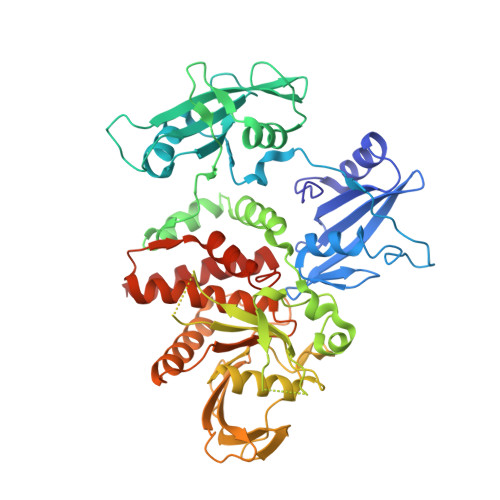
4DGX | pdb_00004dgx

LEOPARD Syndrome-Associated SHP2/Y279C mutant


Experimental Data Snapshot

  • Method: X-RAY DIFFRACTION
  • Resolution: 2.30 Å
  • R-Value Free: 
    0.266 (Depositor), 0.263 (DCC) 
  • R-Value Work: 
    0.209 (Depositor), 0.206 (DCC) 
  • R-Value Observed: 
    0.212 (Depositor) 

wwPDB Validation 3D Report Full Report

Validation slider image for 4DGX

This is version 1.3 of the entry. See complete history

Literature

Structural and Mechanistic Insights into LEOPARD Syndrome-Associated SHP2 Mutations.

Yu, Z.H.Xu, J.Walls, C.D.Chen, L.Zhang, S.Zhang, R.Wu, L.Wang, L.Liu, S.Zhang, Z.Y.

(2013) J Biological Chem 288: 10472-10482

  • DOI: https://doi.org/10.1074/jbc.M113.450023
  • Primary Citation Related Structures: 
    4DGP, 4DGX

  • PubMed Abstract: 

    SHP2 is an allosteric phosphatase essential for growth factor-mediated Ras activation. Germ-line mutations in SHP2 cause clinically similar LEOPARD and Noonan syndromes, two of several autosomal-dominant conditions characterized by gain-of-function mutations in the Ras pathway. Interestingly, Noonan syndrome SHP2 mutants are constitutively active, whereas LEOPARD syndrome SHP2 mutants exhibit reduced phosphatase activity. How do catalytically impaired LEOPARD syndrome mutants engender gain-of-function phenotypes? Our study reveals that LEOPARD syndrome mutations weaken the intramolecular interaction between the N-SH2 and phosphatase domains, leading to a change in SHP2 molecular switching mechanism. Consequently, LEOPARD syndrome SHP2 mutants bind upstream activators preferentially and are hypersensitive to growth factor stimulation. They also stay longer with scaffolding adapters, thus prolonging substrate turnover, which compensates for the reduced phosphatase activity. The study provides a solid framework for understanding how individual SHP2 mutations cause diseases.


  • Organizational Affiliation
    • Department of Biochemistry and Molecular Biology, Indiana University School of Medicine, Indianapolis, Indiana 46202, USA.

Macromolecule Content 

  • Total Structure Weight: 61.7 kDa 
  • Atom Count: 4,223 
  • Modeled Residue Count: 501 
  • Deposited Residue Count: 536 
  • Unique protein chains: 1

Macromolecules

Find similar proteins by:|  3D Structure
Entity ID: 1
MoleculeChains  Sequence LengthOrganismDetailsImage
Tyrosine-protein phosphatase non-receptor type 11536Homo sapiensMutation(s): 1 
Gene Names: PTPN11PTP2CSHPTP2
EC: 3.1.3.48
UniProt & NIH Common Fund Data Resources
Find proteins for Q06124 (Homo sapiens)
Explore Q06124 
Go to UniProtKB:  Q06124
PHAROS:  Q06124
GTEx:  ENSG00000179295 
Entity Groups
Sequence Clusters30% Identity50% Identity70% Identity90% Identity95% Identity100% Identity
UniProt GroupQ06124
Sequence Annotations
Expand
Reference Sequence

Experimental Data & Validation

Experimental Data

  • Method: X-RAY DIFFRACTION
  • Resolution: 2.30 Å
  • R-Value Free:  0.266 (Depositor), 0.263 (DCC) 
  • R-Value Work:  0.209 (Depositor), 0.206 (DCC) 
  • R-Value Observed: 0.212 (Depositor) 
Space Group: P 21 21 2
Unit Cell:
Length ( Å )Angle ( ˚ )
a = 55.14α = 90
b = 225.12β = 90
c = 40.907γ = 90
Software Package:
Software NamePurpose
ADSCdata collection
MOLREPphasing
PHENIXrefinement
HKL-3000data reduction
HKL-3000data scaling

Structure Validation

View Full Validation Report


Entry History 

Deposition Data

Revision History  (Full details and data files)

  • Version 1.0: 2013-03-06
    Type: Initial release
  • Version 1.1: 2013-03-20
    Changes: Database references
  • Version 1.2: 2013-05-01
    Changes: Database references
  • Version 1.3: 2024-02-28
    Changes: Data collection, Database references