4CZ6 | pdb_00004cz6

Truncated tetramerization domain of zebrafish p53 (crystal form II)


Experimental Data Snapshot

  • Method: X-RAY DIFFRACTION
  • Resolution: 1.53 Å
  • R-Value Free: 
    0.184 (Depositor), 0.199 (DCC) 
  • R-Value Work: 
    0.148 (Depositor), 0.163 (DCC) 
  • R-Value Observed: 
    0.150 (Depositor) 

wwPDB Validation 3D Report Full Report

Validation slider image for 4CZ6

This is version 1.4 of the entry. See complete history

Literature

Tracing the Evolution of the P53 Tetramerization Domain

Joerger, A.C.Wilcken, R.Andreeva, A.

(2014) Structure 22: 1301

  • DOI: https://doi.org/10.1016/j.str.2014.07.010
  • Primary Citation Related Structures: 
    4CZ5, 4CZ6, 4CZ7, 4D1L, 4D1M

  • PubMed Abstract: 

    The tetrameric transcription factors p53, p63, and p73 evolved from a common ancestor and play key roles in tumor suppression and development. Surprisingly, p63 and p73 require a second helix in their tetramerization domain for the formation of stable tetramers that is absent in human p53, raising questions about the evolutionary processes leading to diversification. Here we determined the crystal structure of the zebrafish p53 tetramerization domain, which contains a second helix, reminiscent of p63 and p73, combined with p53-like features. Through comprehensive phylogenetic analyses, we systematically traced the evolution of vertebrate p53 family oligomerization domains back to the beginning of multicellular life. We provide evidence that their last common ancestor also had an extended p63/p73-like domain and pinpoint evolutionary events that shaped this domain during vertebrate radiation. Domain compaction and transformation of a structured into a flexible, intrinsically disordered region may have contributed to the expansion of the human p53 interactome.


  • Organizational Affiliation
    • MRC Laboratory of Molecular Biology, Francis Crick Avenue, Cambridge CB2 0QH, UK. Electronic address: acj2@mrc-lmb.cam.ac.uk.

Macromolecule Content 

  • Total Structure Weight: 15.3 kDa 
  • Atom Count: 1,084 
  • Modeled Residue Count: 120 
  • Deposited Residue Count: 132 
  • Unique protein chains: 1

Macromolecules

Find similar proteins by:|  3D Structure
Entity ID: 1
MoleculeChains  Sequence LengthOrganismDetailsImage
CELLULAR TUMOR ANTIGEN P53
A, B, C, D
33Danio rerioMutation(s): 0 
UniProt
Find proteins for P79734 (Danio rerio)
Explore P79734 
Go to UniProtKB:  P79734
Entity Groups
Sequence Clusters30% Identity50% Identity70% Identity90% Identity95% Identity100% Identity
UniProt GroupP79734
Sequence Annotations
Expand
Reference Sequence

Small Molecules

Ligands 1 Unique
IDChains Name / Formula / InChI Key2D Diagram3D Interactions
PEG

Query on PEG


Download:Ideal Coordinates CCD File
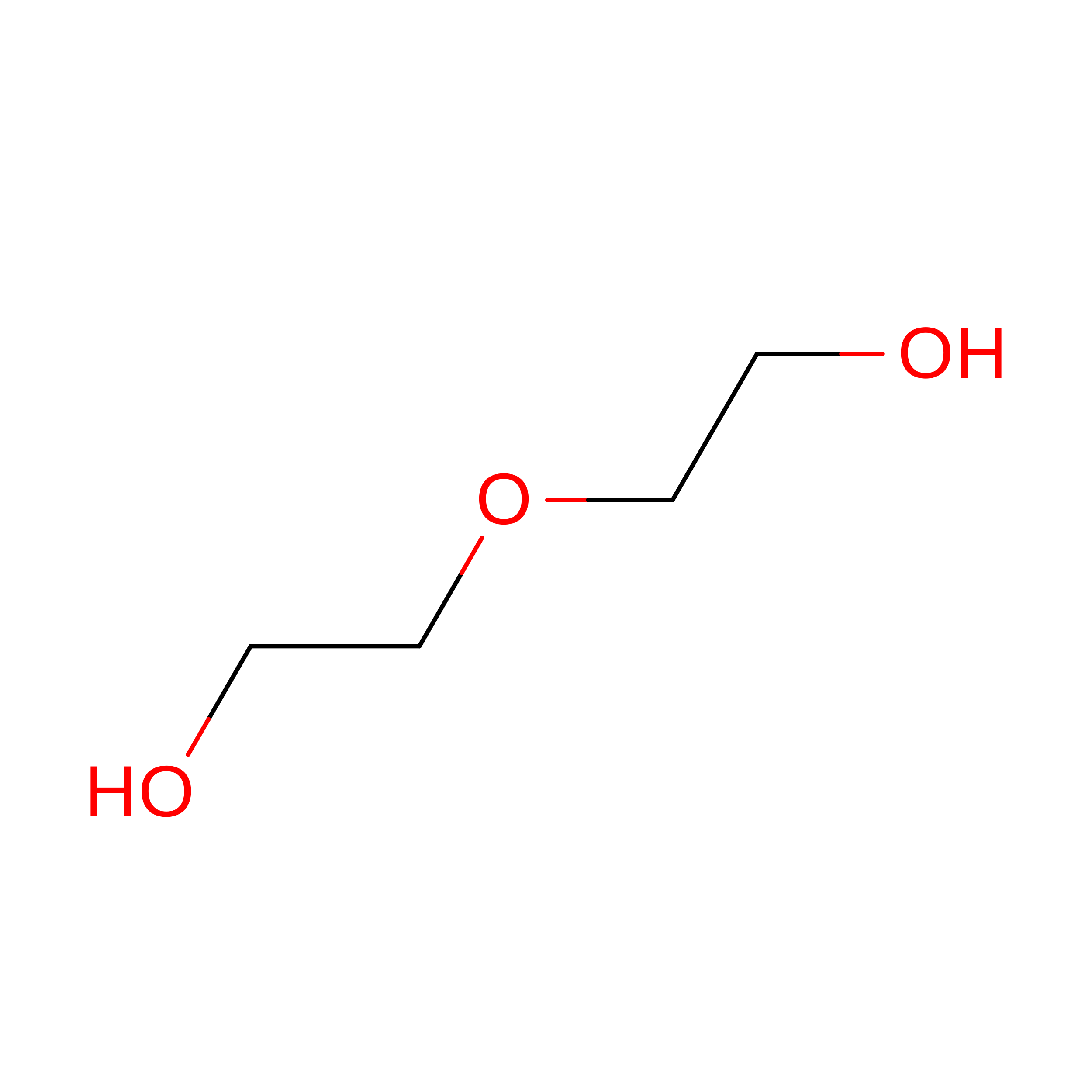
E [auth D]DI(HYDROXYETHYL)ETHER
C4 H10 O3
MTHSVFCYNBDYFN-UHFFFAOYSA-N

Experimental Data & Validation

Experimental Data

  • Method: X-RAY DIFFRACTION
  • Resolution: 1.53 Å
  • R-Value Free:  0.184 (Depositor), 0.199 (DCC) 
  • R-Value Work:  0.148 (Depositor), 0.163 (DCC) 
  • R-Value Observed: 0.150 (Depositor) 
Space Group: P 31 2 1
Unit Cell:
Length ( Å )Angle ( ˚ )
a = 57.529α = 90
b = 57.529β = 90
c = 96.875γ = 120
Software Package:
Software NamePurpose
REFMACrefinement

Structure Validation

View Full Validation Report


Entry History 

Deposition Data

Revision History  (Full details and data files)

  • Version 1.0: 2014-08-27
    Type: Initial release
  • Version 1.1: 2014-09-17
    Changes: Database references
  • Version 1.2: 2019-05-08
    Changes: Data collection, Experimental preparation, Other
  • Version 1.3: 2019-05-22
    Changes: Data collection, Experimental preparation
  • Version 1.4: 2024-05-08
    Changes: Data collection, Database references, Derived calculations, Other