4CP5 | pdb_00004cp5

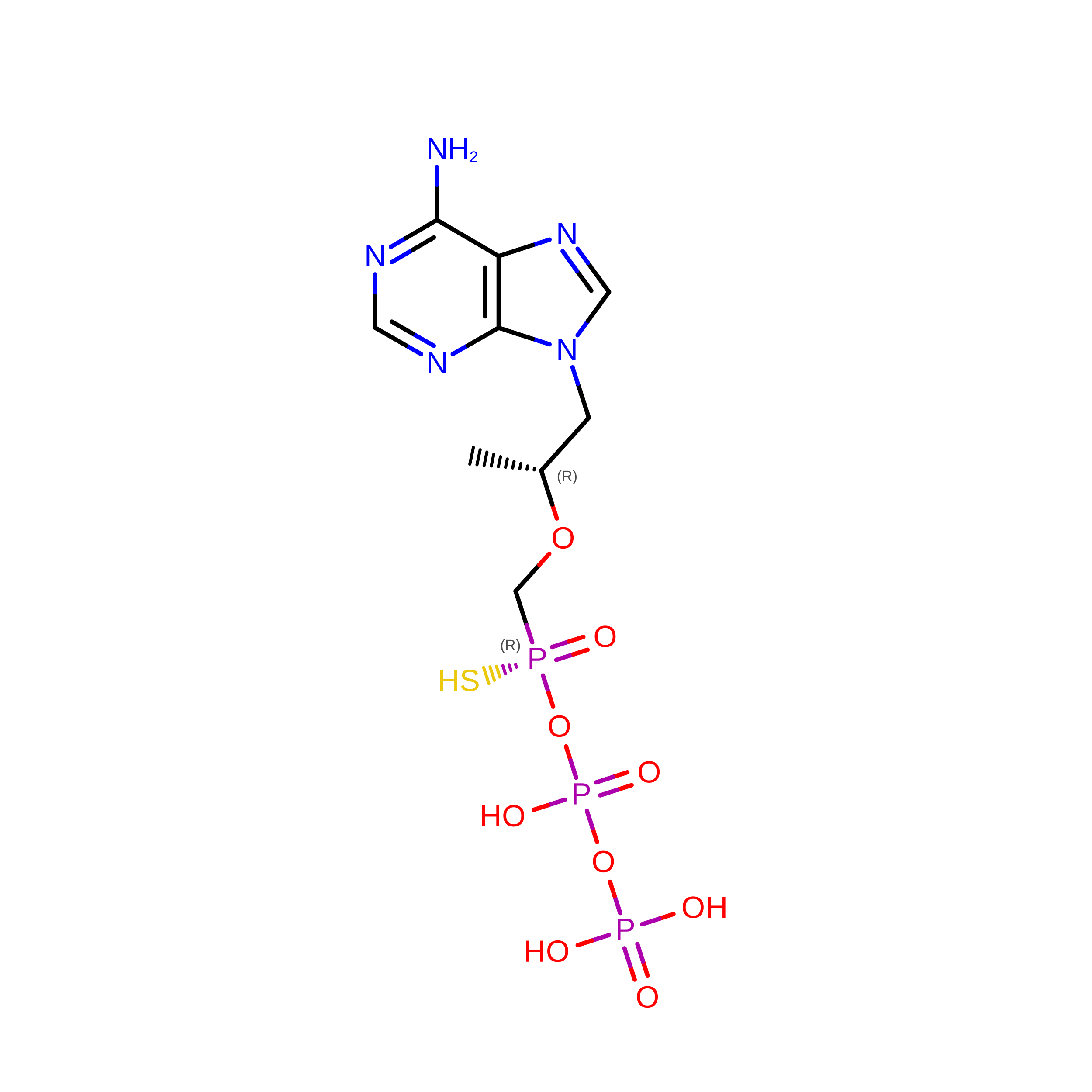
ndpK in complex with (Rp)-SPMPApp


Experimental Data Snapshot

  • Method: X-RAY DIFFRACTION
  • Resolution: 2.32 Å
  • R-Value Free: 
    0.246 (Depositor), 0.249 (DCC) 
  • R-Value Work: 
    0.199 (Depositor), 0.201 (DCC) 
  • R-Value Observed: 
    0.201 (Depositor) 

Starting Model: experimental
View more details

wwPDB Validation 3D Report Full Report

Validation slider image for 4CP5

Ligand Structure Quality Assessment 


This is version 1.4 of the entry. See complete history

Literature

Enzymatic Synthesis of Acyclic Nucleoside Thiophosphonate Diphosphates: Effect of the Alpha-Phosphorus Configuration on HIV-1 RT Activity.

Priet, S.Roux, L.Saez-Ayala, M.Ferron, F.Canard, B.Alvarez, K.

(2015) Antiviral Res 117: 122

  • DOI: https://doi.org/10.1016/j.antiviral.2015.03.003
  • Primary Citation Related Structures: 
    4C6A, 4CP5

  • PubMed Abstract: 

    The acyclic nucleosides thiophosphonates (9-[2-(thiophosphonomethoxy)ethyl]adenine (S-PMEA) and (R)-9-[2-(thiophosphonomethoxy)propyl]adenine (S-PMPA), exhibit antiviral activity against HIV-1, -2 and HBV. Their diphosphate forms S-PMEApp and S-PMPApp, synthesized as stereoisomeric mixture, are potent inhibitors of wild-type (WT) HIV-1 RT. Understanding HIV-1 RT stereoselectivity, however, awaits resolution of the diphosphate forms into defined stereoisomers. To this aim, thiophosphonate monophosphates S-PMEAp and S-PMPAp were synthesized and used in a stereocontrolled enzyme-catalyzed phosphoryl transfer reaction involving either nucleoside diphosphate kinase (NDPK) or creatine kinase (CK) to obtain thiophosphonate diphosphates as separated isomers. We then quantified substrate preference of recombinant WT HIV-1 RT toward pure stereoisomers using in vitro steady-state kinetic analyses. The crystal structure of a complex between Dictyostelium NDPK and S-PMPApp at 2.32Å allowed to determine the absolute configuration at the α-phosphorus atom in relation to the stereo-preference of studied enzymes. The RP isomer of S-PMPApp and S-PMEApp are the preferred substrate over SP for both NDPK and HIV-1 RT.


  • Organizational Affiliation
    • Laboratoire d'Architecture et Fonction des Macromolécules Biologiques, UMR CNRS 7257, Team "Viral Replicases: Structure, Mechanism and Drug-Design", Université Aix-Marseille, Parc scientifique de Luminy, 163 av. de Luminy, 13288 Marseille Cedex 9, France.

Macromolecule Content 

  • Total Structure Weight: 103.19 kDa 
  • Atom Count: 7,632 
  • Modeled Residue Count: 906 
  • Deposited Residue Count: 930 
  • Unique protein chains: 1

Macromolecules

Find similar proteins by:|  3D Structure
Entity ID: 1
MoleculeChains  Sequence LengthOrganismDetailsImage
NUCLEOSIDE DIPHOSPHATE KINASE, CYTOSOLIC
A, B, C, D, E
A, B, C, D, E, F
155Dictyostelium discoideumMutation(s): 1 
EC: 2.7.4.6
UniProt
Find proteins for P22887 (Dictyostelium discoideum)
Explore P22887 
Go to UniProtKB:  P22887
Entity Groups
Sequence Clusters30% Identity50% Identity70% Identity90% Identity95% Identity100% Identity
UniProt GroupP22887
Sequence Annotations
Expand
Reference Sequence

Experimental Data & Validation

Experimental Data

  • Method: X-RAY DIFFRACTION
  • Resolution: 2.32 Å
  • R-Value Free:  0.246 (Depositor), 0.249 (DCC) 
  • R-Value Work:  0.199 (Depositor), 0.201 (DCC) 
  • R-Value Observed: 0.201 (Depositor) 
Space Group: P 1 21 1
Unit Cell:
Length ( Å )Angle ( ˚ )
a = 70.008α = 90
b = 105.79β = 117.23
c = 70.576γ = 90
Software Package:
Software NamePurpose
BUSTERrefinement
XDSdata reduction
SCALAdata scaling
PHASERphasing

Structure Validation

View Full Validation Report


Ligand Structure Quality Assessment 


Entry History 

Deposition Data

Revision History  (Full details and data files)

  • Version 1.0: 2015-02-11
    Type: Initial release
  • Version 1.1: 2015-03-25
    Changes: Database references
  • Version 1.2: 2015-04-22
    Changes: Database references
  • Version 1.3: 2020-03-04
    Changes: Derived calculations, Other
  • Version 1.4: 2023-12-20
    Changes: Data collection, Database references, Derived calculations, Refinement description