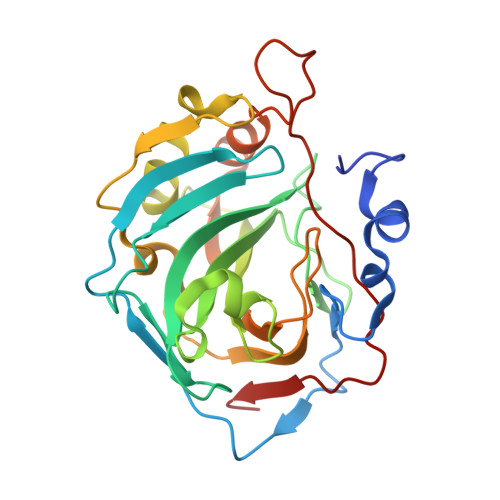
4CNR | pdb_00004cnr

Surface residue engineering of bovine carbonic anhydrase to an extreme halophilic enzyme for potential application in postcombustion CO2 capture


Experimental Data Snapshot

  • Method: X-RAY DIFFRACTION
  • Resolution: 2.29 Å
  • R-Value Free: 
    0.236 (Depositor), 0.260 (DCC) 
  • R-Value Work: 
    0.200 (Depositor), 0.223 (DCC) 
  • R-Value Observed: 
    0.202 (Depositor) 

Starting Model: experimental
View more details

wwPDB Validation 3D Report Full Report

Validation slider image for 4CNR

This is version 1.3 of the entry. See complete history

Literature

Rational Engineering of a Mesohalophilic Carbonic Anhydrase to an Extreme Halotolerant Biocatalyst.

Warden, A.C.Williams, M.Peat, T.S.Seabrook, S.A.Newman, J.Dojchinov, G.Haritos, V.S.

(2015) Nat Commun 6: 10278

  • DOI: https://doi.org/10.1038/ncomms10278
  • Primary Citation Related Structures: 
    4CNR, 4CNV, 4CNW, 4CNX, 5A25

  • PubMed Abstract: 

    Enzymes expressed by highly salt-tolerant organisms show many modifications compared with salt-affected counterparts including biased amino acid and lower α-helix content, lower solvent accessibility and negative surface charge. Here, we show that halotolerance can be generated in an enzyme solely by modifying surface residues. Rational design of carbonic anhydrase II is undertaken in three stages replacing 18 residues in total, crystal structures confirm changes are confined to surface residues. Catalytic activities and thermal unfolding temperatures of the designed enzymes increase at high salt concentrations demonstrating their shift to halotolerance, whereas the opposite response is found in the wild-type enzyme. Molecular dynamics calculations reveal a key role for sodium ions in increasing halotolerant enzyme stability largely through interactions with the highly ordered first Na(+) hydration shell. For the first time, an approach to generate extreme halotolerance, a trait with broad application in industrial biocatalysis, in a wild-type enzyme is demonstrated.


  • Organizational Affiliation
    • Energy Flagship, Commonwealth Scientific and Industrial Research Organisation (CSIRO), GPO Box 1700, Canberra, Australian Capital Territory 2601, Australia.

Macromolecule Content 

  • Total Structure Weight: 117.93 kDa 
  • Atom Count: 8,501 
  • Modeled Residue Count: 1,030 
  • Deposited Residue Count: 1,048 
  • Unique protein chains: 1

Macromolecules

Find similar proteins by:|  3D Structure
Entity ID: 1
MoleculeChains  Sequence LengthOrganismDetailsImage
CARBONIC ANHYDRASE 2
A, B, C, D
262Bos taurusMutation(s): 6 
EC: 4.2.1.1 (PDB Primary Data), 4.2.1.69 (UniProt)
UniProt
Find proteins for P00921 (Bos taurus)
Explore P00921 
Go to UniProtKB:  P00921
Entity Groups
Sequence Clusters30% Identity50% Identity70% Identity90% Identity95% Identity100% Identity
UniProt GroupP00921
Sequence Annotations
Expand
Reference Sequence

Experimental Data & Validation

Experimental Data

  • Method: X-RAY DIFFRACTION
  • Resolution: 2.29 Å
  • R-Value Free:  0.236 (Depositor), 0.260 (DCC) 
  • R-Value Work:  0.200 (Depositor), 0.223 (DCC) 
  • R-Value Observed: 0.202 (Depositor) 
Space Group: P 1 21 1
Unit Cell:
Length ( Å )Angle ( ˚ )
a = 45.294α = 90
b = 141.114β = 90.07
c = 77.188γ = 90
Software Package:
Software NamePurpose
REFMACrefinement
XDSdata reduction
SCALAdata scaling
PHASERphasing

Structure Validation

View Full Validation Report


Entry History 

Deposition Data

Revision History  (Full details and data files)

  • Version 1.0: 2015-02-04
    Type: Initial release
  • Version 1.1: 2016-01-13
    Changes: Database references
  • Version 1.2: 2019-05-15
    Changes: Data collection, Experimental preparation, Other
  • Version 1.3: 2023-12-20
    Changes: Data collection, Database references, Derived calculations, Other, Refinement description