4C2X | pdb_00004c2x

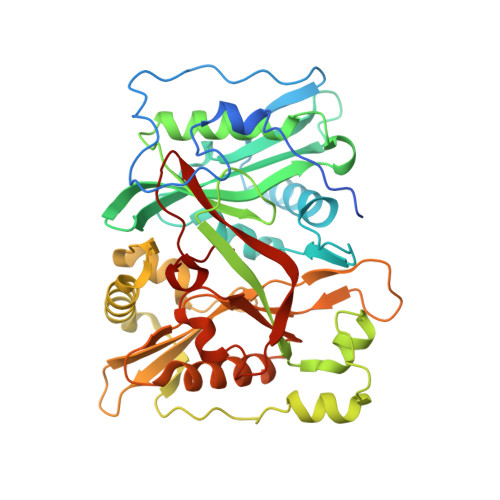
Human N-myristoyltransferase isoform 2 (NMT2)


Experimental Data Snapshot

  • Method: X-RAY DIFFRACTION
  • Resolution: 2.33 Å
  • R-Value Free: 
    0.288 (Depositor) 
  • R-Value Work: 
    0.218 (Depositor) 
  • R-Value Observed: 
    0.222 (Depositor) 

Starting Model: experimental
View more details

wwPDB Validation 3D Report Full Report

Validation slider image for 4C2X

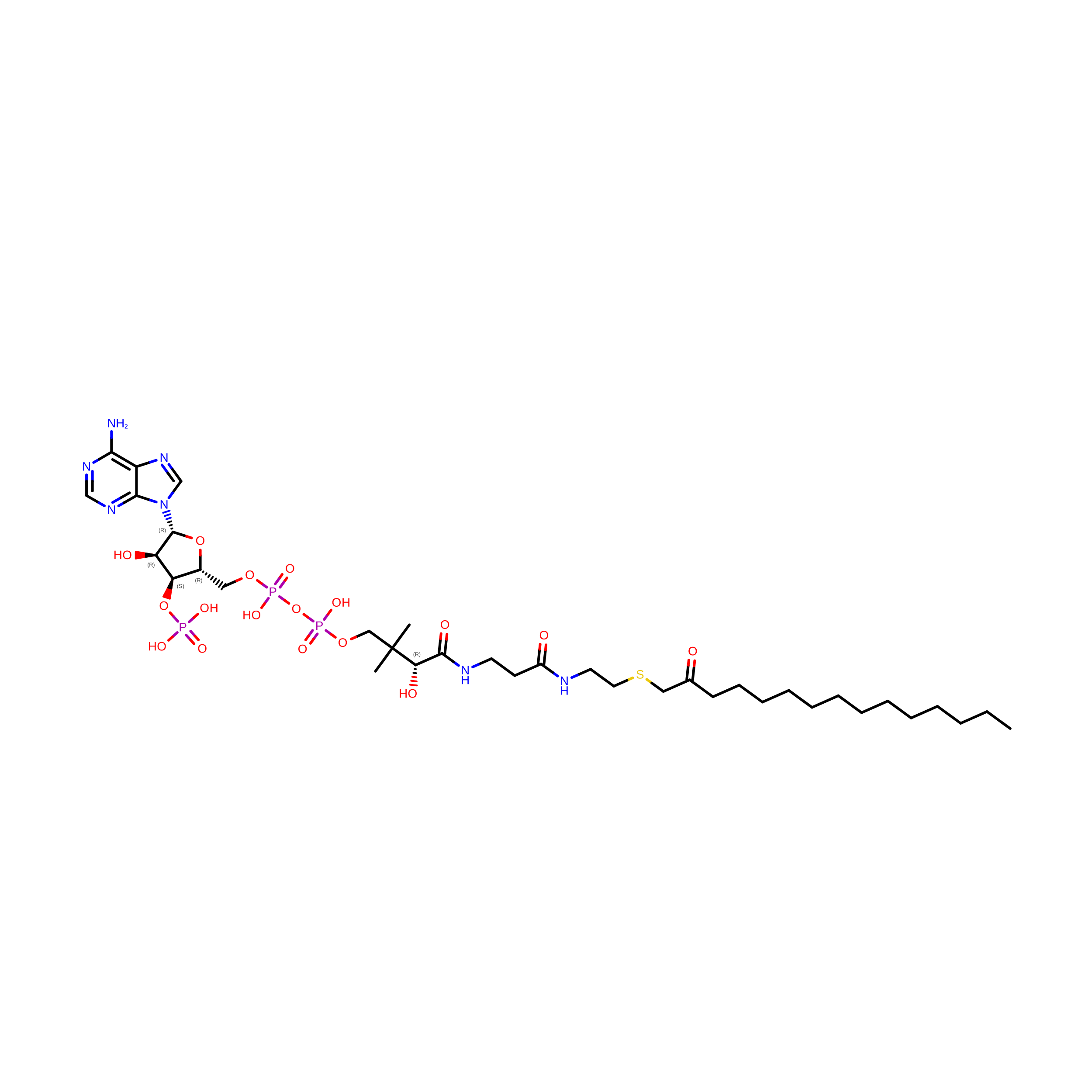
Ligand Structure Quality Assessment 


This is version 1.2 of the entry. See complete history

Literature

Global Profiling of Co- and Post-Translationally N-Myristoylated Proteomes in Human Cells.

Thinon, E.Serwa, R.A.Broncel, M.Brannigan, J.A.Brassat, U.Wright, M.H.Heal, W.P.Wilkinson, A.J.Mann, D.J.Tate, E.W.

(2014) Nat Commun 5: 4919

  • DOI: https://doi.org/10.1038/ncomms5919
  • Primary Citation Related Structures: 
    4C2X, 4C2Y, 4C2Z

  • PubMed Abstract: 

    Protein N-myristoylation is a ubiquitous co- and post-translational modification that has been implicated in the development and progression of a range of human diseases. Here, we report the global N-myristoylated proteome in human cells determined using quantitative chemical proteomics combined with potent and specific human N-myristoyltransferase (NMT) inhibition. Global quantification of N-myristoylation during normal growth or apoptosis allowed the identification of >100 N-myristoylated proteins, >95% of which are identified for the first time at endogenous levels. Furthermore, quantitative dose response for inhibition of N-myristoylation is determined for >70 substrates simultaneously across the proteome. Small-molecule inhibition through a conserved substrate-binding pocket is also demonstrated by solving the crystal structures of inhibitor-bound NMT1 and NMT2. The presented data substantially expand the known repertoire of co- and post-translational N-myristoylation in addition to validating tools for the pharmacological inhibition of NMT in living cells.


  • Organizational Affiliation
    • 1] Department of Chemistry, Imperial College London, Exhibition Road, London SW7 2AZ, UK [2] Department of Life Sciences, Imperial College London, Exhibition Road, London SW7 2AZ, UK.

Macromolecule Content 

  • Total Structure Weight: 48.61 kDa 
  • Atom Count: 3,345 
  • Modeled Residue Count: 388 
  • Deposited Residue Count: 410 
  • Unique protein chains: 1

Macromolecules

Find similar proteins by:|  3D Structure
Entity ID: 1
MoleculeChains  Sequence LengthOrganismDetailsImage
GLYCYLPEPTIDE N-TETRADECANOYLTRANSFERASE 2410Homo sapiensMutation(s): 1 
EC: 2.3.1.97 (PDB Primary Data), 2.3.1 (UniProt)
UniProt & NIH Common Fund Data Resources
Find proteins for O60551 (Homo sapiens)
Explore O60551 
Go to UniProtKB:  O60551
PHAROS:  O60551
GTEx:  ENSG00000152465 
Entity Groups
Sequence Clusters30% Identity50% Identity70% Identity90% Identity95% Identity100% Identity
UniProt GroupO60551
Sequence Annotations
Expand
Reference Sequence

Experimental Data & Validation

Experimental Data

  • Method: X-RAY DIFFRACTION
  • Resolution: 2.33 Å
  • R-Value Free:  0.288 (Depositor) 
  • R-Value Work:  0.218 (Depositor) 
  • R-Value Observed: 0.222 (Depositor) 
Space Group: P 21 21 21
Unit Cell:
Length ( Å )Angle ( ˚ )
a = 49.7α = 90
b = 72.32β = 90
c = 114.69γ = 90
Software Package:
Software NamePurpose
REFMACrefinement
XDSdata reduction
SCALAdata scaling
MOLREPphasing

Structure Validation

View Full Validation Report


Ligand Structure Quality Assessment 


Entry History 

Deposition Data

Revision History  (Full details and data files)

  • Version 1.0: 2014-10-01
    Type: Initial release
  • Version 1.1: 2014-10-08
    Changes: Database references
  • Version 1.2: 2023-12-20
    Changes: Data collection, Database references, Derived calculations, Other, Refinement description