4BNP | pdb_00004bnp

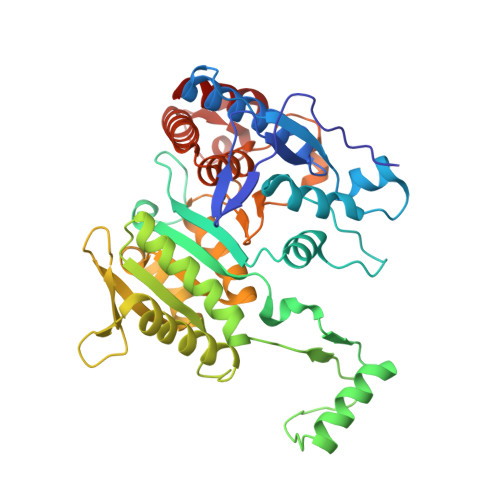
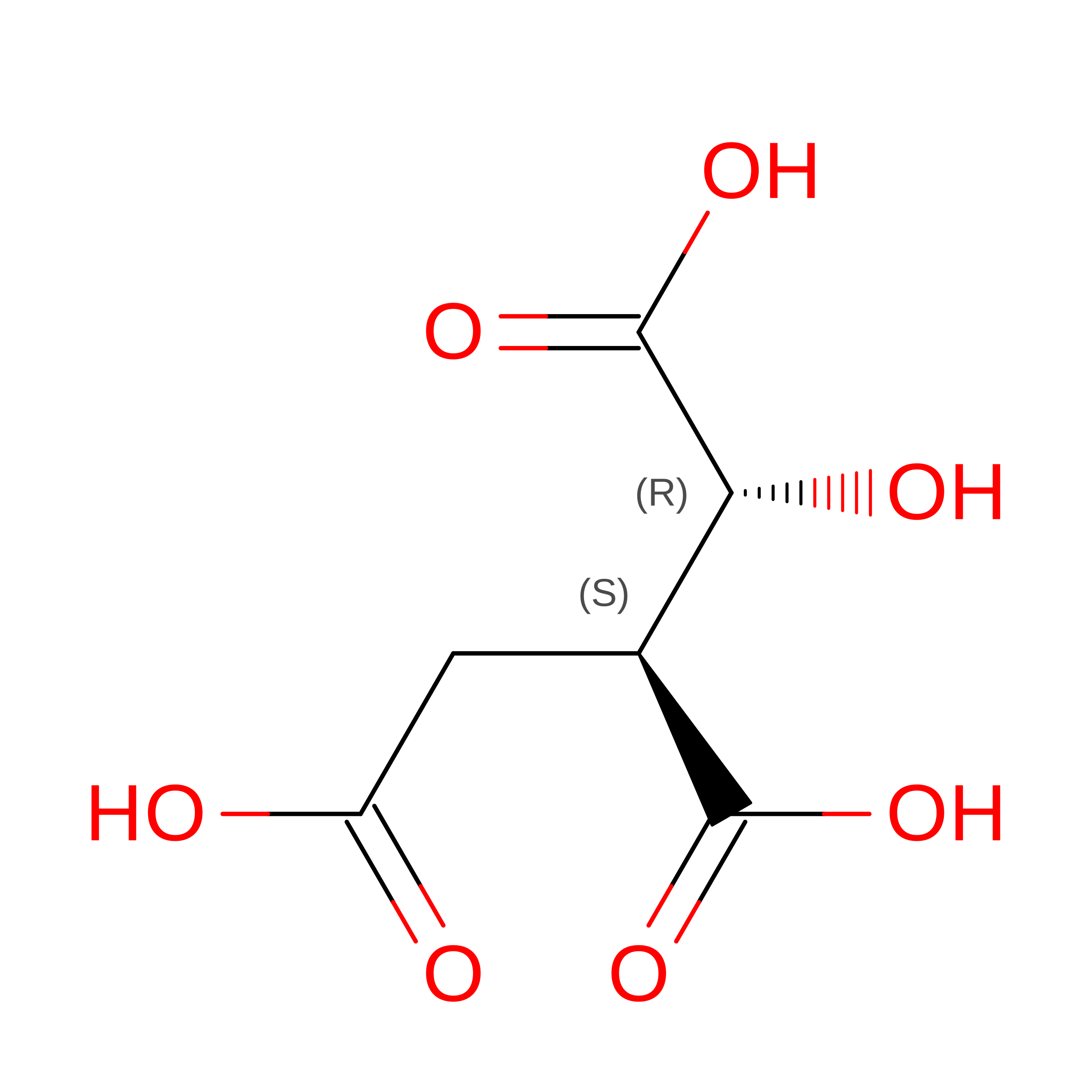
3D structure of E. coli Isocitrate Dehydrogenase K100M mutant in complex with isocitrate and magnesium(II)


Experimental Data Snapshot

  • Method: X-RAY DIFFRACTION
  • Resolution: 2.00 Å
  • R-Value Free: 
    0.192 (Depositor), 0.187 (DCC) 
  • R-Value Work: 
    0.163 (Depositor), 0.161 (DCC) 
  • R-Value Observed: 
    0.165 (Depositor) 

Starting Model: experimental
View more details

wwPDB Validation 3D Report Full Report

Validation slider image for 4BNP

Ligand Structure Quality Assessment 


This is version 1.3 of the entry. See complete history

Literature

Evolution of a Transition State: Role of Lys100 in the Active Site of Isocitrate Dehydrogenase.

Miller, S.P.Goncalves, S.Matias, P.M.Dean, A.M.

(2014) Chembiochem 15: 1145

  • DOI: https://doi.org/10.1002/cbic.201400040
  • Primary Citation Related Structures: 
    4BNP

  • PubMed Abstract: 

    An active site lysine essential to catalysis in isocitrate dehydrogenase (IDH) is absent from related enzymes. As all family members catalyze the same oxidative β-decarboxylation at the (2R)-malate core common to their substrates, it seems odd that an amino acid essential to one is not found in all. Ordinarily, hydride transfer to a nicotinamide C4 neutralizes the positive charge at N1 directly. In IDH, the negatively charged C4-carboxylate of isocitrate stabilizes the ground state positive charge on the adjacent nicotinamide N1, opposing hydride transfer. The critical lysine is poised to stabilize-and perhaps even protonate-an oxyanion formed on the nicotinamide 3-carboxamide, thereby enabling the hydride to be transferred while the positive charge at N1 is maintained. IDH might catalyze the same overall reaction as other family members, but dehydrogenation proceeds through a distinct, though related, transition state. Partial activation of lysine mutants by K(+) and NH4 (+) represents a throwback to the primordial state of the first promiscuous substrate family member.


  • Organizational Affiliation
    • Biotechnology Institute, The University of Minnesota, 1479 Gortner Avenue, St. Paul, MN 55108 (USA).

Macromolecule Content 

  • Total Structure Weight: 46.12 kDa 
  • Atom Count: 3,807 
  • Modeled Residue Count: 415 
  • Deposited Residue Count: 416 
  • Unique protein chains: 1

Macromolecules

Find similar proteins by:|  3D Structure
Entity ID: 1
MoleculeChains  Sequence LengthOrganismDetailsImage
ISOCITRATE DEHYDROGENASE [NADP]416Escherichia coli K-12Mutation(s): 1 
EC: 1.1.1.42
UniProt
Find proteins for P08200 (Escherichia coli (strain K12))
Explore P08200 
Go to UniProtKB:  P08200
Entity Groups
Sequence Clusters30% Identity50% Identity70% Identity90% Identity95% Identity100% Identity
UniProt GroupP08200
Sequence Annotations
Expand
Reference Sequence

Experimental Data & Validation

Experimental Data

  • Method: X-RAY DIFFRACTION
  • Resolution: 2.00 Å
  • R-Value Free:  0.192 (Depositor), 0.187 (DCC) 
  • R-Value Work:  0.163 (Depositor), 0.161 (DCC) 
  • R-Value Observed: 0.165 (Depositor) 
Space Group: P 43 21 2
Unit Cell:
Length ( Å )Angle ( ˚ )
a = 102.562α = 90
b = 102.562β = 90
c = 150.645γ = 90
Software Package:
Software NamePurpose
PHENIXrefinement
SAINTdata reduction
SADABSdata scaling
PHASERphasing

Structure Validation

View Full Validation Report


Ligand Structure Quality Assessment 


Entry History 

Deposition Data

Revision History  (Full details and data files)

  • Version 1.0: 2014-05-21
    Type: Initial release
  • Version 1.1: 2014-06-04
    Changes: Database references
  • Version 1.2: 2017-07-05
    Changes: Data collection
  • Version 1.3: 2023-12-20
    Changes: Data collection, Database references, Derived calculations, Other, Refinement description