4BKM | pdb_00004bkm

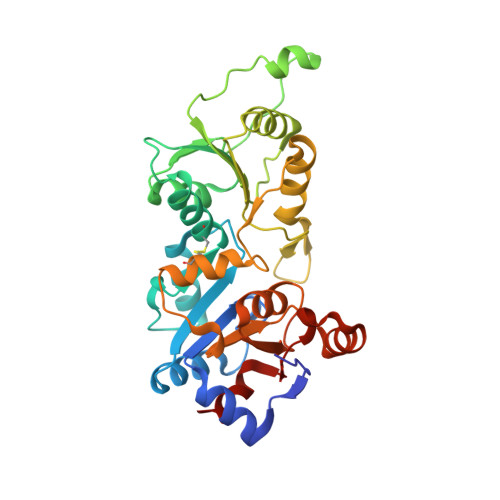
Crystal structure of the murine AUM (phosphoglycolate phosphatase) capping domain as a fusion protein with the catalytic core domain of murine chronophin (pyridoxal phosphate phosphatase)


Experimental Data Snapshot

  • Method: X-RAY DIFFRACTION
  • Resolution: 2.65 Å
  • R-Value Free: 
    0.256 (Depositor) 
  • R-Value Work: 
    0.198 (Depositor) 
  • R-Value Observed: 
    0.201 (Depositor) 

Starting Model: experimental
View more details

wwPDB Validation 3D Report Full Report

Validation slider image for 4BKM

This is version 2.2 of the entry. See complete history

Literature

Evolutionary and Structural Analyses of the Mammalian Haloacid Dehalogenase-Type Phosphatases Aum and Chronophin Provide Insight Into the Basis of Their Different Substrate Specificities.

Seifried, A.Knobloch, G.Duraphe, P.S.Segerer, G.Manhard, J.Schindelin, H.Schultz, J.Gohla, A.

(2014) J Biological Chem 289: 3416

  • DOI: https://doi.org/10.1074/jbc.M113.503359
  • Primary Citation Related Structures: 
    4BKM

  • PubMed Abstract: 

    Mammalian haloacid dehalogenase (HAD)-type phosphatases are an emerging family of phosphatases with important functions in physiology and disease, yet little is known about the basis of their substrate specificity. Here, we characterize a previously unexplored HAD family member (gene annotation, phosphoglycolate phosphatase), which we termed AUM, for aspartate-based, ubiquitous, Mg(2+)-dependent phosphatase. AUM is a tyrosine-specific paralog of the serine/threonine-specific protein and pyridoxal 5'-phosphate-directed HAD phosphatase chronophin. Comparative evolutionary and biochemical analyses reveal that a single, differently conserved residue in the cap domain of either AUM or chronophin is crucial for phosphatase specificity. We have solved the x-ray crystal structure of the AUM cap fused to the catalytic core of chronophin to 2.65 Å resolution and present a detailed view of the catalytic clefts of AUM and chronophin that explains their substrate preferences. Our findings identify a small number of cap domain residues that encode the different substrate specificities of AUM and chronophin.


  • Organizational Affiliation
    • From the Institute for Pharmacology and Toxicology.

Macromolecule Content 

  • Total Structure Weight: 134.07 kDa 
  • Atom Count: 9,450 
  • Modeled Residue Count: 1,216 
  • Deposited Residue Count: 1,236 
  • Unique protein chains: 1

Macromolecules

Find similar proteins by:|  3D Structure
Entity ID: 1
MoleculeChains  Sequence LengthOrganismDetailsImage
PYRIDOXAL PHOSPHATE PHOSPHATASE, PHOSPHOGLYCOLATE PHOSPHATASE, PYRIDOXAL PHOSPHATE PHOSPHATASE
A, B, C, D
309Mus musculusMutation(s): 0 
EC: 3.1.3.3 (PDB Primary Data), 3.1.3.74 (PDB Primary Data), 3.1.3.18 (PDB Primary Data), 3.1.3.21 (UniProt), 3.1.3.16 (UniProt), 3.1.3.48 (UniProt)
UniProt & NIH Common Fund Data Resources
Find proteins for P60487 (Mus musculus)
Explore P60487 
Go to UniProtKB:  P60487
IMPC:  MGI:1919282
Find proteins for Q8CHP8 (Mus musculus)
Explore Q8CHP8 
Go to UniProtKB:  Q8CHP8
Entity Groups
Sequence Clusters30% Identity50% Identity70% Identity90% Identity95% Identity100% Identity
UniProt GroupsP60487Q8CHP8
Sequence Annotations
Expand
Reference Sequence

Experimental Data & Validation

Experimental Data

  • Method: X-RAY DIFFRACTION
  • Resolution: 2.65 Å
  • R-Value Free:  0.256 (Depositor) 
  • R-Value Work:  0.198 (Depositor) 
  • R-Value Observed: 0.201 (Depositor) 
Space Group: P 1 21 1
Unit Cell:
Length ( Å )Angle ( ˚ )
a = 67.5α = 90
b = 91.96β = 90.2
c = 105.92γ = 90
Software Package:
Software NamePurpose
PHENIXrefinement
iMOSFLMdata reduction
SCALAdata scaling
PHASERphasing

Structure Validation

View Full Validation Report


Entry History 

Deposition Data

Revision History  (Full details and data files)

  • Version 1.0: 2013-12-25
    Type: Initial release
  • Version 1.1: 2014-02-19
    Changes: Database references
  • Version 1.2: 2017-03-15
    Changes: Source and taxonomy
  • Version 2.0: 2017-06-28
    Changes: Atomic model, Data collection
  • Version 2.1: 2023-12-20
    Changes: Data collection, Database references, Derived calculations, Other, Refinement description
  • Version 2.2: 2024-10-09
    Changes: Structure summary