4BHK | pdb_00004bhk

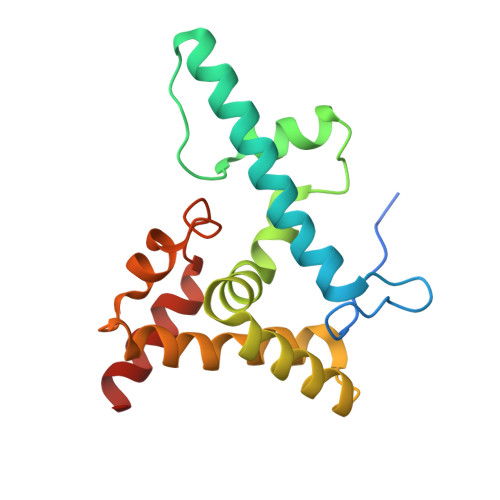
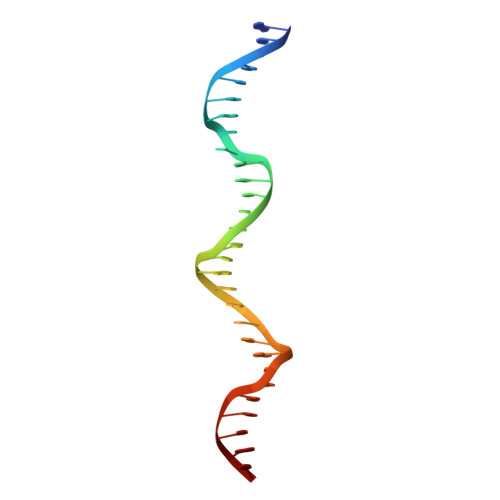
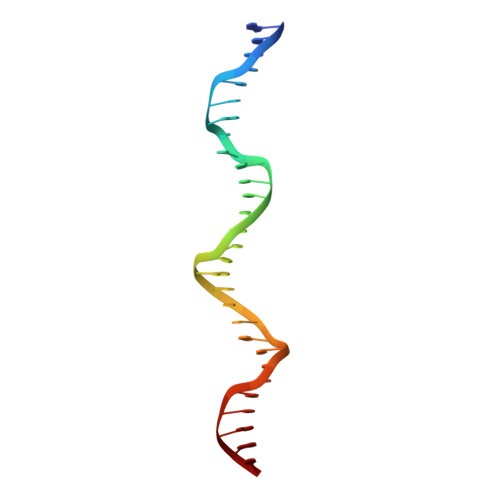
Crystal Structure of Moss Leafy bound to DNA


Experimental Data Snapshot

  • Method: X-RAY DIFFRACTION
  • Resolution: 2.32 Å
  • R-Value Free: 
    0.240 (Depositor), 0.249 (DCC) 
  • R-Value Work: 
    0.196 (Depositor), 0.202 (DCC) 
  • R-Value Observed: 
    0.198 (Depositor) 

Starting Model: experimental
View more details

wwPDB Validation 3D Report Full Report

Validation slider image for 4BHK

This is version 1.3 of the entry. See complete history

Literature

A Promiscuous Intermediate Underlies the Evolution of Leafy DNA Binding Specificity.

Sayou, C.Monniaux, M.Nanao, M.H.Moyroud, E.Brockington, S.F.Thevenon, E.Chahtane, H.Warthmann, N.Melkonian, M.Zhang, Y.Wong, G.K.Weigel, D.Parcy, F.Dumas, R.

(2014) Science 343: 645

  • DOI: https://doi.org/10.1126/science.1248229
  • Primary Citation Related Structures: 
    4BHK

  • PubMed Abstract: 

    Transcription factors (TFs) are key players in evolution. Changes affecting their function can yield novel life forms but may also have deleterious effects. Consequently, gene duplication events that release one gene copy from selective pressure are thought to be the common mechanism by which TFs acquire new activities. Here, we show that LEAFY, a major regulator of flower development and cell division in land plants, underwent changes to its DNA binding specificity, even though plant genomes generally contain a single copy of the LEAFY gene. We examined how these changes occurred at the structural level and identify an intermediate LEAFY form in hornworts that appears to adopt all different specificities. This promiscuous intermediate could have smoothed the evolutionary transitions, thereby allowing LEAFY to evolve new binding specificities while remaining a single-copy gene.


  • Organizational Affiliation
    • CNRS, Laboratoire de Physiologie Cellulaire et Végétale (LPCV), UMR 5168, 38054 Grenoble, France.

Macromolecule Content 

  • Total Structure Weight: 57.88 kDa 
  • Atom Count: 3,944 
  • Modeled Residue Count: 374 
  • Deposited Residue Count: 400 
  • Unique protein chains: 1
  • Unique nucleic acid chains: 2

Macromolecules


Find similar proteins by:|  3D Structure
Entity ID: 1
MoleculeChains  Sequence LengthOrganismDetailsImage
FLORICAULA/LEAFY HOMOLOG 1
A, B
171Physcomitrium patensMutation(s): 0 
UniProt
Find proteins for Q94IF5 (Physcomitrium patens)
Explore Q94IF5 
Go to UniProtKB:  Q94IF5
Entity Groups
Sequence Clusters30% Identity50% Identity70% Identity90% Identity95% Identity100% Identity
UniProt GroupQ94IF5
Sequence Annotations
Expand
Reference Sequence
Find similar nucleic acids by:  (by identity cutoff) 
Entity ID: 2
MoleculeChains LengthOrganismImage
MOSS-CR54 DNAC [auth W]29Physcomitrium patens
Sequence Annotations
Expand
Reference Sequence
Find similar nucleic acids by:  (by identity cutoff) 
Entity ID: 3
MoleculeChains LengthOrganismImage
MOSS-CR54 DNAD [auth X]29Physcomitrium patens
Sequence Annotations
Expand
Reference Sequence

Experimental Data & Validation

Experimental Data

  • Method: X-RAY DIFFRACTION
  • Resolution: 2.32 Å
  • R-Value Free:  0.240 (Depositor), 0.249 (DCC) 
  • R-Value Work:  0.196 (Depositor), 0.202 (DCC) 
  • R-Value Observed: 0.198 (Depositor) 
Space Group: P 21 21 21
Unit Cell:
Length ( Å )Angle ( ˚ )
a = 42.722α = 90
b = 84.523β = 90
c = 152.424γ = 90
Software Package:
Software NamePurpose
BUSTERrefinement
XDSdata reduction
XSCALEdata scaling
PHASERphasing

Structure Validation

View Full Validation Report


Entry History 

Deposition Data

Revision History  (Full details and data files)

  • Version 1.0: 2014-01-22
    Type: Initial release
  • Version 1.1: 2014-01-29
    Changes: Database references
  • Version 1.2: 2014-02-19
    Changes: Database references
  • Version 1.3: 2023-12-20
    Changes: Data collection, Database references, Other, Refinement description