4AT0 | pdb_00004at0

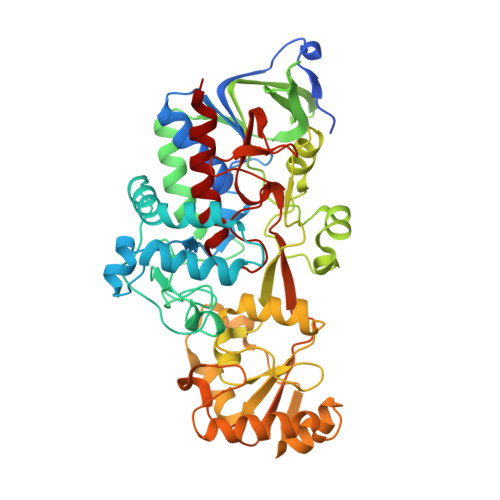
The crystal structure of 3-ketosteroid-delta4-(5alpha)-dehydrogenase from Rhodococcus jostii RHA1


Experimental Data Snapshot

  • Method: X-RAY DIFFRACTION
  • Resolution: 1.60 Å
  • R-Value Free: 
    0.175 (Depositor), 0.175 (DCC) 
  • R-Value Work: 
    0.158 (Depositor), 0.157 (DCC) 
  • R-Value Observed: 
    0.159 (Depositor) 

Starting Models: experimental
View more details

wwPDB Validation 3D Report Full Report

Validation slider image for 4AT0

Ligand Structure Quality Assessment 


This is version 1.2 of the entry. See complete history

Literature

Structure and Catalytic Mechanism of 3-Ketosteroid-{Delta}4-(5Alpha)-Dehydrogenase from Rhodococcus Jostii Rha1 Genome.

Van Oosterwijk, N.Knol, J.Dijkhuizen, L.Van Der Geize, R.Dijkstra, B.W.

(2012) J Biological Chem 287: 30975

  • DOI: https://doi.org/10.1074/jbc.M112.374306
  • Primary Citation Related Structures: 
    4AT0, 4AT2

  • PubMed Abstract: 

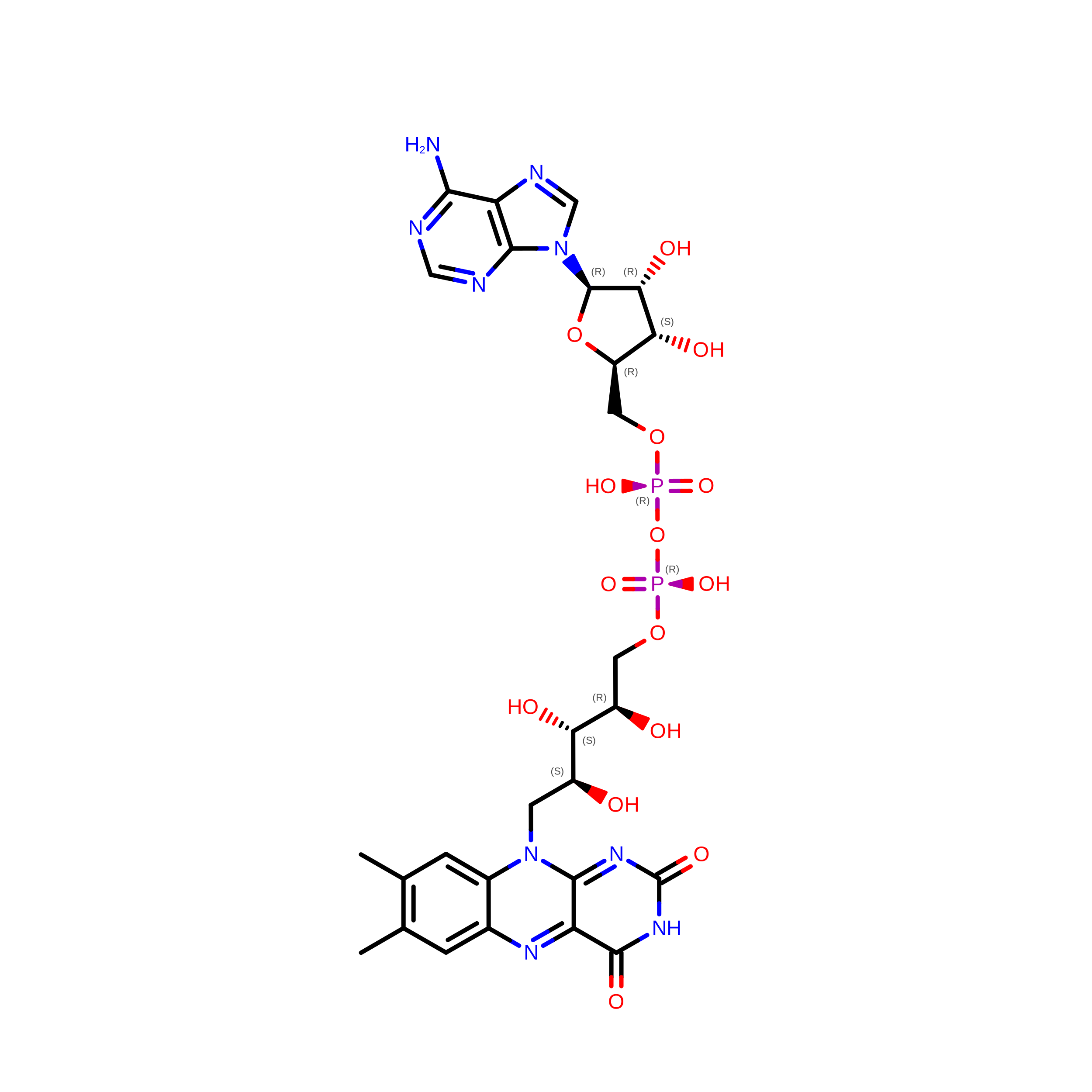
    3-Ketosteroid Δ4-(5α)-dehydrogenases (Δ4-(5α)-KSTDs) are enzymes that introduce a double bond between the C4 and C5 atoms of 3-keto-(5α)-steroids. Here we show that the ro05698 gene from Rhodococcus jostii RHA1 codes for a flavoprotein with Δ4-(5α)-KSTD activity. The 1.6 Å resolution crystal structure of the enzyme revealed three conserved residues (Tyr-319, Tyr-466, and Ser-468) in a pocket near the isoalloxazine ring system of the FAD co-factor. Site-directed mutagenesis of these residues confirmed that they are absolutely essential for catalytic activity. A crystal structure with bound product 4-androstene-3,17-dione showed that Ser-468 is in a position in which it can serve as the base abstracting the 4β-proton from the C4 atom of the substrate. Ser-468 is assisted by Tyr-319, which possibly is involved in shuttling the proton to the solvent. Tyr-466 is at hydrogen bonding distance to the C3 oxygen atom of the substrate and can stabilize the keto-enol intermediate occurring during the reaction. Finally, the FAD N5 atom is in a position to be able to abstract the 5α-hydrogen of the substrate as a hydride ion. These features fully explain the reaction catalyzed by Δ4-(5α)-KSTDs.


  • Organizational Affiliation
    • Laboratory of Biophysical Chemistry, University of Groningen, 9747 AG Groningen, The Netherlands.

Macromolecule Content 

  • Total Structure Weight: 55.11 kDa 
  • Atom Count: 4,355 
  • Modeled Residue Count: 483 
  • Deposited Residue Count: 510 
  • Unique protein chains: 1

Macromolecules

Find similar proteins by:|  3D Structure
Entity ID: 1
MoleculeChains  Sequence LengthOrganismDetailsImage
3-KETOSTEROID-DELTA4-5ALPHA-DEHYDROGENASE510Rhodococcus jostii RHA1Mutation(s): 0 
EC: 1.3.99.5
UniProt
Find proteins for Q0S4Q9 (Rhodococcus jostii (strain RHA1))
Explore Q0S4Q9 
Go to UniProtKB:  Q0S4Q9
Entity Groups
Sequence Clusters30% Identity50% Identity70% Identity90% Identity95% Identity100% Identity
UniProt GroupQ0S4Q9
Sequence Annotations
Expand
Reference Sequence

Experimental Data & Validation

Experimental Data

  • Method: X-RAY DIFFRACTION
  • Resolution: 1.60 Å
  • R-Value Free:  0.175 (Depositor), 0.175 (DCC) 
  • R-Value Work:  0.158 (Depositor), 0.157 (DCC) 
  • R-Value Observed: 0.159 (Depositor) 
Space Group: C 2 2 21
Unit Cell:
Length ( Å )Angle ( ˚ )
a = 99.233α = 90
b = 114.308β = 90
c = 110.161γ = 90
Software Package:
Software NamePurpose
REFMACrefinement
MOSFLMdata reduction
SCALAdata scaling
PHASERphasing

Structure Validation

View Full Validation Report


Ligand Structure Quality Assessment 


Entry History 

Deposition Data

Revision History  (Full details and data files)

  • Version 1.0: 2012-08-01
    Type: Initial release
  • Version 1.1: 2012-10-10
    Changes: Database references
  • Version 1.2: 2023-12-20
    Changes: Data collection, Database references, Derived calculations, Other, Refinement description