4ABK | pdb_00004abk

HUMAN PARP14 (ARTD8, BAL2) - MACRO DOMAIN 3 IN COMPLEX WITH ADENOSINE- 5-DIPHOSPHORIBOSE


Experimental Data Snapshot

  • Method: X-RAY DIFFRACTION
  • Resolution: 1.60 Å
  • R-Value Free: 
    0.206 (Depositor), 0.212 (DCC) 
  • R-Value Work: 
    0.166 (Depositor), 0.178 (DCC) 
  • R-Value Observed: 
    0.168 (Depositor) 

Starting Model: experimental
View more details

wwPDB Validation 3D Report Full Report

Validation slider image for 4ABK

Ligand Structure Quality Assessment 


This is version 1.3 of the entry. See complete history

Literature

Recognition of Mono-Adp-Ribosylated Artd10 Substrates by Artd8 Macrodomains

Forst, A.H.Karlberg, T.Herzog, N.Thorsell, A.G.Gross, A.Feijs, K.L.H.Verheugd, P.Kursula, P.Nijmeijer, B.Kremmer, E.Kleine, H.Ladurner, A.G.Schuler, H.Luscher, B.

(2013) Structure 21: 462

  • DOI: https://doi.org/10.1016/j.str.2012.12.019
  • Primary Citation Related Structures: 
    3Q6Z, 3Q71, 3V2B, 3VFQ, 4ABK, 4ABL, 4D86

  • PubMed Abstract: 

    ADP-ribosyltransferases (ARTs) catalyze the transfer of ADP-ribose from NAD(+) onto substrates. Some ARTs generate in an iterative process ADP-ribose polymers that serve as adaptors for distinct protein domains. Other ARTs, exemplified by ARTD10, function as mono-ADP-ribosyltransferases, but it has been unclear whether this modification occurs in cells and how it is read. We observed that ARTD10 colocalized with ARTD8 and defined its macrodomains 2 and 3 as readers of mono-ADP-ribosylation both in vitro and in cells. The crystal structures of these two ARTD8 macrodomains and isothermal titration calorimetry confirmed their interaction with ADP-ribose. These macrodomains recognized mono-ADP-ribosylated ARTD10, but not poly-ADP-ribosylated ARTD1. This distinguished them from the macrodomain of macroH2A1.1, which interacted with poly- but not mono-ADP-ribosylated substrates. Moreover, Ran, an ARTD10 substrate, was also read by ARTD8 macrodomains. This identifies readers of mono-ADP-ribosylated proteins, defines their structures, and demonstrates the presence of this modification in cells.


  • Organizational Affiliation
    • Institute of Biochemistry and Molecular Biology, Medical School, RWTH Aachen University, Aachen, Germany.

Macromolecule Content 

  • Total Structure Weight: 20.37 kDa 
  • Atom Count: 1,573 
  • Modeled Residue Count: 182 
  • Deposited Residue Count: 183 
  • Unique protein chains: 1

Macromolecules

Find similar proteins by:|  3D Structure
Entity ID: 1
MoleculeChains  Sequence LengthOrganismDetailsImage
POLY [ADP-RIBOSE] POLYMERASE 14183Homo sapiensMutation(s): 0 
EC: 2.4.2.30 (PDB Primary Data), 2.4.2 (UniProt)
UniProt & NIH Common Fund Data Resources
Find proteins for Q460N5 (Homo sapiens)
Explore Q460N5 
Go to UniProtKB:  Q460N5
PHAROS:  Q460N5
GTEx:  ENSG00000173193 
Entity Groups
Sequence Clusters30% Identity50% Identity70% Identity90% Identity95% Identity100% Identity
UniProt GroupQ460N5
Sequence Annotations
Expand
Reference Sequence

Small Molecules

Ligands 1 Unique
IDChains Name / Formula / InChI Key2D Diagram3D Interactions
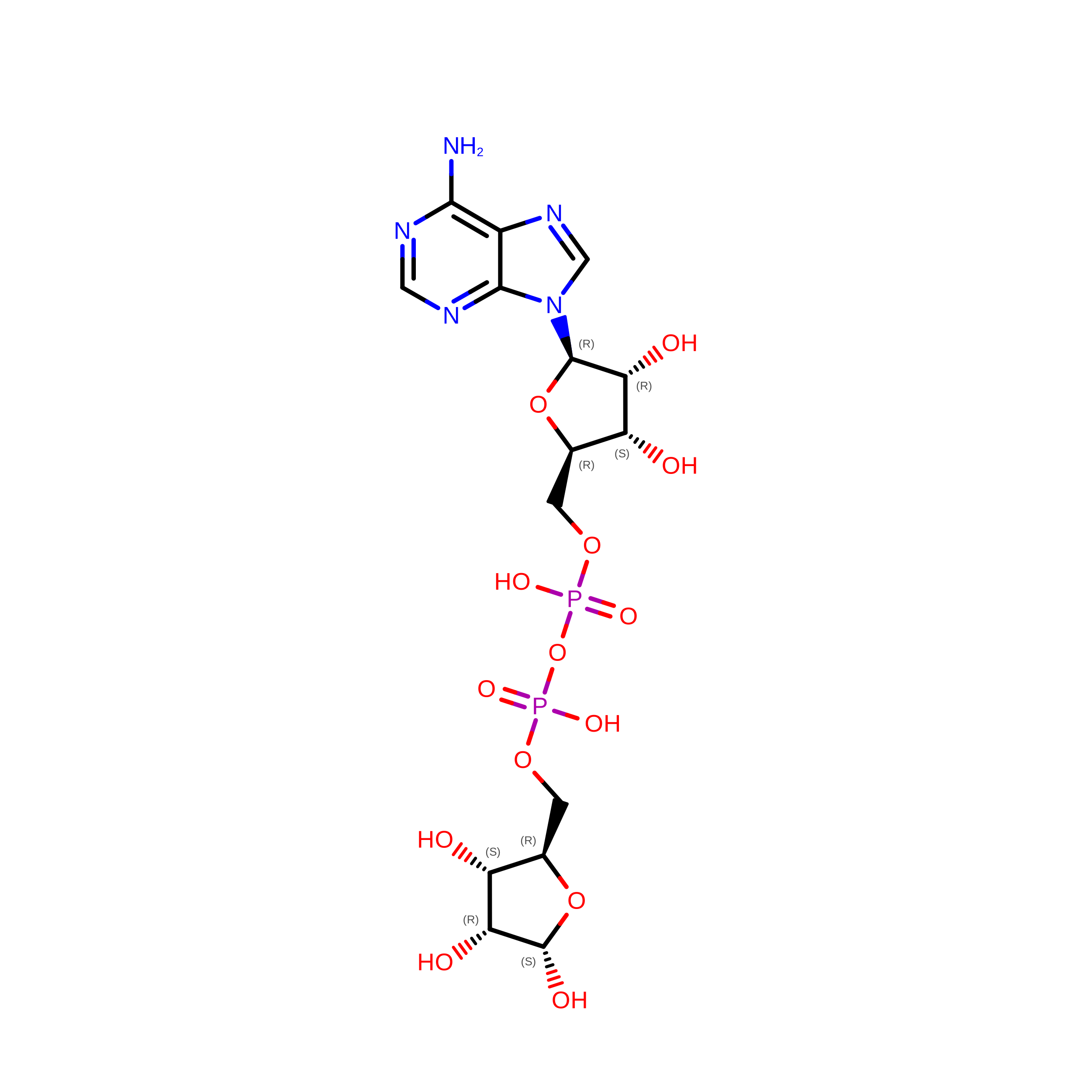
AR6

Query on AR6


Download:Ideal Coordinates CCD File
B [auth A][(2R,3S,4R,5R)-5-(6-AMINOPURIN-9-YL)-3,4-DIHYDROXY-OXOLAN-2-YL]METHYL[HYDROXY-[[(2R,3S,4R,5S)-3,4,5-TRIHYDROXYOXOLAN-2-YL]METHOXY]PHOSPHORYL] HYDROGEN PHOSPHATE
C15 H23 N5 O14 P2
SRNWOUGRCWSEMX-ZQSHOCFMSA-N

Experimental Data & Validation

Experimental Data

  • Method: X-RAY DIFFRACTION
  • Resolution: 1.60 Å
  • R-Value Free:  0.206 (Depositor), 0.212 (DCC) 
  • R-Value Work:  0.166 (Depositor), 0.178 (DCC) 
  • R-Value Observed: 0.168 (Depositor) 
Space Group: P 21 21 21
Unit Cell:
Length ( Å )Angle ( ˚ )
a = 32.949α = 90
b = 41.253β = 90
c = 108.538γ = 90
Software Package:
Software NamePurpose
REFMACrefinement
XDSdata reduction
XSCALEdata scaling
MOLREPphasing

Structure Validation

View Full Validation Report


Ligand Structure Quality Assessment 


Entry History 

Deposition Data

Revision History  (Full details and data files)

  • Version 1.0: 2012-12-19
    Type: Initial release
  • Version 1.1: 2013-03-13
    Changes: Database references
  • Version 1.2: 2013-03-20
    Changes: Database references
  • Version 1.3: 2023-12-20
    Changes: Data collection, Database references, Derived calculations, Other, Refinement description, Structure summary