3ZJC | pdb_00003zjc

Crystal structure of GMPPNP-bound human GIMAP7 L100Q variant


Experimental Data Snapshot

  • Method: X-RAY DIFFRACTION
  • Resolution: 3.15 Å
  • R-Value Free: 
    0.305 (Depositor), 0.238 (DCC) 
  • R-Value Work: 
    0.234 (Depositor), 0.240 (DCC) 
  • R-Value Observed: 
    0.238 (Depositor) 

Starting Model: experimental
View more details

wwPDB Validation 3D Report Full Report

Validation slider image for 3ZJC

Ligand Structure Quality Assessment 


This is version 1.2 of the entry. See complete history

Literature

Structural Insights Into the Mechanism of Gtpase Activation in the Gimap Family.

Schwefel, D.Arasu, B.S.Marino, S.F.Lamprecht, B.Koechert, K.Rosenbaum, E.Eichhorst, J.Wiesner, B.Behlke, J.Rocks, O.Mathas, S.Daumke, O.

(2013) Structure 21: 550

  • DOI: https://doi.org/10.1016/j.str.2013.01.014
  • Primary Citation Related Structures: 
    3ZJC

  • PubMed Abstract: 

    GTPases of immunity-associated proteins (GIMAPs) are regulators of lymphocyte survival and homeostasis. We previously determined the structural basis of GTP-dependent GIMAP2 scaffold formation on lipid droplets. To understand how its GTP hydrolysis is activated, we screened for other GIMAPs on lipid droplets and identified GIMAP7. In contrast to GIMAP2, GIMAP7 displayed dimerization-stimulated GTP hydrolysis. The crystal structure of GTP-bound GIMAP7 showed a homodimer that assembled via the G domains, with the helical extensions protruding in opposite directions. We identified a catalytic arginine that is supplied to the opposing monomer to stimulate GTP hydrolysis. GIMAP7 also stimulated GTP hydrolysis by GIMAP2 via an analogous mechanism. Finally, we found GIMAP2 and GIMAP7 expression differentially regulated in several human T cell lymphoma lines. Our findings suggest that GTPase activity in the GIMAP family is controlled by homo- and heterodimerization. This may have implications for the differential roles of some GIMAPs in lymphocyte survival.


  • Organizational Affiliation
    • Max-Delbrück-Centrum für Molekulare Medizin, Robert-Rössle-Strasse 10, 13125 Berlin, Germany. david.schwefel@nimr.mrc.ac.uk

Macromolecule Content 

  • Total Structure Weight: 213.23 kDa 
  • Atom Count: 12,623 
  • Modeled Residue Count: 1,555 
  • Deposited Residue Count: 1,830 
  • Unique protein chains: 1

Macromolecules

Find similar proteins by:|  3D Structure
Entity ID: 1
MoleculeChains  Sequence LengthOrganismDetailsImage
GTPASE IMAP FAMILY MEMBER 7
A, B, C, D, E
A, B, C, D, E, F
305Homo sapiensMutation(s): 1 
UniProt & NIH Common Fund Data Resources
Find proteins for Q8NHV1 (Homo sapiens)
Explore Q8NHV1 
Go to UniProtKB:  Q8NHV1
PHAROS:  Q8NHV1
GTEx:  ENSG00000179144 
Entity Groups
Sequence Clusters30% Identity50% Identity70% Identity90% Identity95% Identity100% Identity
UniProt GroupQ8NHV1
Sequence Annotations
Expand
Reference Sequence

Small Molecules

Ligands 2 Unique
IDChains Name / Formula / InChI Key2D Diagram3D Interactions
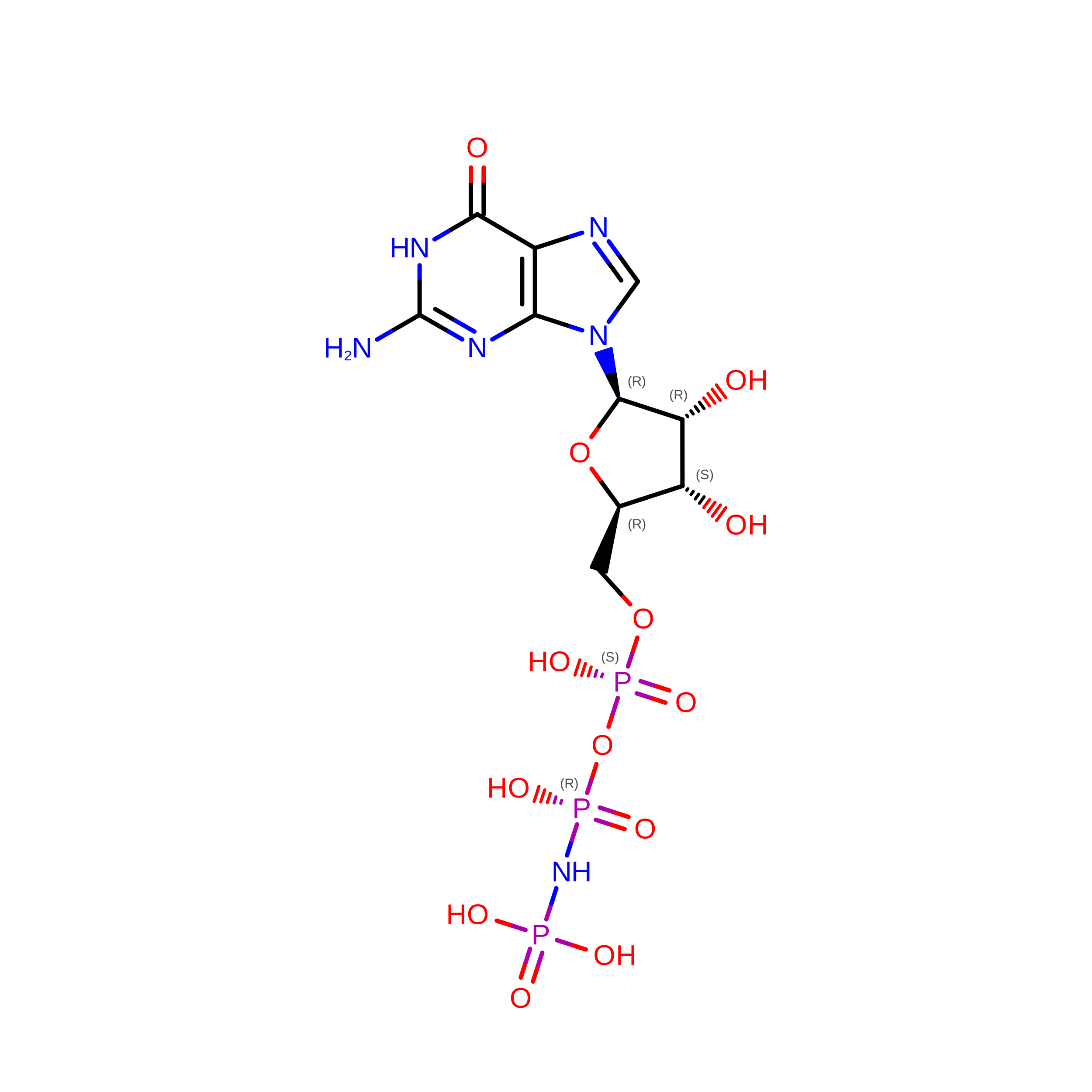
GNP

Query on GNP


Download:Ideal Coordinates CCD File
H [auth A]
J [auth B]
L [auth C]
N [auth D]
P [auth E]
H [auth A],
J [auth B],
L [auth C],
N [auth D],
P [auth E],
R [auth F]
PHOSPHOAMINOPHOSPHONIC ACID-GUANYLATE ESTER
C10 H17 N6 O13 P3
UQABYHGXWYXDTK-UUOKFMHZSA-N
MG

Query on MG


Download:Ideal Coordinates CCD File
G [auth A]
I [auth B]
K [auth C]
M [auth D]
O [auth E]
G [auth A],
I [auth B],
K [auth C],
M [auth D],
O [auth E],
Q [auth F]
MAGNESIUM ION
Mg
JLVVSXFLKOJNIY-UHFFFAOYSA-N

Experimental Data & Validation

Experimental Data

  • Method: X-RAY DIFFRACTION
  • Resolution: 3.15 Å
  • R-Value Free:  0.305 (Depositor), 0.238 (DCC) 
  • R-Value Work:  0.234 (Depositor), 0.240 (DCC) 
  • R-Value Observed: 0.238 (Depositor) 
Space Group: P 1
Unit Cell:
Length ( Å )Angle ( ˚ )
a = 45.853α = 77.3
b = 90.939β = 85.23
c = 114.551γ = 89.23
Software Package:
Software NamePurpose
PHENIXrefinement
XDSdata reduction
XDSdata scaling
MOLREPphasing

Structure Validation

View Full Validation Report


Ligand Structure Quality Assessment 


Entry History 

Deposition Data

Revision History  (Full details and data files)

  • Version 1.0: 2013-03-13
    Type: Initial release
  • Version 1.1: 2013-04-17
    Changes: Database references, Derived calculations
  • Version 1.2: 2023-12-20
    Changes: Data collection, Database references, Derived calculations, Other, Refinement description