3TL4 | pdb_00003tl4

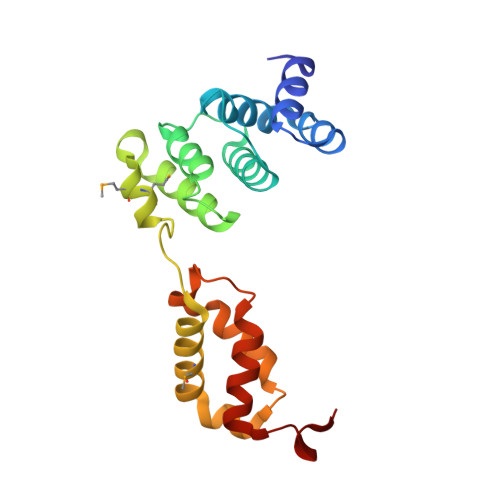
Crystal Structure of the tRNA Binding Domain of Glutaminyl-tRNA Synthetase from Saccharomyces cerevisiae


Experimental Data Snapshot

  • Method: X-RAY DIFFRACTION
  • Resolution: 2.30 Å
  • R-Value Free: 
    0.211 (Depositor), 0.204 (DCC) 
  • R-Value Work: 
    0.182 (Depositor), 0.177 (DCC) 
  • R-Value Observed: 
    0.184 (Depositor) 

wwPDB Validation 3D Report Full Report

Validation slider image for 3TL4

This is version 1.3 of the entry. See complete history

Literature

Structural conservation of an ancient tRNA sensor in eukaryotic glutaminyl-tRNA synthetase.

Grant, T.D.Snell, E.H.Luft, J.R.Quartley, E.Corretore, S.Wolfley, J.R.Snell, M.E.Hadd, A.Perona, J.J.Phizicky, E.M.Grayhack, E.J.

(2012) Nucleic Acids Res 40: 3723-3731

  • DOI: https://doi.org/10.1093/nar/gkr1223
  • Primary Citation Related Structures: 
    3TL4

  • PubMed Abstract: 

    In all organisms, aminoacyl tRNA synthetases covalently attach amino acids to their cognate tRNAs. Many eukaryotic tRNA synthetases have acquired appended domains, whose origin, structure and function are poorly understood. The N-terminal appended domain (NTD) of glutaminyl-tRNA synthetase (GlnRS) is intriguing since GlnRS is primarily a eukaryotic enzyme, whereas in other kingdoms Gln-tRNA(Gln) is primarily synthesized by first forming Glu-tRNA(Gln), followed by conversion to Gln-tRNA(Gln) by a tRNA-dependent amidotransferase. We report a functional and structural analysis of the NTD of Saccharomyces cerevisiae GlnRS, Gln4. Yeast mutants lacking the NTD exhibit growth defects, and Gln4 lacking the NTD has reduced complementarity for tRNA(Gln) and glutamine. The 187-amino acid Gln4 NTD, crystallized and solved at 2.3 Å resolution, consists of two subdomains, each exhibiting an extraordinary structural resemblance to adjacent tRNA specificity-determining domains in the GatB subunit of the GatCAB amidotransferase, which forms Gln-tRNA(Gln). These subdomains are connected by an apparent hinge comprised of conserved residues. Mutation of these amino acids produces Gln4 variants with reduced affinity for tRNA(Gln), consistent with a hinge-closing mechanism proposed for GatB recognition of tRNA. Our results suggest a possible origin and function of the NTD that would link the phylogenetically diverse mechanisms of Gln-tRNA(Gln) synthesis.


  • Organizational Affiliation
    • Hauptman-Woodward Medical Research Institute, Buffalo, NY 14203, USA.

Macromolecule Content 

  • Total Structure Weight: 21.5 kDa 
  • Atom Count: 1,571 
  • Modeled Residue Count: 186 
  • Deposited Residue Count: 187 
  • Unique protein chains: 1

Macromolecules

Find similar proteins by:|  3D Structure
Entity ID: 1
MoleculeChains  Sequence LengthOrganismDetailsImage
Glutaminyl-tRNA synthetaseA [auth X]187Saccharomyces cerevisiae S288CMutation(s): 0 
Gene Names: GLN4O3601YOR168W
EC: 6.1.1.18
UniProt
Find proteins for P13188 (Saccharomyces cerevisiae (strain ATCC 204508 / S288c))
Explore P13188 
Go to UniProtKB:  P13188
Entity Groups
Sequence Clusters30% Identity50% Identity70% Identity90% Identity95% Identity100% Identity
UniProt GroupP13188
Sequence Annotations
Expand
Reference Sequence

Small Molecules

Modified Residues  1 Unique
IDChains TypeFormula2D DiagramParent
MSE
Query on MSE
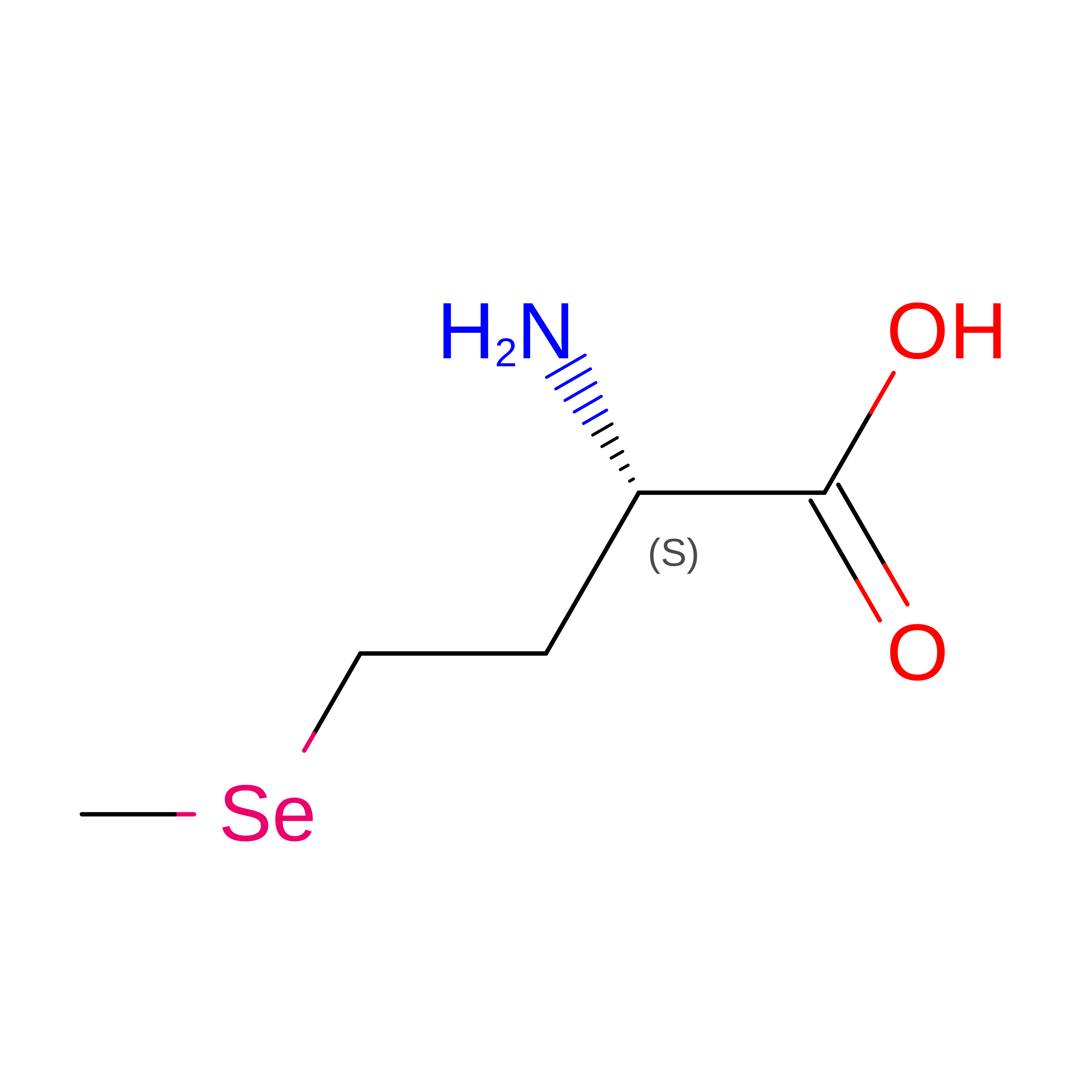
A [auth X]L-PEPTIDE LINKINGC5 H11 N O2 SeMET

Experimental Data & Validation

Experimental Data

  • Method: X-RAY DIFFRACTION
  • Resolution: 2.30 Å
  • R-Value Free:  0.211 (Depositor), 0.204 (DCC) 
  • R-Value Work:  0.182 (Depositor), 0.177 (DCC) 
  • R-Value Observed: 0.184 (Depositor) 
Space Group: P 1 21 1
Unit Cell:
Length ( Å )Angle ( ˚ )
a = 40.8α = 90
b = 34.62β = 97.61
c = 74.269γ = 90
Software Package:
Software NamePurpose
SCALAdata scaling
PHENIXrefinement
PDB_EXTRACTdata extraction

Structure Validation

View Full Validation Report


Entry History 

Deposition Data

Revision History  (Full details and data files)

  • Version 1.0: 2011-11-30
    Type: Initial release
  • Version 1.1: 2011-12-28
    Changes: Database references
  • Version 1.2: 2012-06-13
    Changes: Database references
  • Version 1.3: 2024-10-16
    Changes: Data collection, Database references, Derived calculations, Structure summary