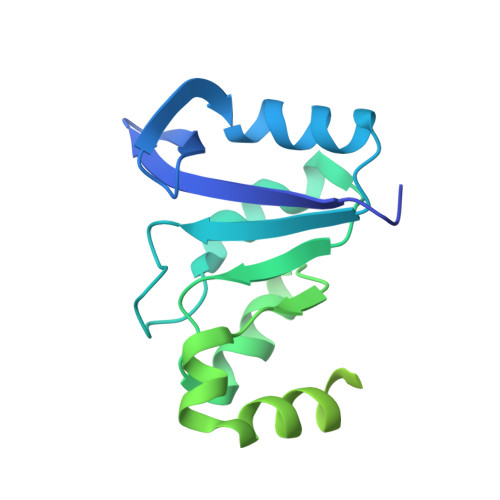
3TDN | pdb_00003tdn

Computationally designed two-fold symmetric Tim-barrel protein, FLR


Experimental Data Snapshot

  • Method: X-RAY DIFFRACTION
  • Resolution: 1.40 Å
  • R-Value Free: 
    0.193 (Depositor), 0.198 (DCC) 
  • R-Value Work: 
    0.157 (Depositor), 0.165 (DCC) 
  • R-Value Observed: 
    0.159 (Depositor) 

Starting Model: in silico
View more details

wwPDB Validation 3D Report Full Report

Validation slider image for 3TDN

This is version 1.3 of the entry. See complete history

Literature

Exploring symmetry as an avenue to the computational design of large protein domains.

Fortenberry, C.Bowman, E.A.Proffitt, W.Dorr, B.Combs, S.Harp, J.Mizoue, L.Meiler, J.

(2011) J Am Chem Soc 133: 18026-18029

  • DOI: https://doi.org/10.1021/ja2051217
  • Primary Citation Related Structures: 
    3TDM, 3TDN

  • PubMed Abstract: 

    It has been demonstrated previously that symmetric, homodimeric proteins are energetically favored, which explains their abundance in nature. It has been proposed that such symmetric homodimers underwent gene duplication and fusion to evolve into protein topologies that have a symmetric arrangement of secondary structure elements--"symmetric superfolds". Here, the ROSETTA protein design software was used to computationally engineer a perfectly symmetric variant of imidazole glycerol phosphate synthase and its corresponding symmetric homodimer. The new protein, termed FLR, adopts the symmetric (βα)(8) TIM-barrel superfold. The protein is soluble and monomeric and exhibits two-fold symmetry not only in the arrangement of secondary structure elements but also in sequence and at atomic detail, as verified by crystallography. When cut in half, FLR dimerizes readily to form the symmetric homodimer. The successful computational design of FLR demonstrates progress in our understanding of the underlying principles of protein stability and presents an attractive strategy for the in silico construction of larger protein domains from smaller pieces.


  • Organizational Affiliation
    • Department of Chemistry, Vanderbilt University, Nashville, Tennessee 37235, United States.

Macromolecule Content 

  • Total Structure Weight: 53.39 kDa 
  • Atom Count: 2,994 
  • Modeled Residue Count: 357 
  • Deposited Residue Count: 494 
  • Unique protein chains: 1

Macromolecules

Find similar proteins by:|  3D Structure
Entity ID: 1
MoleculeChains  Sequence LengthOrganismDetailsImage
FLR SYMMETRIC ALPHA-BETA TIM BARREL
A, B
247synthetic constructMutation(s): 0 

Experimental Data & Validation

Experimental Data

  • Method: X-RAY DIFFRACTION
  • Resolution: 1.40 Å
  • R-Value Free:  0.193 (Depositor), 0.198 (DCC) 
  • R-Value Work:  0.157 (Depositor), 0.165 (DCC) 
  • R-Value Observed: 0.159 (Depositor) 
Space Group: P 32 2 1
Unit Cell:
Length ( Å )Angle ( ˚ )
a = 67.222α = 90
b = 67.222β = 90
c = 124.658γ = 120
Software Package:
Software NamePurpose
REFMACrefinement
HKL-2000data reduction
HKL-2000data scaling

Structure Validation

View Full Validation Report


Entry History 

Deposition Data

Revision History  (Full details and data files)

  • Version 1.0: 2011-11-16
    Type: Initial release
  • Version 1.1: 2011-11-23
    Changes: Database references
  • Version 1.2: 2024-04-03
    Changes: Data collection, Database references, Derived calculations, Refinement description
  • Version 1.3: 2024-10-09
    Changes: Structure summary