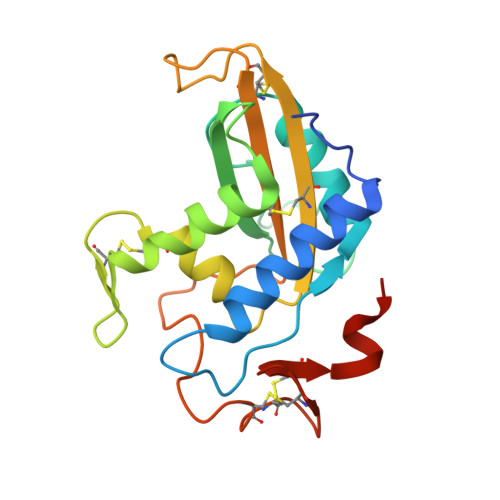
3Q2R | pdb_00003q2r

crystal structure of sGLIPR1 soaked with zinc chloride


Experimental Data Snapshot

  • Method: X-RAY DIFFRACTION
  • Resolution: 2.20 Å
  • R-Value Free: 
    0.192 (Depositor), 0.184 (DCC) 
  • R-Value Work: 
    0.158 (Depositor), 0.154 (DCC) 
  • R-Value Observed: 
    0.160 (Depositor) 

Starting Model: experimental
View more details

wwPDB Validation 3D Report Full Report

Validation slider image for 3Q2R

This is version 1.4 of the entry. See complete history

Literature

Structural studies of human glioma pathogenesis-related protein 1.

Asojo, O.A.Koski, R.A.Bonafe, N.

(2011) Acta Crystallogr D Biol Crystallogr 67: 847-855

  • DOI: https://doi.org/10.1107/S0907444911028198
  • Primary Citation Related Structures: 
    3Q2R, 3Q2U

  • PubMed Abstract: 

    Human glioma pathogenesis-related protein 1 (GLIPR1) is a membrane protein that is highly upregulated in brain cancers but is barely detectable in normal brain tissue. GLIPR1 is composed of a signal peptide that directs its secretion, a conserved cysteine-rich CAP (cysteine-rich secretory proteins, antigen 5 and pathogenesis-related 1 proteins) domain and a transmembrane domain. GLIPR1 is currently being investigated as a candidate for prostate cancer gene therapy and for glioblastoma targeted therapy. Crystal structures of a truncated soluble domain of the human GLIPR1 protein (sGLIPR1) solved by molecular replacement using a truncated polyalanine search model of the CAP domain of stecrisp, a snake-venom cysteine-rich secretory protein (CRISP), are presented. The correct molecular-replacement solution could only be obtained by removing all loops from the search model. The native structure was refined to 1.85 Å resolution and that of a Zn2+ complex was refined to 2.2 Å resolution. The latter structure revealed that the putative binding cavity coordinates Zn2+ similarly to snake-venom CRISPs, which are involved in Zn2+-dependent mechanisms of inflammatory modulation. Both sGLIPR1 structures have extensive flexible loop/turn regions and unique charge distributions that were not observed in any of the previously reported CAP protein structures. A model is also proposed for the structure of full-length membrane-bound GLIPR1.


  • Organizational Affiliation
    • Department of Pathology and Microbiology, College of Medicine, Nebraska Medical Center, Omaha, NE 68198-6495, USA. oasojo@unmc.edu

Macromolecule Content 

  • Total Structure Weight: 23.39 kDa 
  • Atom Count: 1,745 
  • Modeled Residue Count: 192 
  • Deposited Residue Count: 205 
  • Unique protein chains: 1

Macromolecules

Find similar proteins by:|  3D Structure
Entity ID: 1
MoleculeChains  Sequence LengthOrganismDetailsImage
Glioma pathogenesis-related protein 1205Homo sapiensMutation(s): 0 
Gene Names: GLIPRGLIPR1RTVP1synthesized
UniProt & NIH Common Fund Data Resources
Find proteins for P48060 (Homo sapiens)
Explore P48060 
Go to UniProtKB:  P48060
PHAROS:  P48060
GTEx:  ENSG00000139278 
Entity Groups
Sequence Clusters30% Identity50% Identity70% Identity90% Identity95% Identity100% Identity
UniProt GroupP48060
Sequence Annotations
Expand
Reference Sequence

Small Molecules

Ligands 1 Unique
IDChains Name / Formula / InChI Key2D Diagram3D Interactions
ZN

Query on ZN


Download:Ideal Coordinates CCD File
B [auth A]ZINC ION
Zn
PTFCDOFLOPIGGS-UHFFFAOYSA-N

Experimental Data & Validation

Experimental Data

  • Method: X-RAY DIFFRACTION
  • Resolution: 2.20 Å
  • R-Value Free:  0.192 (Depositor), 0.184 (DCC) 
  • R-Value Work:  0.158 (Depositor), 0.154 (DCC) 
  • R-Value Observed: 0.160 (Depositor) 
Space Group: P 21 21 2
Unit Cell:
Length ( Å )Angle ( ˚ )
a = 85.92α = 90
b = 79.72β = 90
c = 38.76γ = 90
Software Package:
Software NamePurpose
PHENIXrefinement
PHASERphasing
REFMACrefinement
CrysalisProdata reduction
SCALAdata scaling
CrysalisProdata collection

Structure Validation

View Full Validation Report


Entry History 

Deposition Data

  • Released Date: 2011-10-05 
  • Deposition Author(s): Asojo, O.A.

Revision History  (Full details and data files)

  • Version 1.0: 2011-10-05
    Type: Initial release
  • Version 1.1: 2017-11-08
    Changes: Refinement description
  • Version 1.2: 2019-07-17
    Changes: Data collection, Refinement description
  • Version 1.3: 2023-09-13
    Changes: Data collection, Database references, Derived calculations, Refinement description
  • Version 1.4: 2024-10-30
    Changes: Structure summary