3P1C | pdb_00003p1c

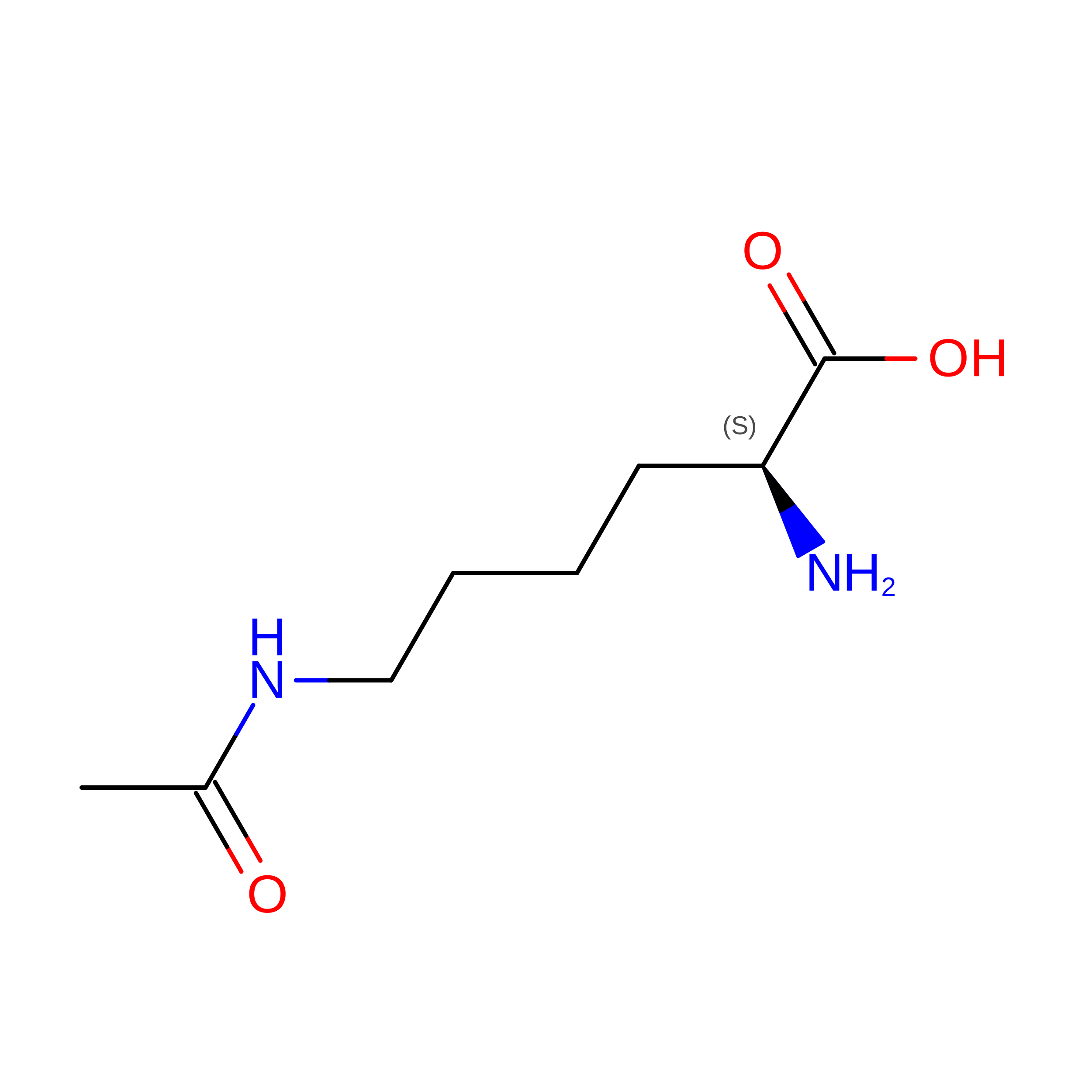
Crystal structure of the bromodomain of human CREBBP in complex with acetylated lysine


Experimental Data Snapshot

  • Method: X-RAY DIFFRACTION
  • Resolution: 1.82 Å
  • R-Value Free: 
    0.218 (Depositor) 
  • R-Value Work: 
    0.166 (Depositor) 
  • R-Value Observed: 
    0.168 (Depositor) 

Starting Model: experimental
View more details

wwPDB Validation 3D Report Full Report

Validation slider image for 3P1C

Ligand Structure Quality Assessment 


This is version 1.5 of the entry. See complete history

Literature

Histone recognition and large-scale structural analysis of the human bromodomain family.

Filippakopoulos, P.Picaud, S.Mangos, M.Keates, T.Lambert, J.P.Barsyte-Lovejoy, D.Felletar, I.Volkmer, R.Muller, S.Pawson, T.Gingras, A.C.Arrowsmith, C.H.Knapp, S.

(2012) Cell 149: 214-231

  • DOI: https://doi.org/10.1016/j.cell.2012.02.013
  • Primary Citation Related Structures: 
    2NXB, 2OO1, 2OSS, 2OUO, 2RFJ, 3D7C, 3DAI, 3DWY, 3GG3, 3HME, 3HMF, 3HMH, 3I3J, 3IU5, 3IU6, 3LXJ, 3MB3, 3MB4, 3MQM, 3NXB, 3P1C, 3P1D, 3Q2E, 3RCW, 3TLP, 3UV2, 3UV4, 3UV5, 3UVD, 3UVW, 3UVX, 3UVY, 3UW9

  • PubMed Abstract: 

    Bromodomains (BRDs) are protein interaction modules that specifically recognize ε-N-lysine acetylation motifs, a key event in the reading process of epigenetic marks. The 61 BRDs in the human genome cluster into eight families based on structure/sequence similarity. Here, we present 29 high-resolution crystal structures, covering all BRD families. Comprehensive crossfamily structural analysis identifies conserved and family-specific structural features that are necessary for specific acetylation-dependent substrate recognition. Screening of more than 30 representative BRDs against systematic histone-peptide arrays identifies new BRD substrates and reveals a strong influence of flanking posttranslational modifications, such as acetylation and phosphorylation, suggesting that BRDs recognize combinations of marks rather than singly acetylated sequences. We further uncovered a structural mechanism for the simultaneous binding and recognition of diverse diacetyl-containing peptides by BRD4. These data provide a foundation for structure-based drug design of specific inhibitors for this emerging target family.


  • Organizational Affiliation
    • Nuffield Department of Clinical Medicine, Structural Genomics Consortium, University of Oxford, Old Road Campus Research Building, Roosevelt Drive, Oxford OX3 7LD, UK. panagis.filippakopoulos@sgc.ox.ac.uk

Macromolecule Content 

  • Total Structure Weight: 28.92 kDa 
  • Atom Count: 2,054 
  • Modeled Residue Count: 227 
  • Deposited Residue Count: 238 
  • Unique protein chains: 1

Macromolecules

Find similar proteins by:|  3D Structure
Entity ID: 1
MoleculeChains  Sequence LengthOrganismDetailsImage
CREB-binding protein
A, B
119Homo sapiensMutation(s): 0 
Gene Names: CBPCREBBP
EC: 2.3.1.48 (PDB Primary Data), 2.3.1 (UniProt)
UniProt & NIH Common Fund Data Resources
Find proteins for Q92793 (Homo sapiens)
Explore Q92793 
Go to UniProtKB:  Q92793
PHAROS:  Q92793
GTEx:  ENSG00000005339 
Entity Groups
Sequence Clusters30% Identity50% Identity70% Identity90% Identity95% Identity100% Identity
UniProt GroupQ92793
Sequence Annotations
Expand
Reference Sequence

Experimental Data & Validation

Experimental Data

  • Method: X-RAY DIFFRACTION
  • Resolution: 1.82 Å
  • R-Value Free:  0.218 (Depositor) 
  • R-Value Work:  0.166 (Depositor) 
  • R-Value Observed: 0.168 (Depositor) 
Space Group: H 3
Unit Cell:
Length ( Å )Angle ( ˚ )
a = 121.687α = 90
b = 121.687β = 90
c = 39.955γ = 120
Software Package:
Software NamePurpose
SCALAdata scaling
PHASERphasing
REFMACrefinement
PDB_EXTRACTdata extraction
CrystalCleardata collection
MOSFLMdata reduction

Structure Validation

View Full Validation Report


Ligand Structure Quality Assessment 


Entry History 

Revision History  (Full details and data files)

  • Version 1.0: 2010-11-24
    Type: Initial release
  • Version 1.1: 2011-07-13
    Changes: Version format compliance
  • Version 1.2: 2012-04-11
    Changes: Database references
  • Version 1.3: 2018-01-31
    Changes: Structure summary
  • Version 1.4: 2023-09-06
    Changes: Data collection, Database references, Derived calculations, Refinement description
  • Version 1.5: 2023-12-06
    Changes: Data collection