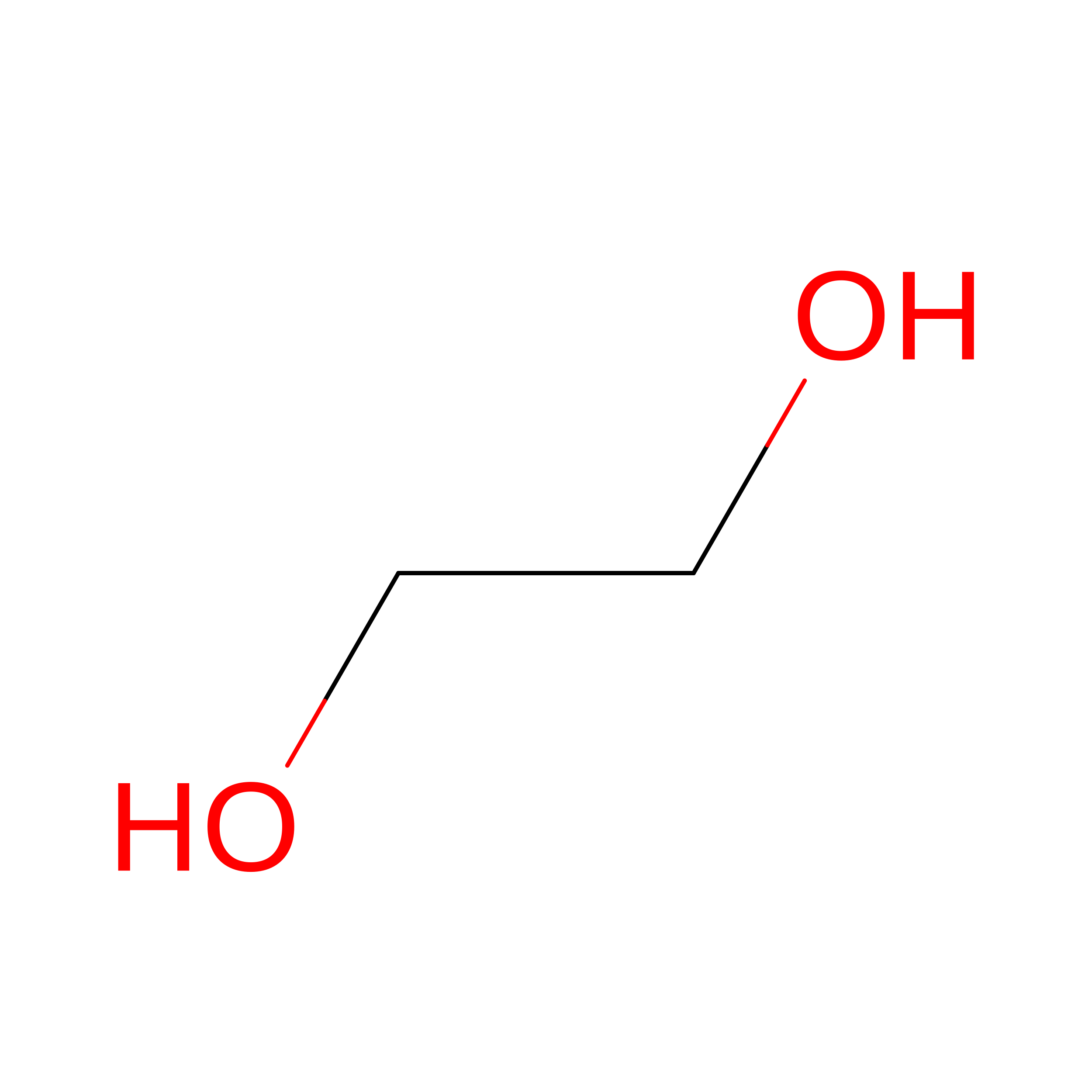
3HMF | pdb_00003hmf

Crystal Structure of the second Bromodomain of Human Poly-bromodomain containing protein 1 (PB1)


Experimental Data Snapshot

  • Method: X-RAY DIFFRACTION
  • Resolution: 1.63 Å
  • R-Value Free: 
    0.199 (Depositor), 0.191 (DCC) 
  • R-Value Work: 
    0.171 (Depositor), 0.165 (DCC) 
  • R-Value Observed: 
    0.172 (Depositor) 

Starting Models: experimental
View more details

wwPDB Validation 3D Report Full Report

Validation slider image for 3HMF

This is version 1.3 of the entry. See complete history

Literature

Histone recognition and large-scale structural analysis of the human bromodomain family.

Filippakopoulos, P.Picaud, S.Mangos, M.Keates, T.Lambert, J.P.Barsyte-Lovejoy, D.Felletar, I.Volkmer, R.Muller, S.Pawson, T.Gingras, A.C.Arrowsmith, C.H.Knapp, S.

(2012) Cell 149: 214-231

  • DOI: https://doi.org/10.1016/j.cell.2012.02.013
  • Primary Citation Related Structures: 
    2NXB, 2OO1, 2OSS, 2OUO, 2RFJ, 3D7C, 3DAI, 3DWY, 3GG3, 3HME, 3HMF, 3HMH, 3I3J, 3IU5, 3IU6, 3LXJ, 3MB3, 3MB4, 3MQM, 3NXB, 3P1C, 3P1D, 3Q2E, 3RCW, 3TLP, 3UV2, 3UV4, 3UV5, 3UVD, 3UVW, 3UVX, 3UVY, 3UW9

  • PubMed Abstract: 

    Bromodomains (BRDs) are protein interaction modules that specifically recognize ε-N-lysine acetylation motifs, a key event in the reading process of epigenetic marks. The 61 BRDs in the human genome cluster into eight families based on structure/sequence similarity. Here, we present 29 high-resolution crystal structures, covering all BRD families. Comprehensive crossfamily structural analysis identifies conserved and family-specific structural features that are necessary for specific acetylation-dependent substrate recognition. Screening of more than 30 representative BRDs against systematic histone-peptide arrays identifies new BRD substrates and reveals a strong influence of flanking posttranslational modifications, such as acetylation and phosphorylation, suggesting that BRDs recognize combinations of marks rather than singly acetylated sequences. We further uncovered a structural mechanism for the simultaneous binding and recognition of diverse diacetyl-containing peptides by BRD4. These data provide a foundation for structure-based drug design of specific inhibitors for this emerging target family.


  • Organizational Affiliation
    • Nuffield Department of Clinical Medicine, Structural Genomics Consortium, University of Oxford, Old Road Campus Research Building, Roosevelt Drive, Oxford OX3 7LD, UK. panagis.filippakopoulos@sgc.ox.ac.uk

Macromolecule Content 

  • Total Structure Weight: 13.5 kDa 
  • Atom Count: 1,148 
  • Modeled Residue Count: 116 
  • Deposited Residue Count: 116 
  • Unique protein chains: 1

Macromolecules

Find similar proteins by:|  3D Structure
Entity ID: 1
MoleculeChains  Sequence LengthOrganismDetailsImage
Protein polybromo-1116Homo sapiensMutation(s): 0 
Gene Names: PB1PBRM1
UniProt & NIH Common Fund Data Resources
Find proteins for Q86U86 (Homo sapiens)
Explore Q86U86 
Go to UniProtKB:  Q86U86
PHAROS:  Q86U86
GTEx:  ENSG00000163939 
Entity Groups
Sequence Clusters30% Identity50% Identity70% Identity90% Identity95% Identity100% Identity
UniProt GroupQ86U86
Sequence Annotations
Expand
Reference Sequence

Experimental Data & Validation

Experimental Data

  • Method: X-RAY DIFFRACTION
  • Resolution: 1.63 Å
  • R-Value Free:  0.199 (Depositor), 0.191 (DCC) 
  • R-Value Work:  0.171 (Depositor), 0.165 (DCC) 
  • R-Value Observed: 0.172 (Depositor) 
Space Group: C 1 2 1
Unit Cell:
Length ( Å )Angle ( ˚ )
a = 85.81α = 90
b = 49.36β = 97.91
c = 33.61γ = 90
Software Package:
Software NamePurpose
SCALAdata scaling
PHASERphasing
PHENIXrefinement
PDB_EXTRACTdata extraction
CrystalCleardata collection
MOSFLMdata reduction

Structure Validation

View Full Validation Report


Entry History 

Revision History  (Full details and data files)

  • Version 1.0: 2009-06-23
    Type: Initial release
  • Version 1.1: 2011-07-13
    Changes: Version format compliance
  • Version 1.2: 2012-04-11
    Changes: Database references
  • Version 1.3: 2023-11-01
    Changes: Data collection, Database references, Derived calculations, Refinement description