3IN9 | pdb_00003in9

Crystal structure of heparin lyase I complexed with disaccharide heparin


Experimental Data Snapshot

  • Method: X-RAY DIFFRACTION
  • Resolution: 2.00 Å
  • R-Value Free: 
    0.217 (Depositor), 0.216 (DCC) 
  • R-Value Work: 
    0.183 (Depositor), 0.182 (DCC) 

Starting Model: experimental
View more details

wwPDB Validation 3D Report Full Report

Validation slider image for 3IN9

This is version 2.1 of the entry. See complete history

Literature

Structural snapshots of heparin depolymerization by heparin lyase I

Han, Y.H.Garron, M.L.Kim, H.Y.Kim, W.S.Zhang, Z.Ryu, K.S.Shaya, D.Xiao, Z.Cheong, C.Kim, Y.S.Linhardt, R.J.Jeon, Y.H.Cygler, M.

(2009) J Biological Chem 284: 34019-34027

  • DOI: https://doi.org/10.1074/jbc.M109.025338
  • Primary Citation Related Structures: 
    3IKW, 3ILR, 3IMN, 3IN9, 3INA

  • PubMed Abstract: 

    Heparin lyase I (heparinase I) specifically depolymerizes heparin, cleaving the glycosidic linkage next to iduronic acid. Here, we show the crystal structures of heparinase I from Bacteroides thetaiotaomicron at various stages of the reaction with heparin oligosaccharides before and just after cleavage and product disaccharide. The heparinase I structure is comprised of a beta-jellyroll domain harboring a long and deep substrate binding groove and an unusual thumb-resembling extension. This thumb, decorated with many basic residues, is of particular importance in activity especially on short heparin oligosaccharides. Unexpected structural similarity of the active site to that of heparinase II with an (alpha/alpha)(6) fold is observed. Mutational studies and kinetic analysis of this enzyme provide insights into the catalytic mechanism, the substrate recognition, and processivity.


  • Organizational Affiliation
    • Magnetic Resonance Team, Korea Basic Science Institute, Ochang, Chungbuk 363-883, Korea.

Macromolecule Content 

  • Total Structure Weight: 44.03 kDa 
  • Atom Count: 3,352 
  • Modeled Residue Count: 373 
  • Deposited Residue Count: 378 
  • Unique protein chains: 1

Macromolecules

Find similar proteins by:|  3D Structure
Entity ID: 1
MoleculeChains  Sequence LengthOrganismDetailsImage
Heparin lyase I378Bacteroides thetaiotaomicronMutation(s): 0 
UniProt
Find proteins for Q89YQ6 (Bacteroides thetaiotaomicron (strain ATCC 29148 / DSM 2079 / JCM 5827 / CCUG 10774 / NCTC 10582 / VPI-5482 / E50))
Explore Q89YQ6 
Go to UniProtKB:  Q89YQ6
Entity Groups
Sequence Clusters30% Identity50% Identity70% Identity90% Identity95% Identity100% Identity
UniProt GroupQ89YQ6
Sequence Annotations
Expand
Reference Sequence

Oligosaccharides

Help  
Entity ID: 2
MoleculeChains Length2D Diagram GlycosylationD Interactions
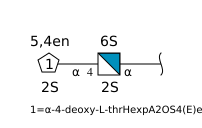
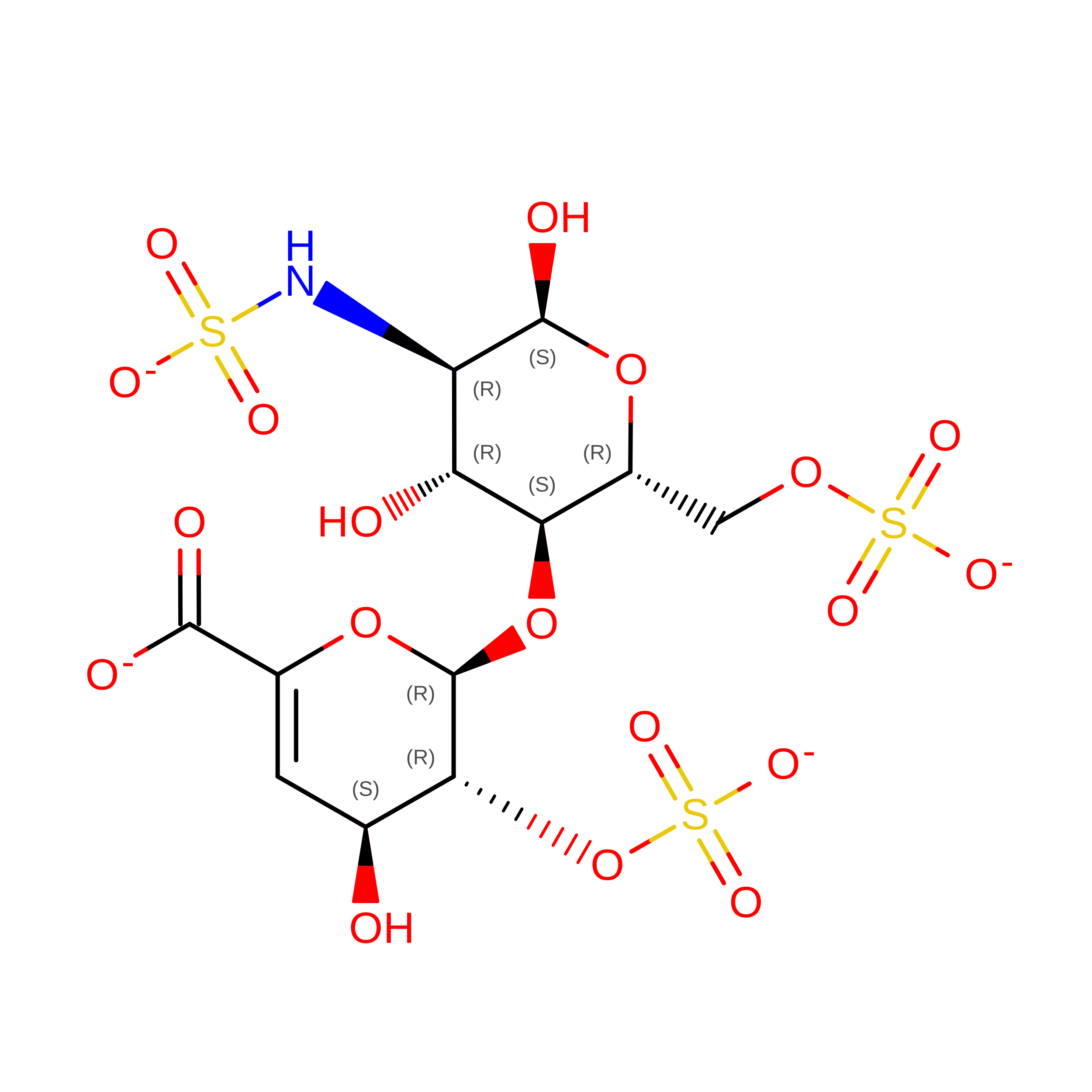
4-deoxy-2-O-sulfo-alpha-L-threo-hex-4-enopyranuronic acid-(1-4)-2-deoxy-6-O-sulfo-2-(sulfoamino)-alpha-D-glucopyranose
B, C
2N/A
Glycosylation Resources
GlyTouCan: G01871HO
GlyCosmos: G01871HO

Small Molecules

Ligands 1 Unique
IDChains Name / Formula / InChI Key2D Diagram3D Interactions
CA

Query on CA


Download:Ideal Coordinates CCD File
D [auth A]CALCIUM ION
Ca
BHPQYMZQTOCNFJ-UHFFFAOYSA-N

Biologically Interesting Molecules (External Reference) 

1 Unique

Experimental Data & Validation

Experimental Data

  • Method: X-RAY DIFFRACTION
  • Resolution: 2.00 Å
  • R-Value Free:  0.217 (Depositor), 0.216 (DCC) 
  • R-Value Work:  0.183 (Depositor), 0.182 (DCC) 
Space Group: C 1 2 1
Unit Cell:
Length ( Å )Angle ( ˚ )
a = 112.789α = 90
b = 63.531β = 115.47
c = 65.204γ = 90
Software Package:
Software NamePurpose
DENZOdata reduction
SCALEPACKdata scaling
MOLREPphasing
CNSrefinement
PDB_EXTRACTdata extraction

Structure Validation

View Full Validation Report


Entry History 

Deposition Data

Revision History  (Full details and data files)

  • Version 1.0: 2009-09-29
    Type: Initial release
  • Version 1.1: 2011-07-13
    Changes: Version format compliance
  • Version 1.2: 2017-11-01
    Changes: Refinement description
  • Version 2.0: 2020-07-29
    Type: Remediation
    Reason: Carbohydrate remediation
    Changes: Atomic model, Data collection, Derived calculations, Non-polymer description, Structure summary
  • Version 2.1: 2023-11-01
    Changes: Data collection, Database references, Refinement description, Structure summary