3HVF | pdb_00003hvf

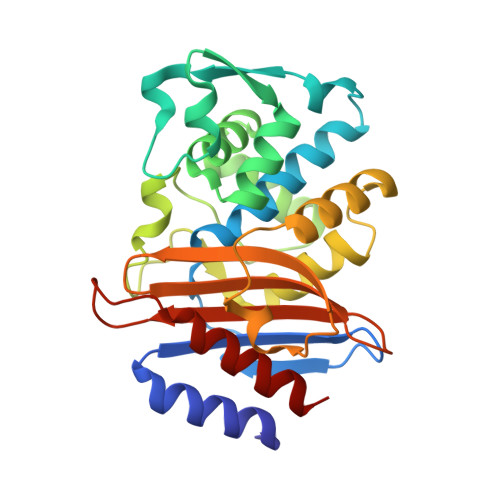
X-ray crystallographic structure of CTX-M-9 S70G in complex with hydrolyzed benzylpenicillin


Experimental Data Snapshot

  • Method: X-RAY DIFFRACTION
  • Resolution: 1.50 Å
  • R-Value Free: 
    0.176 (Depositor), 0.175 (DCC) 
  • R-Value Work: 
    0.146 (Depositor), 0.144 (DCC) 
  • R-Value Observed: 
    0.147 (Depositor) 

wwPDB Validation 3D Report Full Report

Validation slider image for 3HVF

Ligand Structure Quality Assessment 


This is version 1.6 of the entry. See complete history

Literature

Structural insights into substrate recognition and product expulsion in CTX-M enzymes.

Delmas, J.Leyssene, D.Dubois, D.Birck, C.Vazeille, E.Robin, F.Bonnet, R.

(2010) J Mol Biology 400: 108-120

  • DOI: https://doi.org/10.1016/j.jmb.2010.04.062

  • PubMed Abstract: 

    beta-Lactamase-mediated resistance to beta-lactam antibiotics poses a major threat to our antibiotic armamentarium. Among beta-lactamases, a significant threat comes from enzymes that hydrolyze extended-spectrum cephalosporins such as cefotaxime. Among the enzymes that exhibit this phenotype, the CTX-M family is found worldwide. These enzymes have a small active site, which makes it difficult to explain how they hydrolyze the bulky extended-spectrum cephalosporins into the binding site. We investigated noncovalent substrate recognition and product release in CTX-M enzymes using steered molecular dynamics simulation and X-ray diffraction. An arginine residue located far from the binding site favors the capture and tracking of substrates during entrance into the catalytic pocket. We show that the accommodation of extended-spectrum cephalosporins by CTX-M enzymes induced subtle changes in the active site and established a high density of electrostatic interactions. Interestingly, the product of the catalytic reaction initiates its own release because of steric hindrances and electrostatic repulsions. This suggests that there exists a general mechanism for product release for all members of the beta-lactamase family and probably for most carboxypeptidases.


  • Organizational Affiliation
    • CHU Clermont-Ferrand, Laboratoire de Bactériologie, Clermont-Ferrand F-63003, France.

Macromolecule Content 

  • Total Structure Weight: 56.59 kDa 
  • Atom Count: 4,893 
  • Modeled Residue Count: 525 
  • Deposited Residue Count: 526 
  • Unique protein chains: 1

Macromolecules

Find similar proteins by:|  3D Structure
Entity ID: 1
MoleculeChains  Sequence LengthOrganismDetailsImage
CTX-M-9 extended-spectrum beta-lactamase
A, B
263Escherichia coliMutation(s): 1 
Gene Names: blaCTX-M-9blaCTX-M-9ablaCTX-M-9b
EC: 3.5.2.6
UniProt
Find proteins for Q9L5C8 (Escherichia coli)
Explore Q9L5C8 
Go to UniProtKB:  Q9L5C8
Entity Groups
Sequence Clusters30% Identity50% Identity70% Identity90% Identity95% Identity100% Identity
UniProt GroupQ9L5C8
Sequence Annotations
Expand
Reference Sequence

Small Molecules

Ligands 1 Unique
IDChains Name / Formula / InChI Key2D Diagram3D Interactions
PNK

Query on PNK


Download:Ideal Coordinates CCD File
C [auth A],
D [auth B]
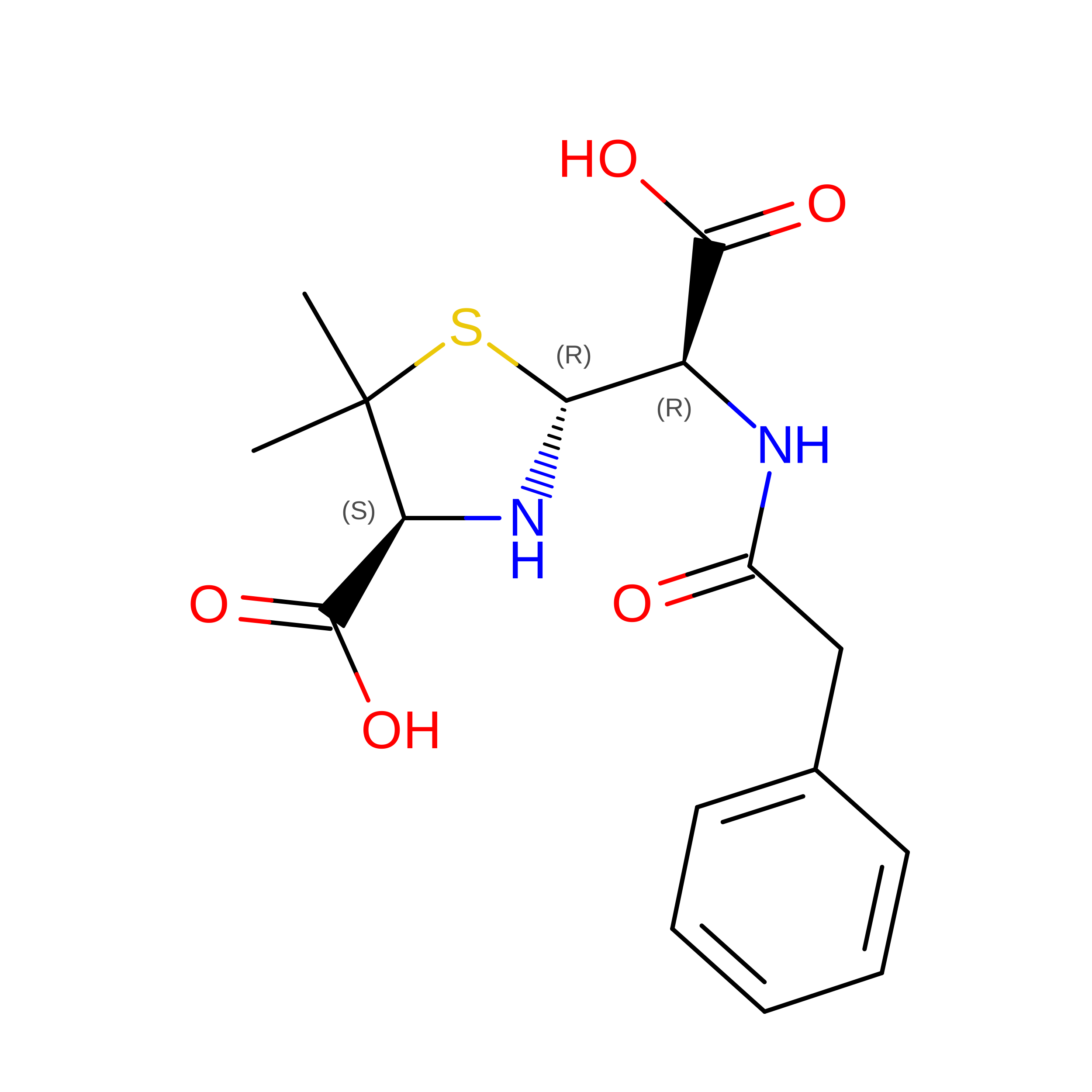
(2R,4S)-2-{(R)-carboxy[(phenylacetyl)amino]methyl}-5,5-dimethyl-1,3-thiazolidine-4-carboxylic acid
C16 H20 N2 O5 S
HCYWNSXLUZRKJX-RWMBFGLXSA-N

Experimental Data & Validation

Experimental Data

  • Method: X-RAY DIFFRACTION
  • Resolution: 1.50 Å
  • R-Value Free:  0.176 (Depositor), 0.175 (DCC) 
  • R-Value Work:  0.146 (Depositor), 0.144 (DCC) 
  • R-Value Observed: 0.147 (Depositor) 
Space Group: P 1 21 1
Unit Cell:
Length ( Å )Angle ( ˚ )
a = 45.223α = 90
b = 106.938β = 101.76
c = 47.827γ = 90
Software Package:
Software NamePurpose
DENZOdata reduction
SCALEPACKdata scaling
MOLREPphasing
REFMACrefinement
PDB_EXTRACTdata extraction
DNAdata collection

Structure Validation

View Full Validation Report


Ligand Structure Quality Assessment 


Entry History 

Deposition Data

Revision History  (Full details and data files)

  • Version 1.0: 2010-05-26
    Type: Initial release
  • Version 1.1: 2011-07-13
    Changes: Version format compliance
  • Version 1.2: 2012-05-23
    Changes: Advisory, Non-polymer description
  • Version 1.3: 2013-11-06
    Changes: Database references
  • Version 1.4: 2017-11-01
    Changes: Refinement description
  • Version 1.5: 2021-11-10
    Changes: Database references, Derived calculations
  • Version 1.6: 2024-05-29
    Changes: Data collection