3ZS6 | pdb_00003zs6

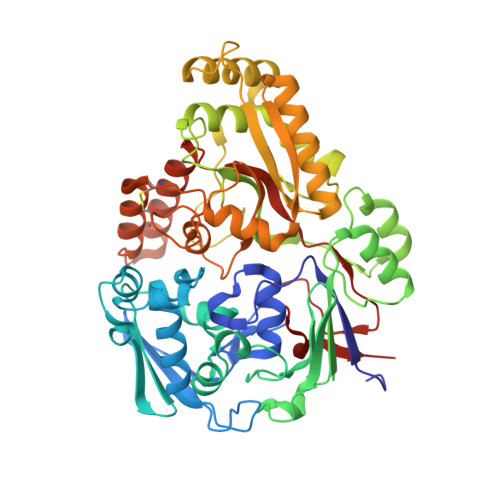
The Structural characterization of Burkholderia pseudomallei OppA.


Experimental Data Snapshot

  • Method: X-RAY DIFFRACTION
  • Resolution: 2.10 Å
  • R-Value Free: 
    0.209 (Depositor), 0.201 (DCC) 
  • R-Value Work: 
    0.158 (Depositor), 0.154 (DCC) 
  • R-Value Observed: 
    0.160 (Depositor) 

Starting Model: experimental
View more details

wwPDB Validation 3D Report Full Report

Validation slider image for 3ZS6

This is version 1.4 of the entry. See complete history

Literature

A Structure-Based Strategy for Epitope Discovery in Burkholderia Pseudomallei Oppa Antigen.

Lassaux, P.Peri, C.Ferrer-Navarro, M.Gourlay, L.J.Gori, A.Conchillo-Sole, O.Rinchai, D.Lertmemongkolchai, G.Longhi, R.Daura, X.Colombo, G.Bolognesi, M.

(2013) Structure 21: 167

  • DOI: https://doi.org/10.1016/j.str.2012.10.005
  • Primary Citation Related Structures: 
    3ZS6

  • PubMed Abstract: 

    We present an approach integrating structural and computational biology with immunological tests to identify epitopes in the OppA antigen from the Gram-negative pathogen Burkholderia pseudomallei, the etiological agent of melioidosis. The crystal structure of OppA(Bp), reported here at 2.1 Å resolution, was the basis for a computational analysis that identified three potential epitopes. In parallel, antigen proteolysis and immunocapturing allowed us to identify three additional peptides. All six potential epitopes were synthesized as free peptides and tested for their immunoreactivity against sera from healthy seronegative, healthy seropositive, and recovered melioidosis patients. Three synthetic peptides allowed the different patient groups to be distinguished, underlining the potential of this approach. Extension of the computational analysis, including energy-based decomposition methods, allowed rationalizing results of the predictive analyses and the immunocapture epitope mapping. Our results illustrate a structure-based epitope discovery process, whose application may expand our perspectives in the diagnostic and vaccine design fields.


  • Organizational Affiliation
    • Department of Biosciences, University of Milan, Milan 20133, Italy.

Macromolecule Content 

  • Total Structure Weight: 57.45 kDa 
  • Atom Count: 4,327 
  • Modeled Residue Count: 509 
  • Deposited Residue Count: 509 
  • Unique protein chains: 2

Macromolecules

Find similar proteins by:|  3D Structure
Entity ID: 1
MoleculeChains  Sequence LengthOrganismDetailsImage
PERIPLASMIC OLIGOPEPTIDE-BINDING PROTEIN506Burkholderia pseudomalleiMutation(s): 0 
UniProt
Find proteins for Q63ID0 (Burkholderia pseudomallei (strain K96243))
Explore Q63ID0 
Go to UniProtKB:  Q63ID0
Entity Groups
Sequence Clusters30% Identity50% Identity70% Identity90% Identity95% Identity100% Identity
UniProt GroupQ63ID0
Sequence Annotations
Expand
Reference Sequence
Find similar proteins by:  Sequence   |   3D Structure  
Entity ID: 2
MoleculeChains  Sequence LengthOrganismDetailsImage
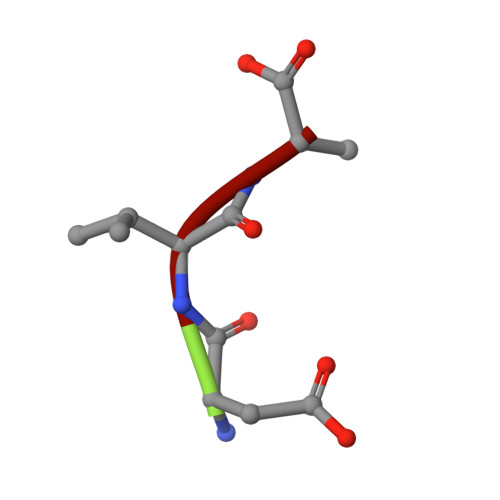
OLIGOPEPTIDE DVA3unidentifiedMutation(s): 0 

Experimental Data & Validation

Experimental Data

  • Method: X-RAY DIFFRACTION
  • Resolution: 2.10 Å
  • R-Value Free:  0.209 (Depositor), 0.201 (DCC) 
  • R-Value Work:  0.158 (Depositor), 0.154 (DCC) 
  • R-Value Observed: 0.160 (Depositor) 
Space Group: P 1 21 1
Unit Cell:
Length ( Å )Angle ( ˚ )
a = 46.86α = 90
b = 81.93β = 104.34
c = 74.18γ = 90
Software Package:
Software NamePurpose
PHENIXrefinement
iMOSFLMdata reduction
SCALAdata scaling
PHASERphasing

Structure Validation

View Full Validation Report


Entry History 

Deposition Data

Revision History  (Full details and data files)

  • Version 1.0: 2012-07-04
    Type: Initial release
  • Version 1.1: 2013-01-09
    Changes: Database references, Structure summary
  • Version 1.2: 2013-01-23
    Changes: Database references
  • Version 1.3: 2023-12-20
    Changes: Data collection, Database references, Derived calculations, Other, Refinement description
  • Version 1.4: 2024-11-13
    Changes: Structure summary