Download Mendeley
The Interaction of Isopenicillin N Synthase with Homologated Substrate Analogues Delta-(L-Alpha-Aminoadipoyl)-L-Homocysteinyl-D-Xaa Characterised by Protein Crystallography.
Daruzzaman, A., Clifton, I.J., Adlington, R.M., Baldwin, J.E., Rutledge, P.J.(2013) Chembiochem 14: 599
- PubMed: 23468426 Search on PubMed
- DOI: https://doi.org/10.1002/cbic.201200728
- Primary Citation Related Structures:
3ZKU, 3ZKY - PubMed Abstract:
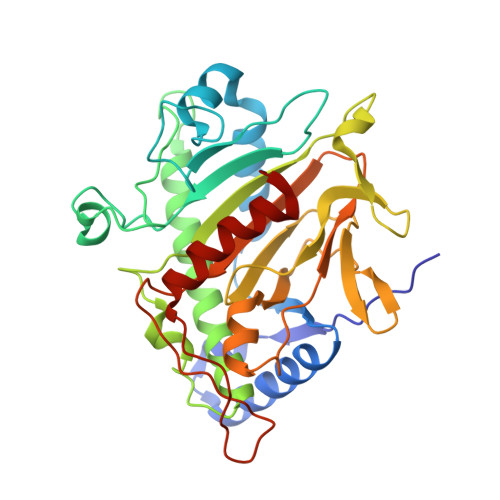
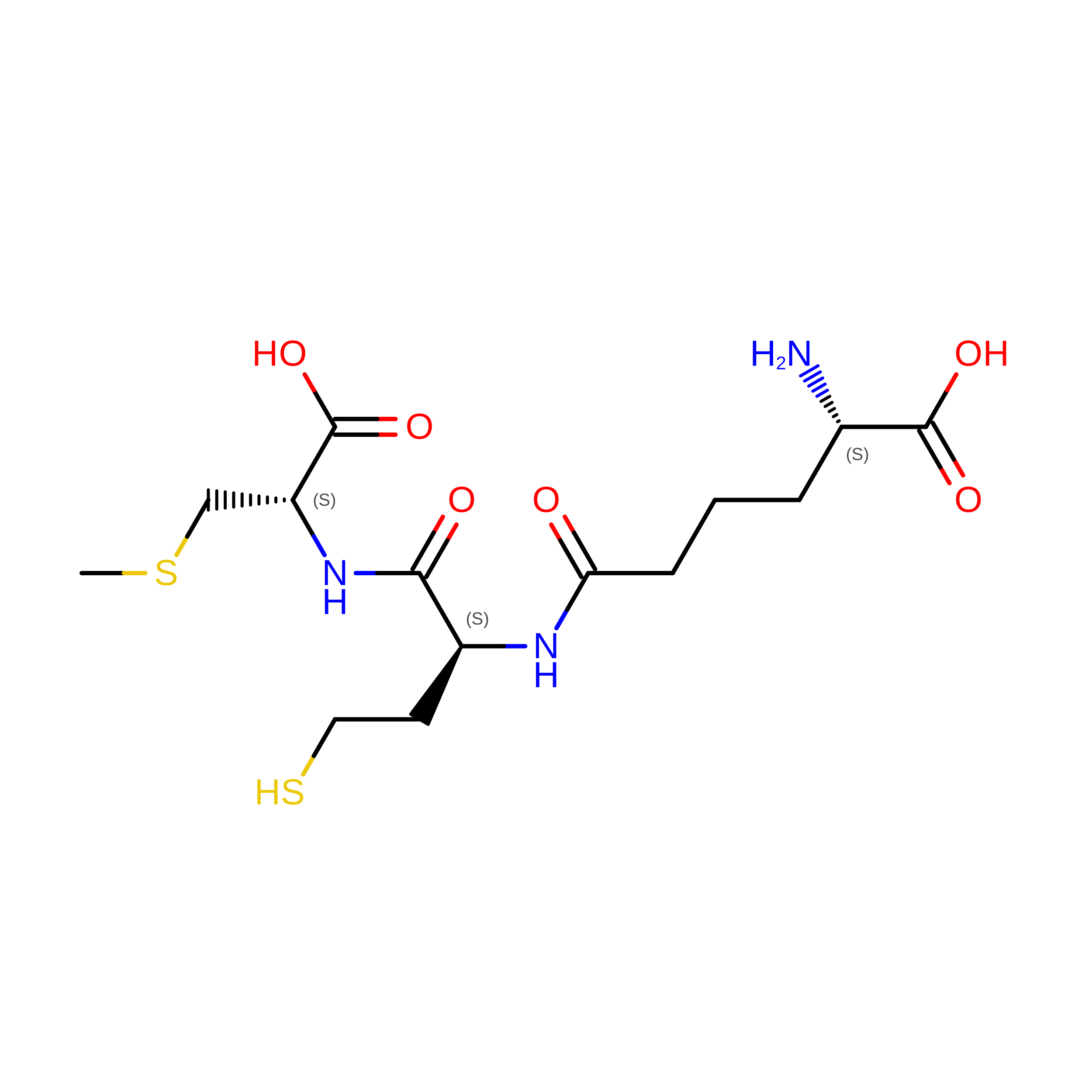
Isopenicillin N synthase (IPNS) converts the linear tripeptide δ-(L-α-aminoadipoyl)-L-cysteinyl-D-valine (ACV) into bicyclic isopenicillin N (IPN) in the central step in the biosynthesis of penicillin and cephalosporin antibiotics. Solution-phase incubation experiments have shown that IPNS turns over analogues with a diverse range of side chains in the third (valinyl) position of the substrate, but copes less well with changes in the second (cysteinyl) residue. IPNS thus converts the homologated tripeptides δ-(L-α-aminoadipoyl)-L-homocysteinyl-D-valine (AhCV) and δ-(L-α-aminoadipoyl)-L-homocysteinyl-D-allylglycine (AhCaG) into monocyclic hydroxy-lactam products; this suggests that the additional methylene unit in these substrates induces conformational changes that preclude second ring closure after initial lactam formation. To investigate this and solution-phase results with other tripeptides δ-(L-α-aminoadipoyl)-L-homocysteinyl-D-Xaa, we have crystallised AhCV and δ-(L-α-aminoadipoyl)-L-homocysteinyl-D-S-methylcysteine (AhCmC) with IPNS and solved crystal structures for the resulting complexes. The IPNS:Fe(II):AhCV complex shows diffuse electron density for several regions of the substrate, revealing considerable conformational freedom within the active site. The substrate is more clearly resolved in the IPNS:Fe(II):AhCmC complex, by virtue of thioether coordination to iron. AhCmC occupies two distinct conformations, both distorted relative to the natural substrate ACV, in order to accommodate the extra methylene group in the second residue. Attempts to turn these substrates over within crystalline IPNS using hyperbaric oxygenation give rise to product mixtures.
- Chemistry Research Laboratory, University of Oxford, Mansfield Rd, Oxford, OX1 3TA, UK.
Organizational Affiliation: