3ZID | pdb_00003zid

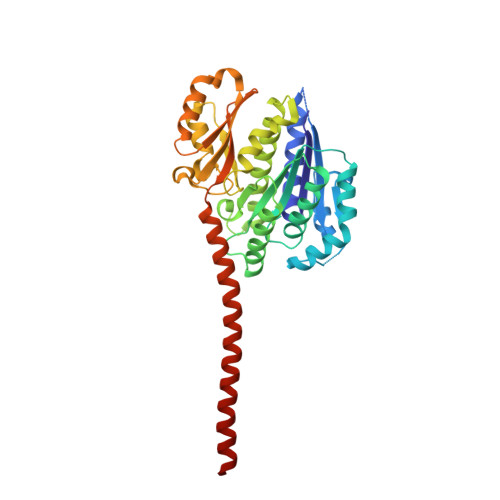
CetZ from Methanosaeta thermophila strain DSM 6194


Experimental Data Snapshot

  • Method: X-RAY DIFFRACTION
  • Resolution: 2.00 Å
  • R-Value Free: 
    0.229 (Depositor), 0.178 (DCC) 
  • R-Value Work: 
    0.182 (Depositor), 0.186 (DCC) 
  • R-Value Observed: 
    0.184 (Depositor) 

Starting Model: experimental
View more details

wwPDB Validation 3D Report Full Report

Validation slider image for 3ZID

Ligand Structure Quality Assessment 


This is version 1.4 of the entry. See complete history

Literature

Cetz Tubulin-Like Proteins Control Archaeal Cell Shape

Duggin, I.G.Aylett, C.H.S.Walsh, J.C.Michie, K.A.Wang, Q.Turnbull, L.Dawson, E.M.Harry, E.J.Whitchurch, C.B.Amos, A.Lowe, J.

(2015) Nature 519: 362

  • DOI: https://doi.org/10.1038/nature13983
  • Primary Citation Related Structures: 
    3ZID, 4B45, 4B46

  • PubMed Abstract: 

    Tubulin is a major component of the eukaryotic cytoskeleton, controlling cell shape, structure and dynamics, whereas its bacterial homologue FtsZ establishes the cytokinetic ring that constricts during cell division. How such different roles of tubulin and FtsZ evolved is unknown. Studying Archaea may provide clues as these organisms share characteristics with Eukarya and Bacteria. Here we report the structure and function of proteins from a distinct family related to tubulin and FtsZ, named CetZ, which co-exists with FtsZ in many archaea. CetZ X-ray crystal structures showed the FtsZ/tubulin superfamily fold, and one crystal form contained sheets of protofilaments, suggesting a structural role. However, inactivation of CetZ proteins in Haloferax volcanii did not affect cell division. Instead, CetZ1 was required for differentiation of the irregular plate-shaped cells into a rod-shaped cell type that was essential for normal swimming motility. CetZ1 formed dynamic cytoskeletal structures in vivo, relating to its capacity to remodel the cell envelope and direct rod formation. CetZ2 was also implicated in H. volcanii cell shape control. Our findings expand the known roles of the FtsZ/tubulin superfamily to include archaeal cell shape dynamics, suggesting that a cytoskeletal role might predate eukaryotic cell evolution, and they support the premise that a major function of the microbial rod shape is to facilitate swimming.


  • Organizational Affiliation
    • 1] Medical Research Council Laboratory of Molecular Biology, Francis Crick Avenue, Cambridge CB2 0QH, UK [2] The ithree institute, University of Technology Sydney, New South Wales 2007, Australia.

Macromolecule Content 

  • Total Structure Weight: 85.17 kDa 
  • Atom Count: 5,772 
  • Modeled Residue Count: 702 
  • Deposited Residue Count: 746 
  • Unique protein chains: 1

Macromolecules

Find similar proteins by:|  3D Structure
Entity ID: 1
MoleculeChains  Sequence LengthOrganismDetailsImage
TUBULIN/FTSZ, GTPASE
A, B
373Methanothrix thermoacetophilaMutation(s): 0 
UniProt
Find proteins for A0B5R2 (Methanothrix thermoacetophila (strain DSM 6194 / JCM 14653 / NBRC 101360 / PT))
Explore A0B5R2 
Go to UniProtKB:  A0B5R2
Entity Groups
Sequence Clusters30% Identity50% Identity70% Identity90% Identity95% Identity100% Identity
UniProt GroupA0B5R2
Sequence Annotations
Expand
Reference Sequence

Experimental Data & Validation

Experimental Data

  • Method: X-RAY DIFFRACTION
  • Resolution: 2.00 Å
  • R-Value Free:  0.229 (Depositor), 0.178 (DCC) 
  • R-Value Work:  0.182 (Depositor), 0.186 (DCC) 
  • R-Value Observed: 0.184 (Depositor) 
Space Group: P 1 21 1
Unit Cell:
Length ( Å )Angle ( ˚ )
a = 44.547α = 90
b = 107.011β = 91.42
c = 76.966γ = 90
Software Package:
Software NamePurpose
PHENIXrefinement
XDSdata reduction
SCALAdata scaling
PHASERphasing

Structure Validation

View Full Validation Report


Ligand Structure Quality Assessment 


Entry History 

Deposition Data

Revision History  (Full details and data files)

  • Version 1.0: 2013-08-14
    Type: Initial release
  • Version 1.1: 2014-12-17
    Changes: Database references
  • Version 1.2: 2015-01-14
    Changes: Database references
  • Version 1.3: 2015-03-25
    Changes: Database references
  • Version 1.4: 2024-05-01
    Changes: Data collection, Database references, Derived calculations, Other, Refinement description