3WPW | pdb_00003wpw

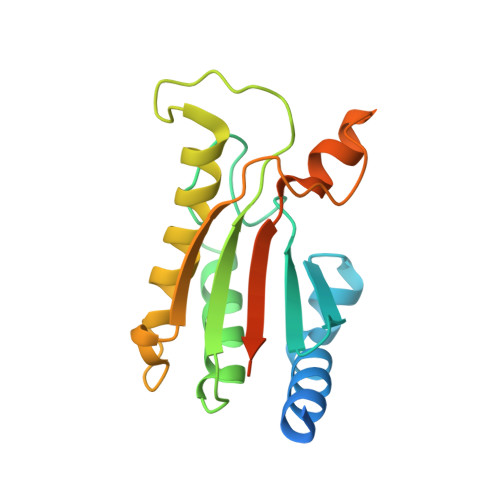
Structure of PomBc5, a periplasmic fragment of PomB from Vibrio


Experimental Data Snapshot

  • Method: X-RAY DIFFRACTION
  • Resolution: 2.00 Å
  • R-Value Free: 
    0.238 (Depositor), 0.256 (DCC) 
  • R-Value Work: 
    0.187 (Depositor) 
  • R-Value Observed: 
    0.193 (Depositor) 

wwPDB Validation 3D Report Full Report

Validation slider image for 3WPW

This is version 1.5 of the entry. See complete history

Literature

Conformational change in the periplasmic region of the flagellar stator coupled with the assembly around the rotor

Zhu, S.Takao, M.Li, N.Sakuma, M.Nishino, Y.Homma, M.Kojima, S.Imada, K.

(2014) Proc Natl Acad Sci U S A 111: 13523-13528

  • DOI: https://doi.org/10.1073/pnas.1324201111
  • Primary Citation Related Structures: 
    3WPW, 3WPX

  • PubMed Abstract: 

    The torque of the bacterial flagellum is generated by the rotor-stator interaction coupled with the ion flow through the channel in the stator. Anchoring the stator unit to the peptidoglycan layer with proper orientation around the rotor is believed to be essential for smooth rotation of the flagellar motor. The stator unit of the sodium-driven flagellar motor of Vibrio is composed of PomA and PomB, and is thought to be fixed to the peptidoglycan layer and the T-ring by the C-terminal periplasmic region of PomB. Here, we report the crystal structure of a C-terminal fragment of PomB (PomBC) at 2.0-Å resolution, and the structure suggests a conformational change in the N-terminal region of PomBC for anchoring the stator. On the basis of the structure, we designed double-Cys replaced mutants of PomB for in vivo disulfide cross-linking experiments and examined their motility. The motility can be controlled reproducibly by reducing reagent. The results of these experiments suggest that the N-terminal disordered region (121-153) and following the N-terminal two-thirds of α1(154-164) in PomBC changes its conformation to form a functional stator around the rotor. The cross-linking did not affect the localization of the stator nor the ion conductivity, suggesting that the conformational change occurs in the final step of the stator assembly around the rotor.


  • Organizational Affiliation
    • Division of Biological Science, Graduate School of Science, Nagoya University, Chikusa-Ku, Nagoya 464-8602, Japan; and.

Macromolecule Content 

  • Total Structure Weight: 43.09 kDa 
  • Atom Count: 2,543 
  • Modeled Residue Count: 298 
  • Deposited Residue Count: 374 
  • Unique protein chains: 1

Macromolecules

Find similar proteins by:|  3D Structure
Entity ID: 1
MoleculeChains  Sequence LengthOrganismDetailsImage
PomB
A, B
187Vibrio alginolyticusMutation(s): 0 
Gene Names: pomB
UniProt
Find proteins for O06874 (Vibrio alginolyticus)
Explore O06874 
Go to UniProtKB:  O06874
Entity Groups
Sequence Clusters30% Identity50% Identity70% Identity90% Identity95% Identity100% Identity
UniProt GroupO06874
Sequence Annotations
Expand
Reference Sequence

Small Molecules

Ligands 1 Unique
IDChains Name / Formula / InChI Key2D Diagram3D Interactions
ACT

Query on ACT


Download:Ideal Coordinates CCD File
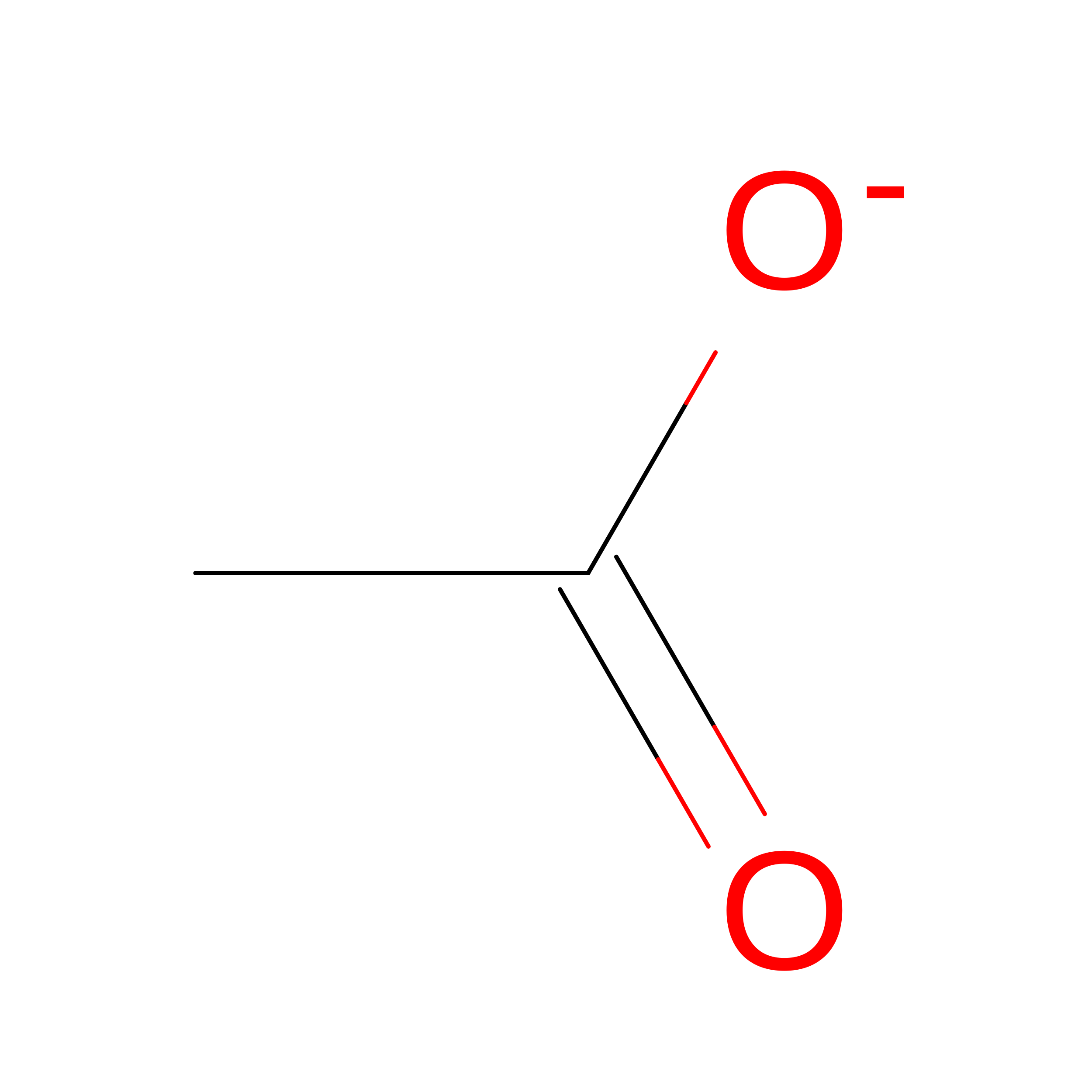
C [auth A]ACETATE ION
C2 H3 O2
QTBSBXVTEAMEQO-UHFFFAOYSA-M

Experimental Data & Validation

Experimental Data

  • Method: X-RAY DIFFRACTION
  • Resolution: 2.00 Å
  • R-Value Free:  0.238 (Depositor), 0.256 (DCC) 
  • R-Value Work:  0.187 (Depositor) 
  • R-Value Observed: 0.193 (Depositor) 
Space Group: P 21 21 21
Unit Cell:
Length ( Å )Angle ( ˚ )
a = 58.624α = 90
b = 63.302β = 90
c = 77.002γ = 90
Software Package:
Software NamePurpose
BSSdata collection
Cootmodel building
PHENIXmodel building
PHENIXrefinement
MOSFLMdata reduction
SCALAdata scaling
PHENIXphasing

Structure Validation

View Full Validation Report


Entry History 

Deposition Data

Revision History  (Full details and data files)

  • Version 1.0: 2014-09-10
    Type: Initial release
  • Version 1.1: 2015-12-09
    Changes: Database references
  • Version 1.2: 2015-12-16
    Changes: Other
  • Version 1.3: 2015-12-23
    Changes: Other
  • Version 1.4: 2017-09-13
    Changes: Database references
  • Version 1.5: 2024-03-20
    Changes: Data collection, Database references, Derived calculations