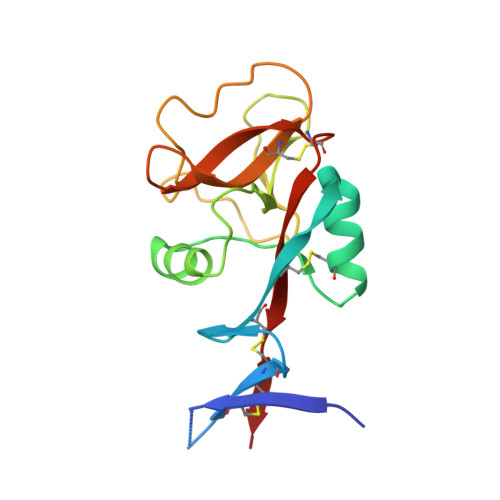
3WHD | pdb_00003whd

C-type lectin, human MCL


Experimental Data Snapshot

  • Method: X-RAY DIFFRACTION
  • Resolution: 2.29 Å
  • R-Value Free: 
    0.218 (Depositor), 0.218 (DCC) 
  • R-Value Work: 
    0.176 (Depositor), 0.177 (DCC) 
  • R-Value Observed: 
    0.178 (Depositor) 

wwPDB Validation 3D Report Full Report

Validation slider image for 3WHD

This is version 1.2 of the entry. See complete history

Literature

Structural analysis for glycolipid recognition by the C-type lectins Mincle and MCL

Furukawa, A.Kamishikiryo, J.Mori, D.Toyonaga, K.Okabe, Y.Toji, A.Kanda, R.Miyake, Y.Ose, T.Yamasaki, S.Maenaka, K.

(2013) Proc Natl Acad Sci U S A 110: 17438-17443

  • DOI: https://doi.org/10.1073/pnas.1312649110
  • Primary Citation Related Structures: 
    3WH2, 3WH3, 3WHD

  • PubMed Abstract: 

    Mincle [macrophage inducible Ca(2+)-dependent (C-type) lectin; CLEC4E] and MCL (macrophage C-type lectin; CLEC4D) are receptors for the cord factor TDM (trehalose-6,6'-dimycolate), a unique glycolipid of mycobacterial cell-surface components, and activate immune cells to confer adjuvant activity. Although it is known that receptor-TDM interactions require both sugar and lipid moieties of TDM, the mechanisms of glycolipid recognition by Mincle and MCL remain unclear. We here report the crystal structures of Mincle, MCL, and the Mincle-citric acid complex. The structures revealed that these receptors are capable of interacting with sugar in a Ca(2+)-dependent manner, as observed in other C-type lectins. However, Mincle and MCL uniquely possess shallow hydrophobic regions found adjacent to their putative sugar binding sites, which reasonably locate for recognition of fatty acid moieties of glycolipids. Functional studies using mutant receptors as well as glycolipid ligands support this deduced binding mode. These results give insight into the molecular mechanism of glycolipid recognition through C-type lectin receptors, which may provide clues to rational design for effective adjuvants.


  • Organizational Affiliation
    • Laboratory of Biomolecular Science, Faculty of Pharmaceutical Sciences, Hokkaido University, Sapporo 060-0812, Japan.

Macromolecule Content 

  • Total Structure Weight: 36.61 kDa 
  • Atom Count: 2,659 
  • Modeled Residue Count: 293 
  • Deposited Residue Count: 312 
  • Unique protein chains: 1

Macromolecules

Find similar proteins by:|  3D Structure
Entity ID: 1
MoleculeChains  Sequence LengthOrganismDetailsImage
C-type lectin domain family 4 member DA,
B [auth C]
156Homo sapiensMutation(s): 0 
Gene Names: CLEC4D
UniProt & NIH Common Fund Data Resources
Find proteins for Q8WXI8 (Homo sapiens)
Explore Q8WXI8 
Go to UniProtKB:  Q8WXI8
PHAROS:  Q8WXI8
GTEx:  ENSG00000166527 
Entity Groups
Sequence Clusters30% Identity50% Identity70% Identity90% Identity95% Identity100% Identity
UniProt GroupQ8WXI8
Sequence Annotations
Expand
Reference Sequence

Experimental Data & Validation

Experimental Data

  • Method: X-RAY DIFFRACTION
  • Resolution: 2.29 Å
  • R-Value Free:  0.218 (Depositor), 0.218 (DCC) 
  • R-Value Work:  0.176 (Depositor), 0.177 (DCC) 
  • R-Value Observed: 0.178 (Depositor) 
Space Group: I 2 2 2
Unit Cell:
Length ( Å )Angle ( ˚ )
a = 85.19α = 90
b = 96.056β = 90
c = 104.826γ = 90
Software Package:
Software NamePurpose
HKL-2000data collection
MOLREPphasing
PHENIXrefinement
HKL-2000data reduction
HKL-2000data scaling

Structure Validation

View Full Validation Report


Entry History 

Deposition Data

Revision History  (Full details and data files)

  • Version 1.0: 2013-10-23
    Type: Initial release
  • Version 1.1: 2013-12-11
    Changes: Database references
  • Version 1.2: 2024-10-30
    Changes: Data collection, Database references, Derived calculations, Structure summary