3WG8 | pdb_00003wg8

Crystal structure of the abscisic acid receptor PYR1 in complex with an antagonist AS6


Experimental Data Snapshot

  • Method: X-RAY DIFFRACTION
  • Resolution: 2.30 Å
  • R-Value Free: 
    0.281 (Depositor), 0.267 (DCC) 
  • R-Value Work: 
    0.237 (Depositor) 
  • R-Value Observed: 
    0.239 (Depositor) 

Starting Model: experimental
View more details

wwPDB Validation 3D Report Full Report

Validation slider image for 3WG8

Ligand Structure Quality Assessment 


This is version 1.2 of the entry. See complete history

Literature

Designed abscisic acid analogs as antagonists of PYL-PP2C receptor interactions

Takeuchi, J.Okamoto, M.Akiyama, T.Muto, T.Yajima, S.Sue, M.Seo, M.Kanno, Y.Kamo, T.Endo, A.Nambara, E.Hirai, N.Ohnishi, T.Cutler, S.R.Todoroki, Y.

(2014) Nat Chem Biol 10: 477-482

  • DOI: https://doi.org/10.1038/nchembio.1524
  • Primary Citation Related Structures: 
    3WG8

  • PubMed Abstract: 

    The plant stress hormone abscisic acid (ABA) is critical for several abiotic stress responses. ABA signaling is normally repressed by group-A protein phosphatases 2C (PP2Cs), but stress-induced ABA binds Arabidopsis PYR/PYL/RCAR (PYL) receptors, which then bind and inhibit PP2Cs. X-ray structures of several receptor-ABA complexes revealed a tunnel above ABA's 3' ring CH that opens at the PP2C binding interface. Here, ABA analogs with sufficiently long 3' alkyl chains were predicted to traverse this tunnel and block PYL-PP2C interactions. To test this, a series of 3'-alkylsulfanyl ABAs were synthesized with different alkyl chain lengths. Physiological, biochemical and structural analyses revealed that a six-carbon alkyl substitution produced a potent ABA antagonist that was sufficiently active to block multiple stress-induced ABA responses in vivo. This study provides a new approach for the design of ABA analogs, and the results validated structure-based design for this target class.


  • Organizational Affiliation
    • 1] Graduate School of Science and Technology, Shizuoka University, Shizuoka, Japan. [2].

Macromolecule Content 

  • Total Structure Weight: 25.81 kDa 
  • Atom Count: 1,467 
  • Modeled Residue Count: 175 
  • Deposited Residue Count: 227 
  • Unique protein chains: 1

Macromolecules

Find similar proteins by:|  3D Structure
Entity ID: 1
MoleculeChains  Sequence LengthOrganismDetailsImage
Abscisic acid receptor PYR1227Arabidopsis thalianaMutation(s): 0 
Gene Names: PYR1
UniProt
Find proteins for O49686 (Arabidopsis thaliana)
Explore O49686 
Go to UniProtKB:  O49686
Entity Groups
Sequence Clusters30% Identity50% Identity70% Identity90% Identity95% Identity100% Identity
UniProt GroupO49686
Sequence Annotations
Expand
Reference Sequence

Small Molecules

Ligands 1 Unique
IDChains Name / Formula / InChI Key2D Diagram3D Interactions
6AS

Query on 6AS


Download:Ideal Coordinates CCD File
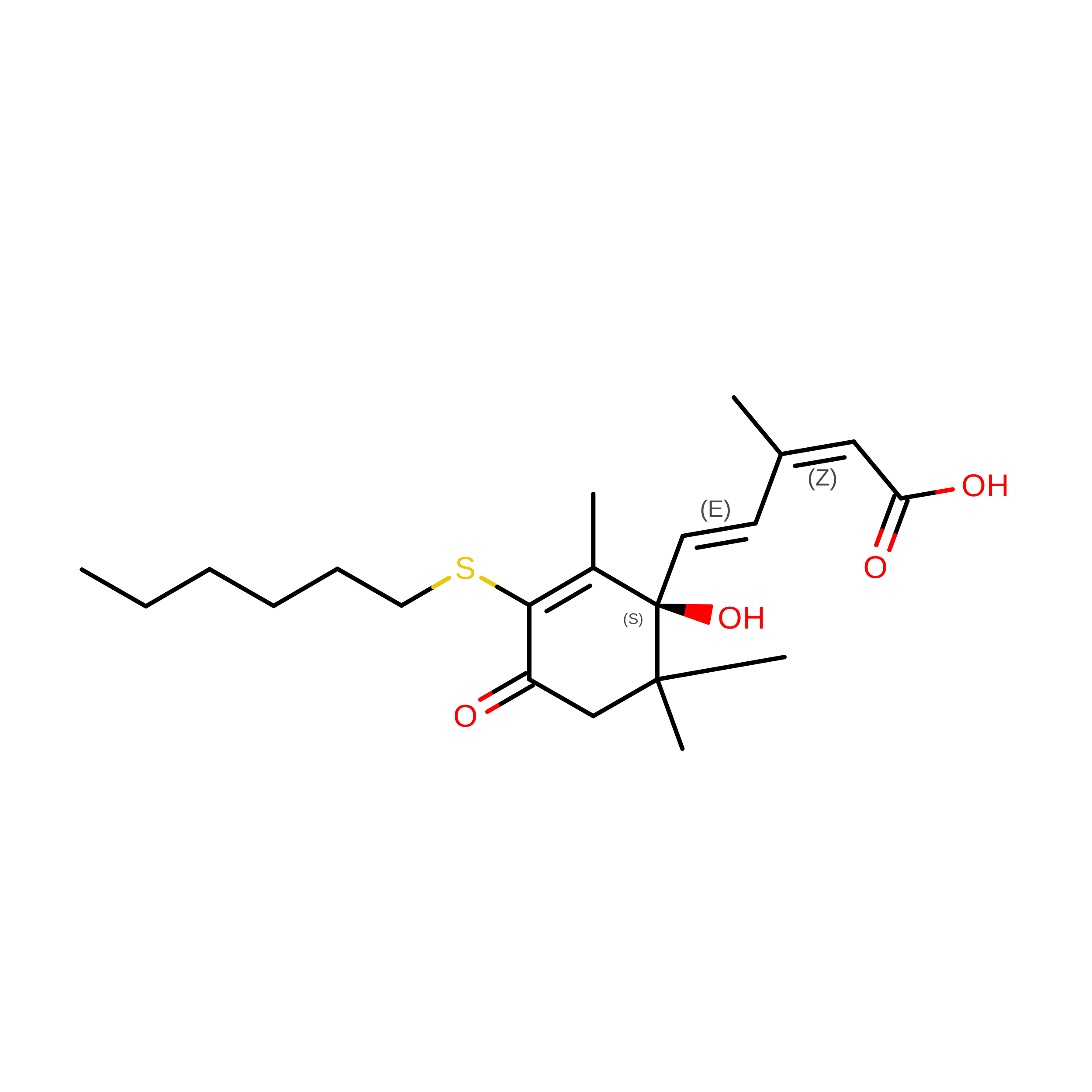
B [auth A](2Z,4E)-5-[(1S)-3-(hexylsulfanyl)-1-hydroxy-2,6,6-trimethyl-4-oxocyclohex-2-en-1-yl]-3-methylpenta-2,4-dienoic acid
C21 H32 O4 S
AOFXVHRNNSAVEA-IHZHKDPYSA-N

Experimental Data & Validation

Experimental Data

  • Method: X-RAY DIFFRACTION
  • Resolution: 2.30 Å
  • R-Value Free:  0.281 (Depositor), 0.267 (DCC) 
  • R-Value Work:  0.237 (Depositor) 
  • R-Value Observed: 0.239 (Depositor) 
Space Group: P 31 2 1
Unit Cell:
Length ( Å )Angle ( ˚ )
a = 66.932α = 90
b = 66.932β = 90
c = 78.237γ = 120
Software Package:
Software NamePurpose
ADSCdata collection
MOLREPphasing
REFMACrefinement
HKL-2000data reduction
HKL-2000data scaling

Structure Validation

View Full Validation Report


Ligand Structure Quality Assessment 


Entry History 

Deposition Data

Revision History  (Full details and data files)

  • Version 1.0: 2014-05-07
    Type: Initial release
  • Version 1.1: 2014-06-11
    Changes: Database references
  • Version 1.2: 2023-11-08
    Changes: Data collection, Database references, Derived calculations, Refinement description