3W7X | pdb_00003w7x

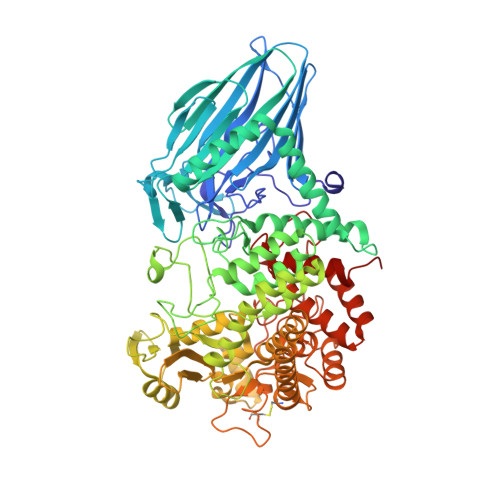
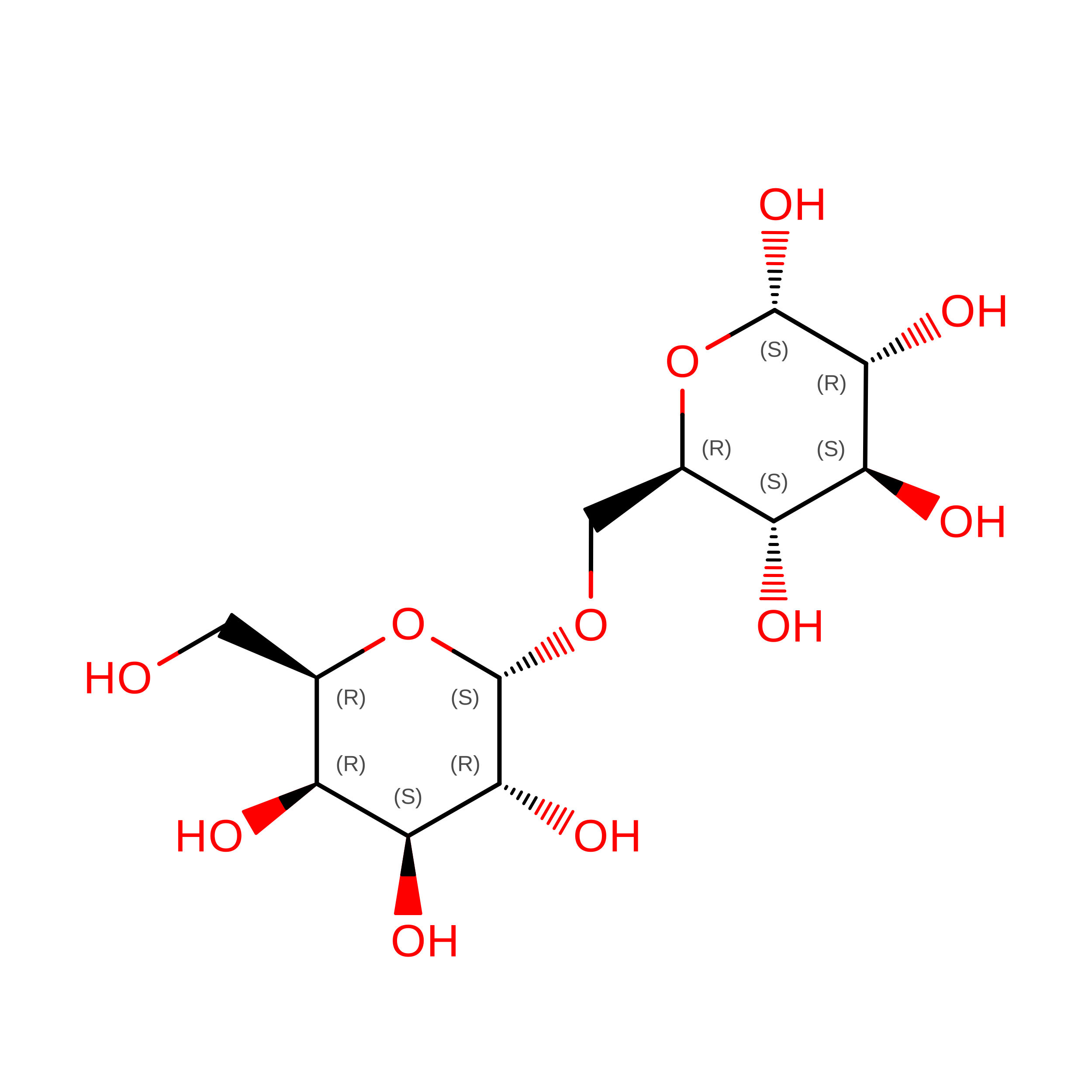
Crystal structure of E. coli YgjK D324N complexed with melibiose


Experimental Data Snapshot

  • Method: X-RAY DIFFRACTION
  • Resolution: 2.70 Å
  • R-Value Free: 
    0.249 (Depositor), 0.244 (DCC) 
  • R-Value Work: 
    0.189 (Depositor), 0.191 (DCC) 
  • R-Value Observed: 
    0.192 (Depositor) 

Starting Model: experimental
View more details

wwPDB Validation 3D Report Full Report

Validation slider image for 3W7X

This is version 2.2 of the entry. See complete history

Literature

Structure of a bacterial glycoside hydrolase family 63 enzyme in complex with its glycosynthase product, and insights into the substrate specificity.

Miyazaki, T.Ichikawa, M.Yokoi, G.Kitaoka, M.Mori, H.Kitano, Y.Nishikawa, A.Tonozuka, T.

(2013) FEBS J 280: 4560-4571

  • DOI: https://doi.org/10.1111/febs.12424
  • Primary Citation Related Structures: 
    3W7W, 3W7X

  • PubMed Abstract: 

    Proteins belonging to glycoside hydrolase family 63 (GH63) are found in bacteria, archaea and eukaryotes. Although the eukaryotic GH63 proteins have been identified as processing α-glucosidase I, the substrate specificities of the bacterial and archaeal GH63 proteins are not clear. Here, we converted a bacterial GH63 enzyme, Escherichia coli YgjK, to a glycosynthase to probe its substrate specificity. Two mutants of YgjK (E727A and D324N) were constructed, and both mutants showed glycosynthase activity. The reactions of E727A with β-D-glucosyl fluoride and monosaccharides showed that the largest amount of glycosynthase product accumulated when galactose was employed as an acceptor molecule. The crystal structure of E727A complexed with the reaction product indicated that the disaccharide bound at the active site was 2-O-α-D-glucopyranosyl-α-D-galactopyranose (Glc12Gal). A comparison of the structures of E727A-Glc12Gal and D324N-melibiose showed that there were two main types of conformation: the open and closed forms. The structure of YgjK adopted the closed form when subsite -1 was occupied by glucose. These results suggest that sugars containing the Glc12Gal structure are the most likely candidates for natural substrates of YgjK.


  • Organizational Affiliation
    • Department of Applied Biological Science, Tokyo University of Agriculture and Technology, Fuchu, Tokyo, Japan.

Macromolecule Content 

  • Total Structure Weight: 172.77 kDa 
  • Atom Count: 12,360 
  • Modeled Residue Count: 1,520 
  • Deposited Residue Count: 1,520 
  • Unique protein chains: 1

Macromolecules

Find similar proteins by:|  3D Structure
Entity ID: 1
MoleculeChains  Sequence LengthOrganismDetailsImage
Uncharacterized protein YgjK
A, B
760Escherichia coli K-12Mutation(s): 1 
Gene Names: b3080JW3051ygjK
EC: 3.2.1
UniProt
Find proteins for P42592 (Escherichia coli (strain K12))
Explore P42592 
Go to UniProtKB:  P42592
Entity Groups
Sequence Clusters30% Identity50% Identity70% Identity90% Identity95% Identity100% Identity
UniProt GroupP42592
Sequence Annotations
Expand
Reference Sequence

Oligosaccharides

Help  
Entity ID: 2
MoleculeChains Length2D Diagram GlycosylationD Interactions
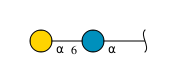
alpha-D-galactopyranose-(1-6)-alpha-D-glucopyranose
C, D
2N/A
Glycosylation Resources
GlyTouCan: G54976AD
GlyCosmos: G54976AD
GlyGen: G54976AD

Biologically Interesting Molecules (External Reference) 

1 Unique

Experimental Data & Validation

Experimental Data

  • Method: X-RAY DIFFRACTION
  • Resolution: 2.70 Å
  • R-Value Free:  0.249 (Depositor), 0.244 (DCC) 
  • R-Value Work:  0.189 (Depositor), 0.191 (DCC) 
  • R-Value Observed: 0.192 (Depositor) 
Space Group: P 1 21 1
Unit Cell:
Length ( Å )Angle ( ˚ )
a = 62.14α = 90
b = 138.16β = 98.37
c = 86.2γ = 90
Software Package:
Software NamePurpose
ADSCdata collection
MOLREPphasing
REFMACrefinement
HKL-2000data reduction
HKL-2000data scaling

Structure Validation

View Full Validation Report


Entry History 

Deposition Data

Revision History  (Full details and data files)

  • Version 1.0: 2013-07-17
    Type: Initial release
  • Version 1.1: 2014-03-12
    Changes: Database references
  • Version 2.0: 2020-07-29
    Type: Remediation
    Reason: Carbohydrate remediation
    Changes: Atomic model, Data collection, Database references, Derived calculations, Non-polymer description, Structure summary
  • Version 2.1: 2023-11-08
    Changes: Data collection, Database references, Refinement description, Structure summary
  • Version 2.2: 2024-11-06
    Changes: Structure summary