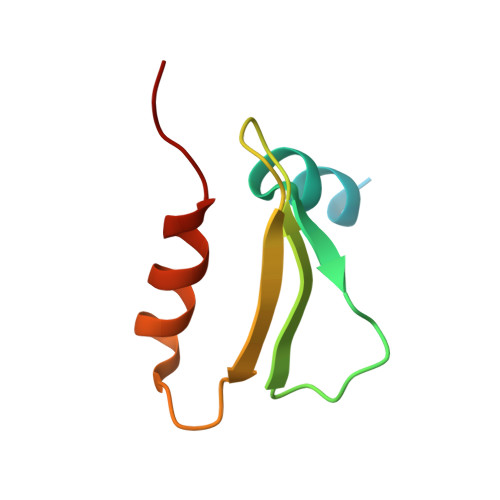
3VZ9 | pdb_00003vz9

Crystal structure of the chicken Spc24-Spc25 globular domain


Experimental Data Snapshot

  • Method: X-RAY DIFFRACTION
  • Resolution: 1.03 Å
  • R-Value Free: 
    0.207 (Depositor), 0.217 (DCC) 
  • R-Value Work: 
    0.193 (Depositor) 
  • R-Value Observed: 
    0.193 (Depositor) 

Starting Model: experimental
View more details

wwPDB Validation 3D Report Full Report

Validation slider image for 3VZ9

This is version 1.1 of the entry. See complete history

Literature

CENP-T provides a structural platform for outer kinetochore assembly

Nishino, T.Rago, F.Hori, T.Tomii, K.Cheeseman, I.M.Fukagawa, T.

(2013) EMBO J 32: 424-436

  • DOI: https://doi.org/10.1038/emboj.2012.348
  • Primary Citation Related Structures: 
    3VZ9, 3VZA

  • PubMed Abstract: 

    The kinetochore forms a dynamic interface with microtubules from the mitotic spindle during mitosis. The Ndc80 complex acts as the key microtubule-binding complex at kinetochores. However, it is unclear how the Ndc80 complex associates with the inner kinetochore proteins that assemble upon centromeric chromatin. Here, based on a high-resolution structural analysis, we demonstrate that the N-terminal region of vertebrate CENP-T interacts with the 'RWD' domain in the Spc24/25 portion of the Ndc80 complex. Phosphorylation of CENP-T strengthens a cryptic hydrophobic interaction between CENP-T and Spc25 resulting in a phospho-regulated interaction that occurs without direct recognition of the phosphorylated residue. The Ndc80 complex interacts with both CENP-T and the Mis12 complex, but we find that these interactions are mutually exclusive, supporting a model in which two distinct pathways target the Ndc80 complex to kinetochores. Our results provide a model for how the multiple protein complexes at kinetochores associate in a phospho-regulated manner.


  • Organizational Affiliation
    • Department of Molecular Genetics, National Institute of Genetics and The Graduate University for Advanced Studies SOKENDAI, Shizuoka 411-8540, Japan.

Macromolecule Content 

  • Total Structure Weight: 20.99 kDa 
  • Atom Count: 1,617 
  • Modeled Residue Count: 163 
  • Deposited Residue Count: 179 
  • Unique protein chains: 2

Macromolecules

Find similar proteins by:|  3D Structure
Entity ID: 1
MoleculeChains  Sequence LengthOrganismDetailsImage
Uncharacterized proteinA [auth B]106Gallus gallusMutation(s): 0 
Gene Names: SPC25
Find similar proteins by:|  3D Structure
Entity ID: 2
MoleculeChains  Sequence LengthOrganismDetailsImage
Spc24 proteinB [auth D]73Gallus gallusMutation(s): 0 
UniProt
Find proteins for R4GRT3 (Gallus gallus)
Explore R4GRT3 
Go to UniProtKB:  R4GRT3
Entity Groups
Sequence Clusters30% Identity50% Identity70% Identity90% Identity95% Identity100% Identity
UniProt GroupR4GRT3
Sequence Annotations
Expand
Reference Sequence

Experimental Data & Validation

Experimental Data

  • Method: X-RAY DIFFRACTION
  • Resolution: 1.03 Å
  • R-Value Free:  0.207 (Depositor), 0.217 (DCC) 
  • R-Value Work:  0.193 (Depositor) 
  • R-Value Observed: 0.193 (Depositor) 
Space Group: P 21 21 21
Unit Cell:
Length ( Å )Angle ( ˚ )
a = 47.321α = 90
b = 58.137β = 90
c = 58.479γ = 90
Software Package:
Software NamePurpose
HKL-2000data collection
PHENIXmodel building
PHENIXrefinement
HKL-2000data reduction
HKL-2000data scaling
PHENIXphasing

Structure Validation

View Full Validation Report


Entry History 

Deposition Data

Revision History  (Full details and data files)

  • Version 1.0: 2013-04-03
    Type: Initial release
  • Version 1.1: 2023-11-08
    Changes: Data collection, Database references, Refinement description