Download Mendeley
The core of allosteric motion in Thermus caldophilus L-lactate dehydrogenase.
Ikehara, Y., Arai, K., Furukawa, N., Ohno, T., Miyake, T., Fushinobu, S., Nakajima, M., Miyanaga, A., Taguchi, H.(2014) J Biol Chem
- PubMed: 25258319 Search on PubMedSearch on PubMed Central
- DOI: https://doi.org/10.1074/jbc.M114.599092
- Primary Citation Related Structures:
3VPG, 3VPH - PubMed Abstract:
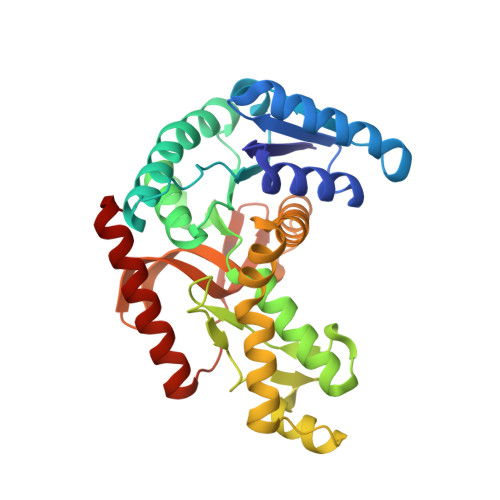
For Thermus caldophilus L-lactate dehydrogenase (TcLDH), fructose 1,6-bisphosphate (FBP) reduced the pyruvate S(0.5) value 10(3)-fold and increased the V(max) value 4-fold at 30 °C and pH 7.0, indicating that TcLDH has a much more T state-sided allosteric equilibrium than Thermus thermophilus L-lactate dehydrogenase, which has only two amino acid replacements, A154G and H179Y. The inactive (T) and active (R) state structures of TcLDH were determined at 1.8 and 2.0 Å resolution, respectively. The structures indicated that two mobile regions, MR1 (positions 172-185) and MR2 (positions 211-221), form a compact core for allosteric motion, and His(179) of MR1 forms constitutive hydrogen bonds with MR2. The Q4(R) mutation, which comprises the L67E, H68D, E178K, and A235R replacements, increased V(max) 4-fold but reduced pyruvate S(0.5) only 5-fold in the reaction without FBP. In contrast, the P2 mutation, comprising the R173Q and R216L replacements, did not markedly increase V(max), but 10(2)-reduced pyruvate S(0.5), and additively increased the FBP-independent activity of the Q4(R) enzyme. The two types of mutation consistently increased the thermal stability of the enzyme. The MR1-MR2 area is a positively charged cluster, and its center approaches another positively charged cluster (N domain cluster) across the Q-axis subunit interface by 5 Å, when the enzyme undergoes the T to R transition. Structural and kinetic analyses thus revealed the simple and unique allosteric machinery of TcLDH, where the MR1-MR2 area pivotally moves during the allosteric motion and mediates the allosteric equilibrium through electrostatic repulsion within the protein molecule.
- From the Department of Applied Biological Science, Faculty of Science and Technology, Tokyo University of Science, 2641 Yamazaki, Noda, Chiba 278-8510, Japan.
Organizational Affiliation: