Download Mendeley
High-resolution structures of Neotermes koshunensis beta-glucosidase mutants provide insights into the catalytic mechanism and the synthesis of glucoconjugates
Jeng, W.Y., Wang, N.C., Lin, C.T., Chang, W.J., Liu, C.I., Wang, A.H.J.(2012) Acta Crystallogr D Biol Crystallogr 68: 829-838
- PubMed: 22751668 Search on PubMed
- DOI: https://doi.org/10.1107/S0907444912013224
- Primary Citation Related Structures:
3VIF, 3VIG, 3VIH, 3VII, 3VIJ, 3VIK, 3VIL, 3VIM, 3VIN, 3VIO, 3VIP - PubMed Abstract:
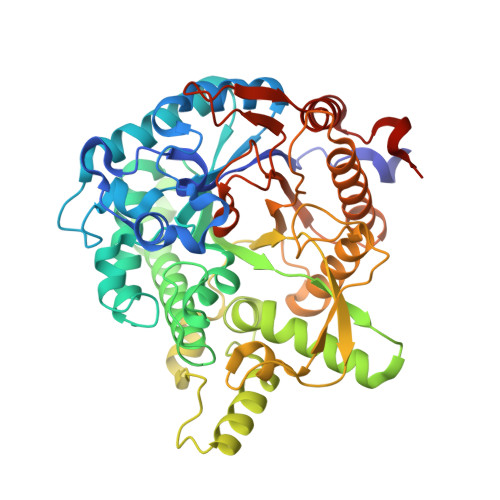
NkBgl, a β-glucosidase from Neotermes koshunensis, is a β-retaining glycosyl hydrolase family 1 enzyme that cleaves β-glucosidic linkages in disaccharide or glucose-substituted molecules. β-Glucosidases have been widely used in several applications. For example, mutagenesis of the attacking nucleophile in β-glucosidase has been conducted to convert it into a glycosynthase for the synthesis of oligosaccharides. Here, several high-resolution structures of wild-type or mutated NkBgl in complex with different ligand molecules are reported. In the wild-type NkBgl structures it was found that glucose-like glucosidase inhibitors bind to the glycone-binding pocket, allowing the buffer molecule HEPES to remain in the aglycone-binding pocket. In the crystal structures of NkBgl E193A, E193S and E193D mutants Glu193 not only acts as the catalytic acid/base but also plays an important role in controlling substrate entry and product release. Furthermore, in crystal structures of the NkBgl E193D mutant it was found that new glucoconjugates were generated by the conjugation of glucose (hydrolyzed product) and HEPES/EPPS/opipramol (buffer components). Based on the wild-type and E193D-mutant structures of NkBgl, the glucosidic bond of cellobiose or salicin was hydrolyzed and a new bond was subsequently formed between glucose and HEPES/EPPS/opipramol to generate new glucopyranosidic products through the transglycosylation reaction in the NkBgl E193D mutant. This finding highlights an innovative way to further improve β-glucosidases for the enzymatic synthesis of oligosaccharides.
- Institute of Biological Chemistry, Academia Sinica, Taipei 115, Taiwan.
Organizational Affiliation: