3VDP | pdb_00003vdp

Structure and biochemical studies of the recombination mediator protein RecR in RecFOR pathway


Experimental Data Snapshot

  • Method: X-RAY DIFFRACTION
  • Resolution: 2.45 Å
  • R-Value Free: 
    0.227 (Depositor), 0.198 (DCC) 
  • R-Value Work: 
    0.196 (Depositor), 0.197 (DCC) 
  • R-Value Observed: 
    0.198 (Depositor) 

wwPDB Validation 3D Report Full Report

Validation slider image for 3VDP

This is version 1.1 of the entry. See complete history

Literature

RecOR complex including RecR N-N dimer and RecO monomer displays a high affinity for ssDNA

Tang, Q.Gao, P.Liu, Y.P.Gao, A.An, X.M.Liu, S.Yan, X.X.Liang, D.C.

(2012) Nucleic Acids Res 40: 11115-11125

  • DOI: https://doi.org/10.1093/nar/gks889
  • Primary Citation Related Structures: 
    3VDP, 3VDU, 3VE5

  • PubMed Abstract: 

    RecR is an important recombination mediator protein in the RecFOR pathway. RecR together with RecO and RecF facilitates RecA nucleoprotein filament formation and homologous pairing. Structural and biochemical studies of Thermoanaerobacter tengcongensis RecR (TTERecR) and its series mutants revealed that TTERecR uses the N-N dimer as a basic functional unit to interact with TTERecO monomer. Two TTERecR N-N dimers form a ring-shaped tetramer via an interaction between their C-terminal regions. The tetramer is a result of crystallization only. Hydrophobic interactions between the entire helix-hairpin-helix domains within the N-terminal regions of two TTERecR monomers are necessary for formation of a RecR functional N-N dimer. The TTERecR N-N dimer conformation also affects formation of a hydrophobic patch, which creates a binding site for TTERecO in the TTERecR Toprim domain. In addition, we demonstrate that TTERecR does not bind single-stranded DNA (ssDNA) and binds double-stranded DNA very weakly, whereas TTERecOR complex can stably bind DNA, with a higher affinity for ssDNA than double-stranded DNA. Based on these results, we propose an interaction model for the RecOR:ssDNA complex.


  • Organizational Affiliation
    • National Laboratory of Biomacromolecules, Institute of Biophysics, Chinese Academy of Sciences, Beijing 100101, China.

Macromolecule Content 

  • Total Structure Weight: 95.22 kDa 
  • Atom Count: 6,481 
  • Modeled Residue Count: 788 
  • Deposited Residue Count: 848 
  • Unique protein chains: 1

Macromolecules

Find similar proteins by:|  3D Structure
Entity ID: 1
MoleculeChains  Sequence LengthOrganismDetailsImage
Recombination protein recR
A, B, C, D
212Caldanaerobacter subterraneus subsp. tengcongensis MB4Mutation(s): 0 
Gene Names: recR
UniProt
Find proteins for Q8RDI4 (Caldanaerobacter subterraneus subsp. tengcongensis (strain DSM 15242 / JCM 11007 / NBRC 100824 / MB4))
Explore Q8RDI4 
Go to UniProtKB:  Q8RDI4
Entity Groups
Sequence Clusters30% Identity50% Identity70% Identity90% Identity95% Identity100% Identity
UniProt GroupQ8RDI4
Sequence Annotations
Expand
Reference Sequence

Small Molecules

Ligands 2 Unique
IDChains Name / Formula / InChI Key2D Diagram3D Interactions
IMD

Query on IMD


Download:Ideal Coordinates CCD File
F [auth A]
G [auth A]
H [auth A]
J [auth B]
L [auth C]
F [auth A],
G [auth A],
H [auth A],
J [auth B],
L [auth C],
N [auth D]
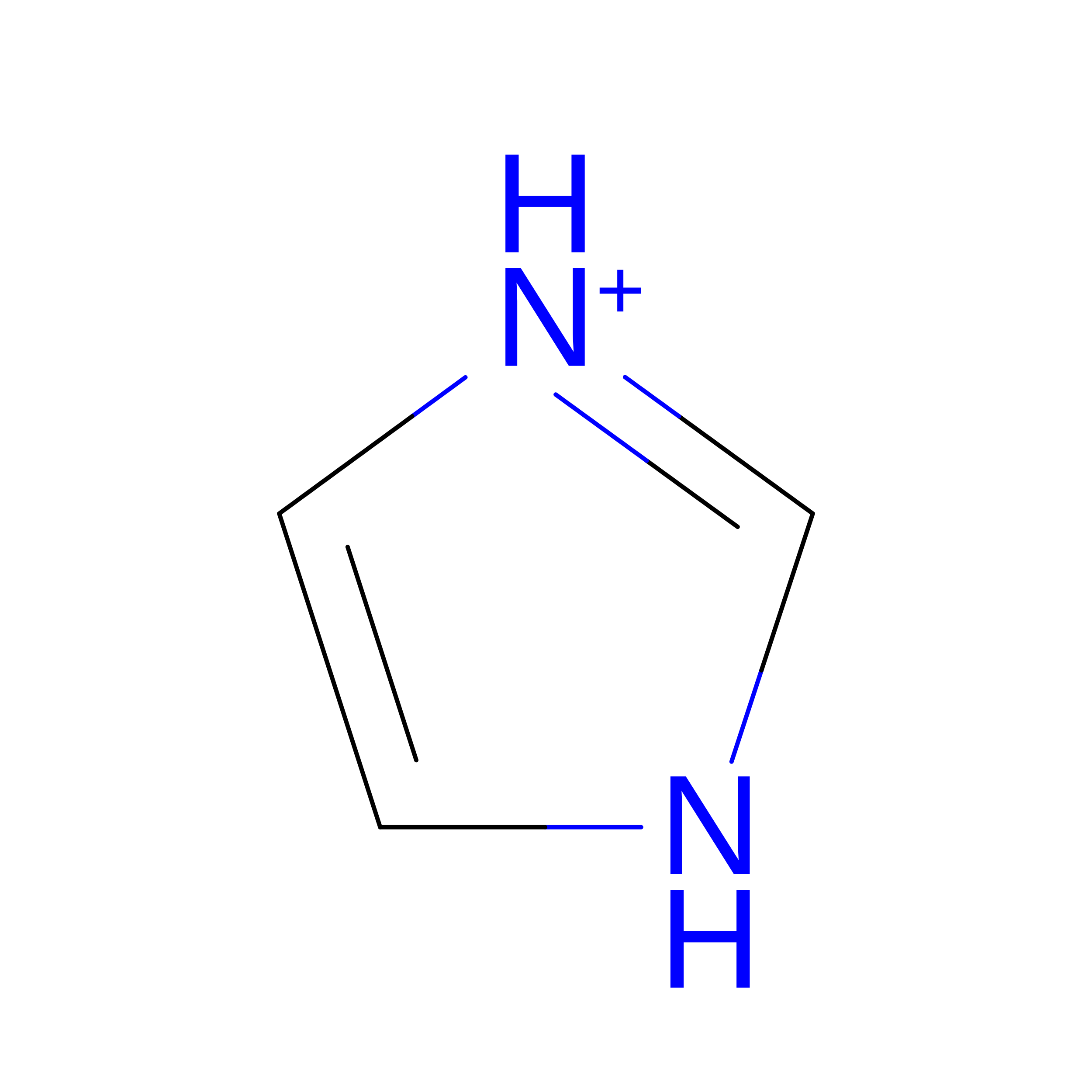
IMIDAZOLE
C3 H5 N2
RAXXELZNTBOGNW-UHFFFAOYSA-O
ZN

Query on ZN


Download:Ideal Coordinates CCD File
E [auth A],
I [auth B],
K [auth C],
M [auth D]
ZINC ION
Zn
PTFCDOFLOPIGGS-UHFFFAOYSA-N

Experimental Data & Validation

Experimental Data

  • Method: X-RAY DIFFRACTION
  • Resolution: 2.45 Å
  • R-Value Free:  0.227 (Depositor), 0.198 (DCC) 
  • R-Value Work:  0.196 (Depositor), 0.197 (DCC) 
  • R-Value Observed: 0.198 (Depositor) 
Space Group: P 1 21 1
Unit Cell:
Length ( Å )Angle ( ˚ )
a = 90.26α = 90
b = 68.325β = 92.95
c = 94.056γ = 90
Software Package:
Software NamePurpose
HKL-2000data collection
PHASESphasing
PHENIXrefinement
HKL-2000data reduction
HKL-2000data scaling

Structure Validation

View Full Validation Report


Entry History 

Deposition Data

Revision History  (Full details and data files)

  • Version 1.0: 2012-12-19
    Type: Initial release
  • Version 1.1: 2024-03-20
    Changes: Data collection, Database references, Derived calculations