3UYL | pdb_00003uyl

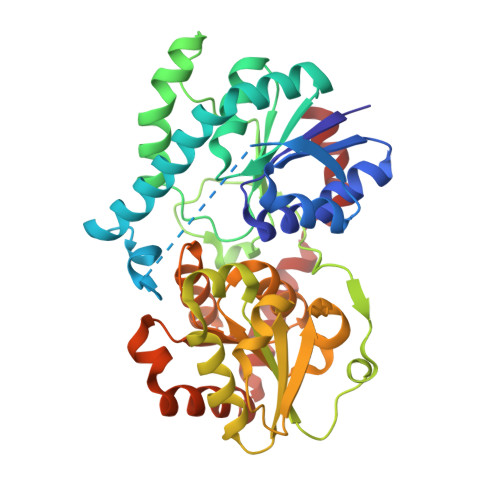
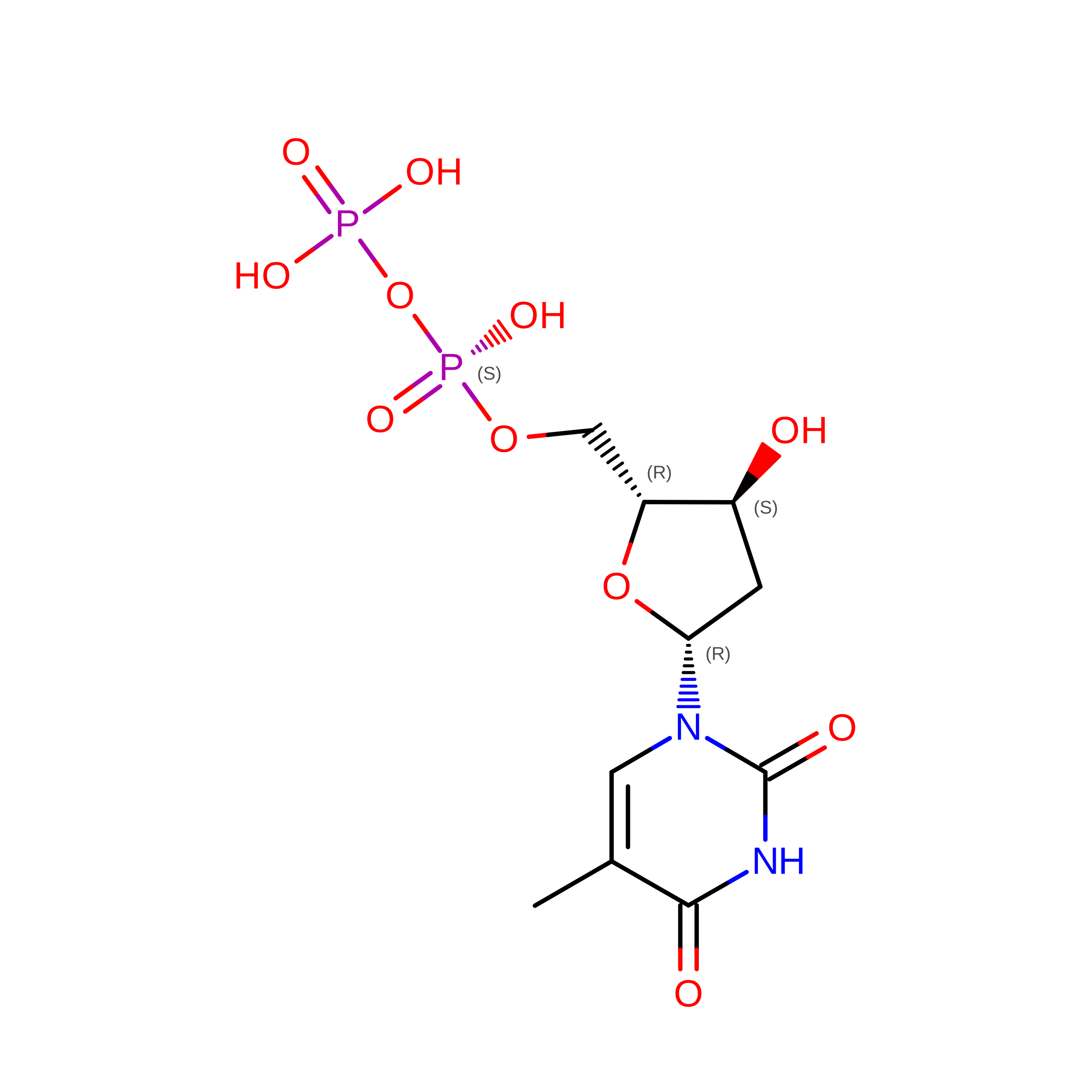
Spinosyn Rhamnosyltransferase SpnG complexed with thymidine diphosphate


Experimental Data Snapshot

  • Method: X-RAY DIFFRACTION
  • Resolution: 1.85 Å
  • R-Value Free: 
    0.291 (Depositor), 0.287 (DCC) 
  • R-Value Work: 
    0.232 (Depositor), 0.229 (DCC) 
  • R-Value Observed: 
    0.235 (Depositor) 

Starting Model: experimental
View more details

wwPDB Validation 3D Report Full Report

Validation slider image for 3UYL

Ligand Structure Quality Assessment 


This is version 1.4 of the entry. See complete history

Literature

Structural Studies of the Spinosyn Rhamnosyltransferase, SpnG.

Isiorho, E.A.Liu, H.W.Keatinge-Clay, A.T.

(2012) Biochemistry 51: 1213-1222

  • DOI: https://doi.org/10.1021/bi201860q
  • Primary Citation Related Structures: 
    3TSA, 3UYK, 3UYL

  • PubMed Abstract: 

    Spinosyns A and D (spinosad), like many other complex polyketides, are tailored near the end of their biosyntheses through the addition of sugars. SpnG, which catalyzes their 9-OH rhamnosylation, is also capable of adding other monosaccharides to the spinosyn aglycone (AGL) from TDP-sugars; however, the substitution of UDP-D-glucose for TDP-D-glucose as the donor substrate is known to result in a >60000-fold reduction in k(cat). Here, we report the structure of SpnG at 1.65 Å resolution, SpnG bound to TDP at 1.86 Å resolution, and SpnG bound to AGL at 1.70 Å resolution. The SpnG-TDP complex reveals how SpnG employs N202 to discriminate between TDP- and UDP-sugars. A conformational change of several residues in the active site is promoted by the binding of TDP. The SpnG-AGL complex shows that the binding of AGL is mediated via hydrophobic interactions and that H13, the potential catalytic base, is within 3 Å of the nucleophilic 9-OH group of AGL. A model for the Michaelis complex was constructed to reveal the features that allow SpnG to transfer diverse sugars; it also revealed that the rhamnosyl moiety is in a skew-boat conformation during the transfer reaction.


  • Organizational Affiliation
    • Division of Medicinal Chemistry, College of Pharmacy, The University of Texas at Austin, Austin, Texas 78712, United States.

Macromolecule Content 

  • Total Structure Weight: 82.92 kDa 
  • Atom Count: 6,014 
  • Modeled Residue Count: 742 
  • Deposited Residue Count: 774 
  • Unique protein chains: 1

Macromolecules

Find similar proteins by:|  3D Structure
Entity ID: 1
MoleculeChains  Sequence LengthOrganismDetailsImage
NDP-rhamnosyltransferase
A, B
387Saccharopolyspora spinosaMutation(s): 0 
Gene Names: spnG
EC: 2.4.1
UniProt
Find proteins for Q9ALM8 (Saccharopolyspora spinosa)
Explore Q9ALM8 
Go to UniProtKB:  Q9ALM8
Entity Groups
Sequence Clusters30% Identity50% Identity70% Identity90% Identity95% Identity100% Identity
UniProt GroupQ9ALM8
Sequence Annotations
Expand
Reference Sequence

Experimental Data & Validation

Experimental Data

  • Method: X-RAY DIFFRACTION
  • Resolution: 1.85 Å
  • R-Value Free:  0.291 (Depositor), 0.287 (DCC) 
  • R-Value Work:  0.232 (Depositor), 0.229 (DCC) 
  • R-Value Observed: 0.235 (Depositor) 
Space Group: P 1
Unit Cell:
Length ( Å )Angle ( ˚ )
a = 54.152α = 81.63
b = 57.629β = 73.79
c = 68.203γ = 85.74
Software Package:
Software NamePurpose
ADSCdata collection
PHASERphasing
REFMACrefinement
HKL-2000data reduction
HKL-2000data scaling

Structure Validation

View Full Validation Report


Ligand Structure Quality Assessment 


Entry History 

Deposition Data

Revision History  (Full details and data files)

  • Version 1.0: 2012-02-15
    Type: Initial release
  • Version 1.1: 2012-02-29
    Changes: Database references
  • Version 1.2: 2018-01-24
    Changes: Structure summary
  • Version 1.3: 2020-07-29
    Type: Remediation
    Reason: Carbohydrate remediation
    Changes: Data collection, Database references, Derived calculations, Structure summary
  • Version 1.4: 2023-09-13
    Changes: Data collection, Database references, Refinement description, Structure summary