3UW6 | pdb_00003uw6

Crystal Structure of Engineered Protein, Northeast Structural Genomics Consortium Target OR120


Experimental Data Snapshot

  • Method: X-RAY DIFFRACTION
  • Resolution: 2.30 Å
  • R-Value Free: 
    0.259 (Depositor), 0.267 (DCC) 
  • R-Value Work: 
    0.215 (Depositor), 0.231 (DCC) 
  • R-Value Observed: 
    0.215 (Depositor) 

wwPDB Validation 3D Report Full Report

Validation slider image for 3UW6

This is version 1.3 of the entry. See complete history

Literature

Computational design of enone-binding proteins with catalytic activity for the Morita-Baylis-Hillman reaction.

Bjelic, S.Nivon, L.G.Celebi-Olcum, N.Kiss, G.Rosewall, C.F.Lovick, H.M.Ingalls, E.L.Gallaher, J.L.Seetharaman, J.Lew, S.Montelione, G.T.Hunt, J.F.Michael, F.E.Houk, K.N.Baker, D.

(2013) ACS Chem Biol 8: 749-757

  • DOI: https://doi.org/10.1021/cb3006227
  • Primary Citation Related Structures: 
    3U26, 3UW6

  • PubMed Abstract: 

    The Morita-Baylis-Hillman reaction forms a carbon-carbon bond between the α-carbon of a conjugated carbonyl compound and a carbon electrophile. The reaction mechanism involves Michael addition of a nucleophile catalyst at the carbonyl β-carbon, followed by bond formation with the electrophile and catalyst disassociation to release the product. We used Rosetta to design 48 proteins containing active sites predicted to carry out this mechanism, of which two show catalytic activity by mass spectrometry (MS). Substrate labeling measured by MS and site-directed mutagenesis experiments show that the designed active-site residues are responsible for activity, although rate acceleration over background is modest. To characterize the designed proteins, we developed a fluorescence-based screen for intermediate formation in cell lysates, carried out microsecond molecular dynamics simulations, and solved X-ray crystal structures. These data indicate a partially formed active site and suggest several clear avenues for designing more active catalysts.


  • Organizational Affiliation
    • Department of Biochemistry, University of Washington, Seattle, WA 98195, USA.

Macromolecule Content 

  • Total Structure Weight: 132.56 kDa 
  • Atom Count: 8,977 
  • Modeled Residue Count: 1,113 
  • Deposited Residue Count: 1,170 
  • Unique protein chains: 1

Macromolecules

Find similar proteins by:|  3D Structure
Entity ID: 1
MoleculeChains  Sequence LengthOrganismDetailsImage
Alanine racemase
A, B, C
390Geobacillus stearothermophilusMutation(s): 0 
Gene Names: alrdal
EC: 5.1.1.1
UniProt
Find proteins for P10724 (Geobacillus stearothermophilus)
Explore P10724 
Go to UniProtKB:  P10724
Entity Groups
Sequence Clusters30% Identity50% Identity70% Identity90% Identity95% Identity100% Identity
UniProt GroupP10724
Sequence Annotations
Expand
Reference Sequence

Small Molecules

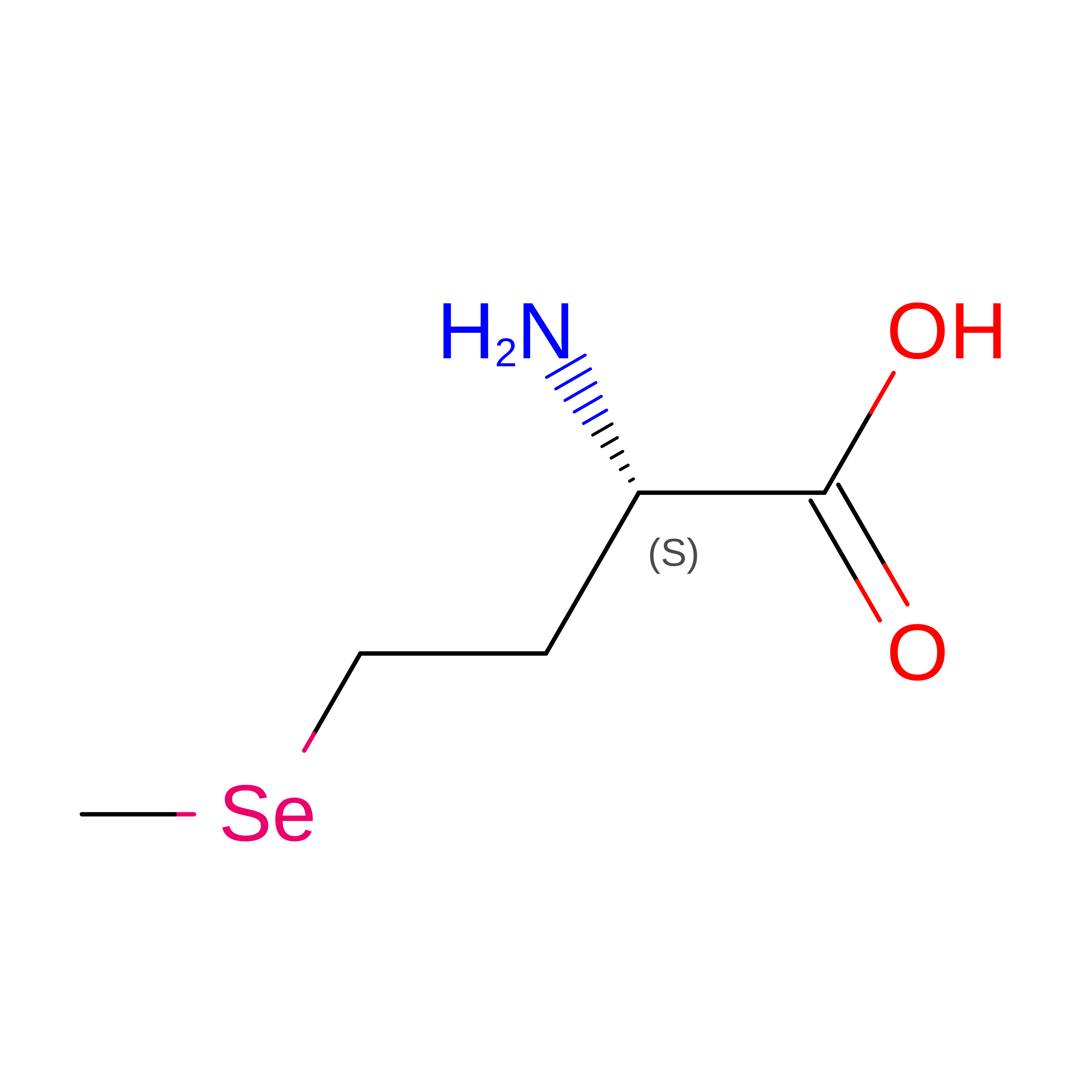
Modified Residues  1 Unique
IDChains TypeFormula2D DiagramParent
MSE
Query on MSE
A, B, C
L-PEPTIDE LINKINGC5 H11 N O2 SeMET

Experimental Data & Validation

Experimental Data

  • Method: X-RAY DIFFRACTION
  • Resolution: 2.30 Å
  • R-Value Free:  0.259 (Depositor), 0.267 (DCC) 
  • R-Value Work:  0.215 (Depositor), 0.231 (DCC) 
  • R-Value Observed: 0.215 (Depositor) 
Space Group: P 41 21 2
Unit Cell:
Length ( Å )Angle ( ˚ )
a = 112.348α = 90
b = 112.348β = 90
c = 237.059γ = 90
Software Package:
Software NamePurpose
ADSCdata collection
SOLVEphasing
CNSrefinement
HKL-2000data reduction
HKL-2000data scaling

Structure Validation

View Full Validation Report


Entry History 

Revision History  (Full details and data files)

  • Version 1.0: 2012-02-08
    Type: Initial release
  • Version 1.1: 2018-01-24
    Changes: Database references, Structure summary
  • Version 1.2: 2022-03-02
    Changes: Database references, Derived calculations
  • Version 1.3: 2024-11-20
    Changes: Data collection, Structure summary