Download Mendeley
Structural, Bioinformatic, and In Vivo Analyses of Two Treponema pallidum Lipoproteins Reveal a Unique TRAP Transporter.
Deka, R.K., Brautigam, C.A., Goldberg, M., Schuck, P., Tomchick, D.R., Norgard, M.V.(2012) J Mol Biol 416: 678-696
- PubMed: 22306465 Search on PubMedSearch on PubMed Central
- DOI: https://doi.org/10.1016/j.jmb.2012.01.015
- Primary Citation Related Structures:
3U64, 3U65 - PubMed Abstract:
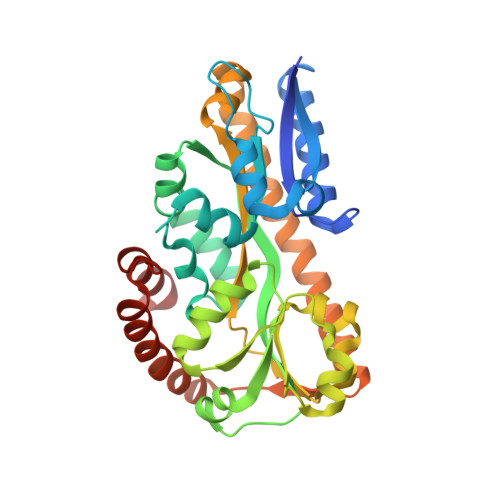
Treponema pallidum, the bacterial agent of syphilis, is predicted to encode one tripartite ATP-independent periplasmic transporter (TRAP-T). TRAP-Ts typically employ a periplasmic substrate-binding protein (SBP) to deliver the cognate ligand to the transmembrane symporter. Herein, we demonstrate that the genes encoding the putative TRAP-T components from T. pallidum, tp0957 (the SBP), and tp0958 (the symporter), are in an operon with an uncharacterized third gene, tp0956. We determined the crystal structure of recombinant Tp0956; the protein is trimeric and perforated by a pore. Part of Tp0956 forms an assembly similar to those of "tetratricopeptide repeat" (TPR) motifs. The crystal structure of recombinant Tp0957 was also determined; like the SBPs of other TRAP-Ts, there are two lobes separated by a cleft. In these other SBPs, the cleft binds a negatively charged ligand. However, the cleft of Tp0957 has a strikingly hydrophobic chemical composition, indicating that its ligand may be substantially different and likely hydrophobic. Analytical ultracentrifugation of the recombinant versions of Tp0956 and Tp0957 established that these proteins associate avidly. This unprecedented interaction was confirmed for the native molecules using in vivo cross-linking experiments. Finally, bioinformatic analyses suggested that this transporter exemplifies a new subfamily of TPATs (TPR-protein-associated TRAP-Ts) that require the action of a TPR-containing accessory protein for the periplasmic transport of a potentially hydrophobic ligand(s).
- Department of Microbiology, The University of Texas Southwestern Medical Center at Dallas, 5323 Harry Hines Boulevard, Dallas, TX 75390, USA.
Organizational Affiliation: