3SRZ | pdb_00003srz

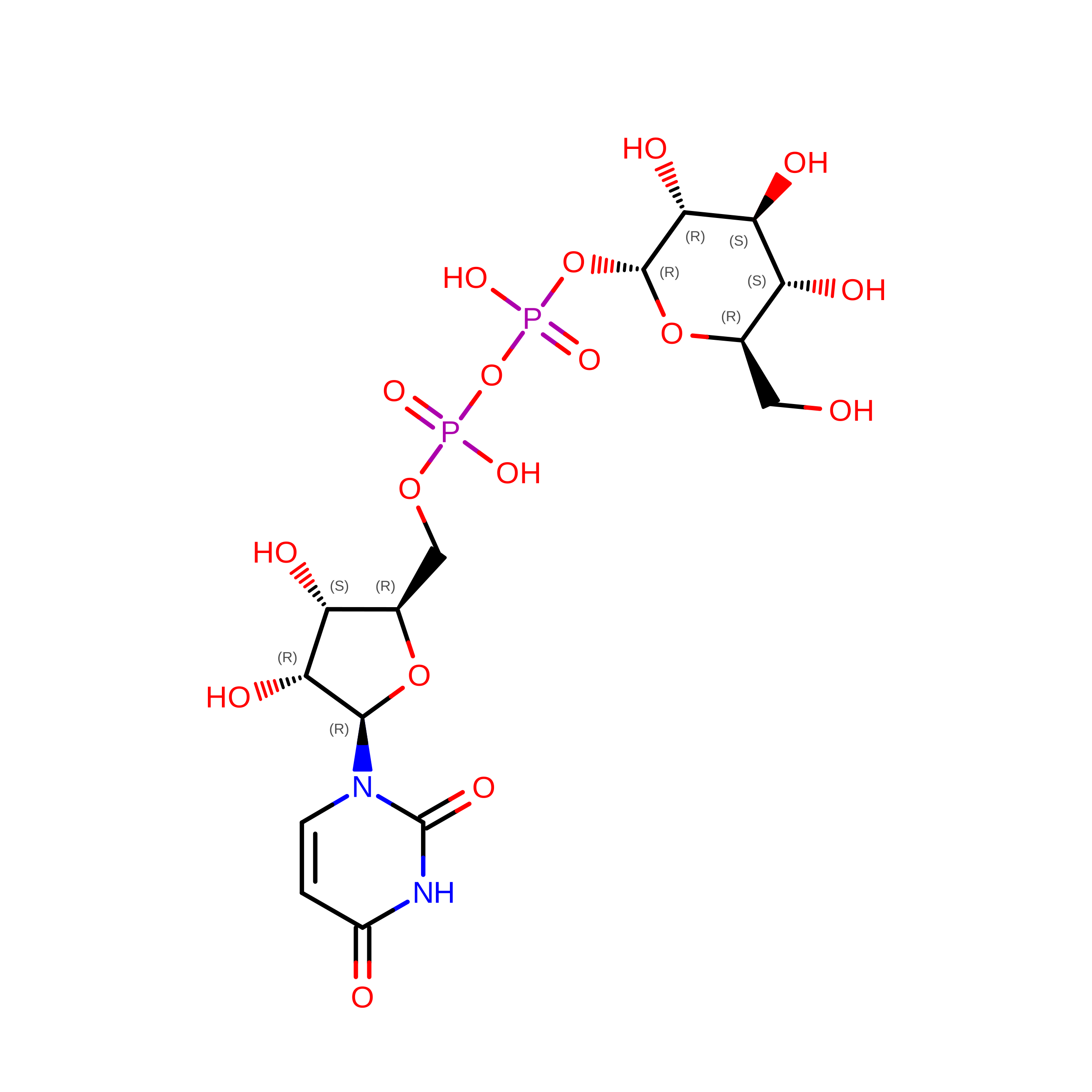
Clostridium difficile toxin A (TcdA) glucolsyltransferase domain bound to UDP-glucose


Experimental Data Snapshot

  • Method: X-RAY DIFFRACTION
  • Resolution: 2.58 Å
  • R-Value Free: 
    0.248 (Depositor), 0.243 (DCC) 
  • R-Value Work: 
    0.177 (Depositor), 0.175 (DCC) 
  • R-Value Observed: 
    0.183 (Depositor) 

wwPDB Validation 3D Report Full Report

Validation slider image for 3SRZ

Ligand Structure Quality Assessment 


This is version 1.3 of the entry. See complete history

Literature

Structural Determinants of Clostridium difficile Toxin A Glucosyltransferase Activity.

Pruitt, R.N.Chumbler, N.M.Rutherford, S.A.Farrow, M.A.Friedman, D.B.Spiller, B.Lacy, D.B.

(2012) J Biological Chem 287: 8013-8020

  • DOI: https://doi.org/10.1074/jbc.M111.298414
  • Primary Citation Related Structures: 
    3SRZ, 3SS1

  • PubMed Abstract: 

    The principle virulence factors in Clostridium difficile pathogenesis are TcdA and TcdB, homologous glucosyltransferases capable of inactivating small GTPases within the host cell. We present crystal structures of the TcdA glucosyltransferase domain in the presence and absence of the co-substrate UDP-glucose. Although the enzymatic core is similar to that of TcdB, the proposed GTPase-binding surface differs significantly. We show that TcdA is comparable with TcdB in its modification of Rho family substrates and that, unlike TcdB, TcdA is also capable of modifying Rap family GTPases both in vitro and in cells. The glucosyltransferase activities of both toxins are reduced in the context of the holotoxin but can be restored with autoproteolytic activation and glucosyltransferase domain release. These studies highlight the importance of cellular activation in determining the array of substrates available to the toxins once delivered into the cell.


  • Organizational Affiliation
    • Department of Pathology, Microbiology, and Immunology, Vanderbilt University School of Medicine, Nashville, Tennessee 37232, USA.

Macromolecule Content 

  • Total Structure Weight: 65.02 kDa 
  • Atom Count: 4,549 
  • Modeled Residue Count: 537 
  • Deposited Residue Count: 555 
  • Unique protein chains: 1

Macromolecules

Find similar proteins by:|  3D Structure
Entity ID: 1
MoleculeChains  Sequence LengthOrganismDetailsImage
Toxin A555Clostridioides difficile 630Mutation(s): 0 
Gene Names: CD0663CD630_06630tcdA
EC: 2.4.1 (PDB Primary Data), 3.4.22 (UniProt)
UniProt
Find proteins for P16154 (Clostridioides difficile)
Explore P16154 
Go to UniProtKB:  P16154
Entity Groups
Sequence Clusters30% Identity50% Identity70% Identity90% Identity95% Identity100% Identity
UniProt GroupP16154
Sequence Annotations
Expand
Reference Sequence

Small Molecules

Experimental Data & Validation

Experimental Data

  • Method: X-RAY DIFFRACTION
  • Resolution: 2.58 Å
  • R-Value Free:  0.248 (Depositor), 0.243 (DCC) 
  • R-Value Work:  0.177 (Depositor), 0.175 (DCC) 
  • R-Value Observed: 0.183 (Depositor) 
Space Group: P 65
Unit Cell:
Length ( Å )Angle ( ˚ )
a = 141.779α = 90
b = 141.779β = 90
c = 63.351γ = 120
Software Package:
Software NamePurpose
ADSCdata collection
PHENIXmodel building
PHASERphasing
PHENIXrefinement
HKL-2000data reduction
HKL-2000data scaling
PHENIXphasing

Structure Validation

View Full Validation Report


Ligand Structure Quality Assessment 


Entry History 

Deposition Data

Revision History  (Full details and data files)

  • Version 1.0: 2012-02-01
    Type: Initial release
  • Version 1.1: 2012-02-08
    Changes: Database references
  • Version 1.2: 2012-03-28
    Changes: Database references
  • Version 1.3: 2024-02-28
    Changes: Data collection, Database references, Derived calculations