3SLA | pdb_00003sla

X-ray structure of first four repeats of human beta-catenin


Experimental Data Snapshot

  • Method: X-RAY DIFFRACTION
  • Resolution: 2.50 Å
  • R-Value Free: 
    0.277 (Depositor), 0.246 (DCC) 
  • R-Value Work: 
    0.218 (Depositor) 
  • R-Value Observed: 
    0.221 (Depositor) 

wwPDB Validation 3D Report Full Report

Validation slider image for 3SLA

This is version 1.2 of the entry. See complete history

Literature

An intrinsically labile alpha-helix abutting the BCL9-binding site of beta-catenin is required for its inhibition by carnosic acid.

de la Roche, M.Rutherford, T.J.Gupta, D.Veprintsev, D.B.Saxty, B.Freund, S.M.Bienz, M.

(2012) Nat Commun 3: 680-680

  • DOI: https://doi.org/10.1038/ncomms1680
  • Primary Citation Related Structures: 
    3SL9, 3SLA

  • PubMed Abstract: 

    Wnt/β-catenin signalling controls development and tissue homeostasis. Moreover, activated β-catenin can be oncogenic and, notably, drives colorectal cancer. Inhibiting oncogenic β-catenin has proven a formidable challenge. Here we design a screen for small-molecule inhibitors of β-catenin's binding to its cofactor BCL9, and discover five related natural compounds, including carnosic acid from rosemary, which attenuates transcriptional β-catenin outputs in colorectal cancer cells. Evidence from NMR and analytical ultracentrifugation demonstrates that the carnosic acid response requires an intrinsically labile α-helix (H1) amino-terminally abutting the BCL9-binding site in β-catenin. Similarly, in colorectal cancer cells with hyperactive β-catenin signalling, carnosic acid targets predominantly the transcriptionally active ('oncogenic') form of β-catenin for proteasomal degradation in an H1-dependent manner. Hence, H1 is an 'Achilles' Heel' of β-catenin, which can be exploited for destabilization of oncogenic β-catenin by small molecules, providing proof-of-principle for a new strategy for developing direct inhibitors of oncogenic β-catenin.


  • Organizational Affiliation
    • MRC Laboratory of Molecular Biology, Hills Road, Cambridge CB2 0QH, UK.

Macromolecule Content 

  • Total Structure Weight: 92.48 kDa 
  • Atom Count: 6,074 
  • Modeled Residue Count: 801 
  • Deposited Residue Count: 840 
  • Unique protein chains: 1

Macromolecules

Find similar proteins by:|  3D Structure
Entity ID: 1
MoleculeChains  Sequence LengthOrganismDetailsImage
Catenin beta-1
A, B, C, D, E
168Homo sapiensMutation(s): 0 
Gene Names: Beta cateninCTNNBCTNNB1OK/SW-cl.35PRO2286
UniProt & NIH Common Fund Data Resources
Find proteins for P35222 (Homo sapiens)
Explore P35222 
Go to UniProtKB:  P35222
PHAROS:  P35222
GTEx:  ENSG00000168036 
Entity Groups
Sequence Clusters30% Identity50% Identity70% Identity90% Identity95% Identity100% Identity
UniProt GroupP35222
Sequence Annotations
Expand
Reference Sequence

Small Molecules

Ligands 2 Unique
IDChains Name / Formula / InChI Key2D Diagram3D Interactions
GOL

Query on GOL


Download:Ideal Coordinates CCD File
F [auth A]
G [auth A]
H [auth A]
I [auth A]
J [auth D]
F [auth A],
G [auth A],
H [auth A],
I [auth A],
J [auth D],
K [auth D],
L [auth E],
M [auth E]
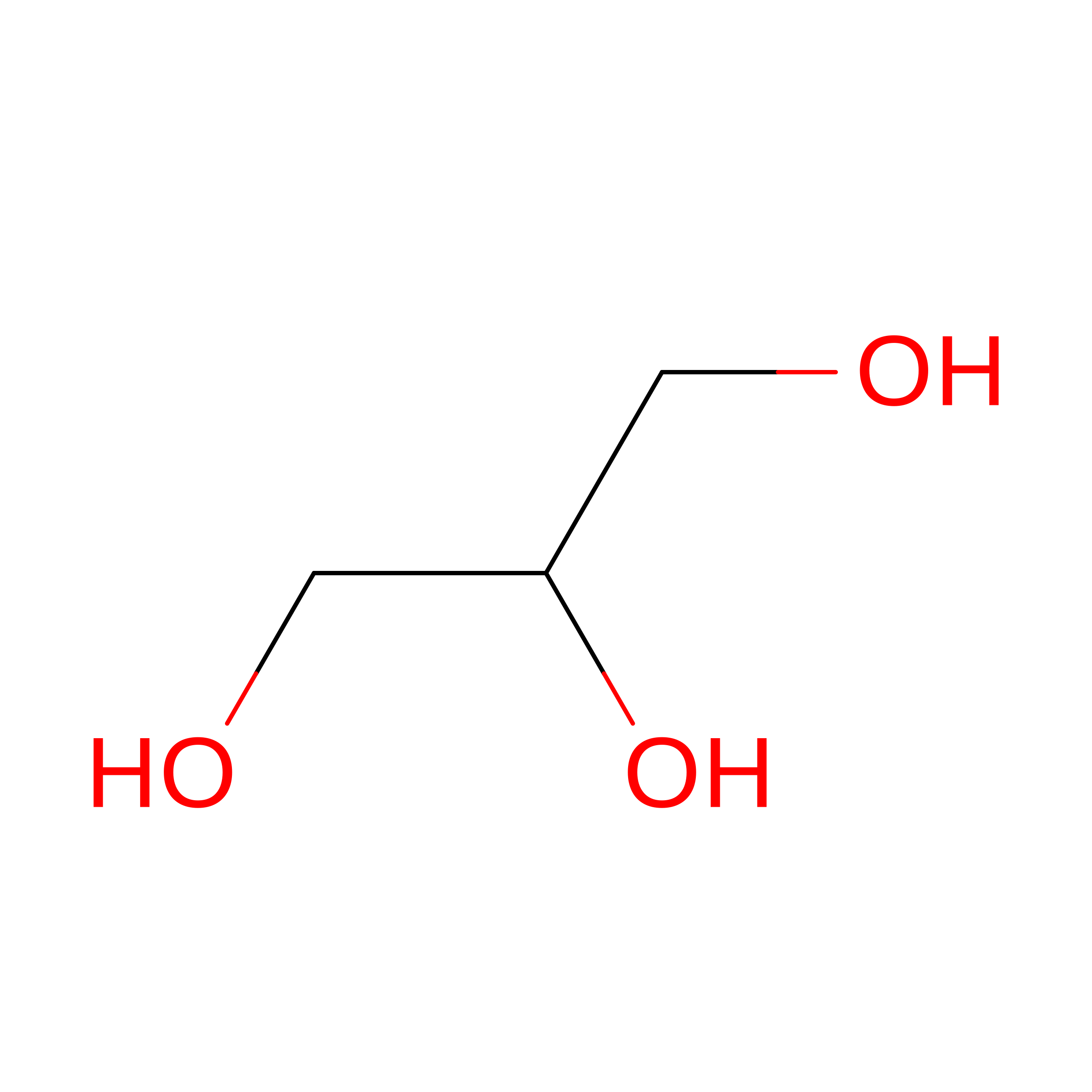
GLYCEROL
C3 H8 O3
PEDCQBHIVMGVHV-UHFFFAOYSA-N
NA

Query on NA


Download:Ideal Coordinates CCD File
N [auth E],
O [auth E]
SODIUM ION
Na
FKNQFGJONOIPTF-UHFFFAOYSA-N

Experimental Data & Validation

Experimental Data

  • Method: X-RAY DIFFRACTION
  • Resolution: 2.50 Å
  • R-Value Free:  0.277 (Depositor), 0.246 (DCC) 
  • R-Value Work:  0.218 (Depositor) 
  • R-Value Observed: 0.221 (Depositor) 
Space Group: P 41 21 2
Unit Cell:
Length ( Å )Angle ( ˚ )
a = 90.79α = 90
b = 90.79β = 90
c = 364.34γ = 90
Software Package:
Software NamePurpose
PHASERphasing
REFMACrefinement
MOSFLMdata reduction
SCALAdata scaling

Structure Validation

View Full Validation Report


Entry History 

Deposition Data

Revision History  (Full details and data files)

  • Version 1.0: 2012-02-29
    Type: Initial release
  • Version 1.1: 2012-05-30
    Changes: Database references
  • Version 1.2: 2024-02-28
    Changes: Data collection, Database references, Derived calculations