3ROE | pdb_00003roe

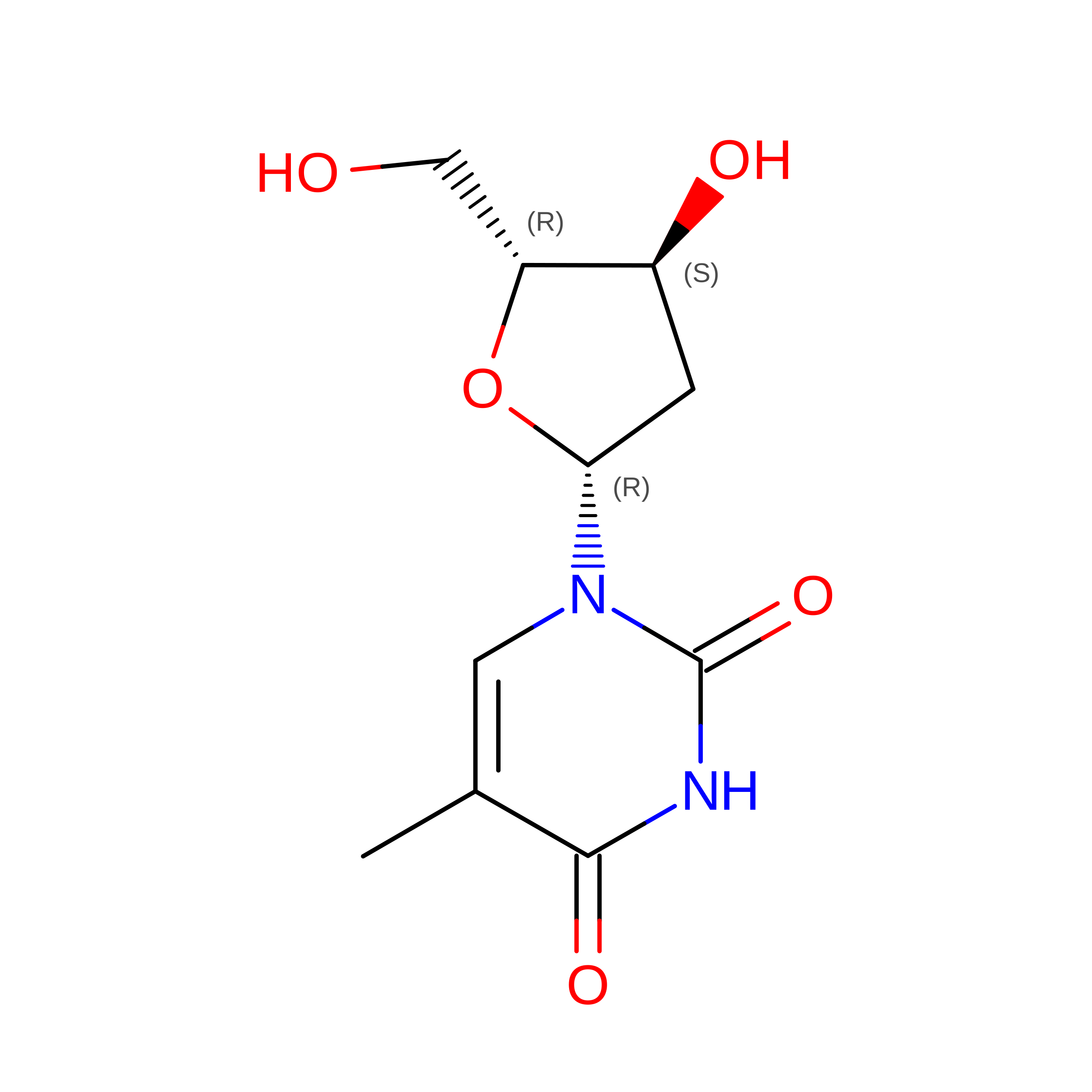
Crystal Structure of Mouse Apolipoprotein A-I Binding Protein in Complex with Thymidine


Experimental Data Snapshot

  • Method: X-RAY DIFFRACTION
  • Resolution: 2.11 Å
  • R-Value Free: 
    0.211 (Depositor), 0.216 (DCC) 
  • R-Value Work: 
    0.177 (Depositor), 0.184 (DCC) 
  • R-Value Observed: 
    0.178 (Depositor) 

Starting Model: experimental
View more details

wwPDB Validation 3D Report Full Report

Validation slider image for 3ROE

Ligand Structure Quality Assessment 


This is version 1.5 of the entry. See complete history

Literature

Identification of unknown protein function using metabolite cocktail screening.

Shumilin, I.A.Cymborowski, M.Chertihin, O.Jha, K.N.Herr, J.C.Lesley, S.A.Joachimiak, A.Minor, W.

(2012) Structure 20: 1715-1725

  • DOI: https://doi.org/10.1016/j.str.2012.07.016
  • Primary Citation Related Structures: 
    3RNO, 3RO7, 3ROE, 3ROG, 3ROX, 3ROZ, 3RPH, 3RPZ, 3RQ2, 3RQ5, 3RQ6, 3RQ8, 3RQH, 3RQQ, 3RQX, 3RRB, 3RRE, 3RRF, 3RRJ, 3RS8, 3RS9, 3RSF, 3RSG, 3RSQ, 3RSS, 3RT7, 3RT9, 3RTA, 3RTB, 3RTC, 3RTD, 3RTE, 3RTG, 3RU2, 3RU3

  • PubMed Abstract: 

    Proteins of unknown function comprise a significant fraction of sequenced genomes. Defining the roles of these proteins is vital to understanding cellular processes. Here, we describe a method to determine a protein function based on the identification of its natural ligand(s) by the crystallographic screening of the binding of a metabolite library, followed by a focused search in the metabolic space. The method was applied to two protein families with unknown function, PF01256 and YjeF_N. The PF01256 proteins, represented by YxkO from Bacillus subtilis and the C-terminal domain of Tm0922 from Thermotoga maritima, were shown to catalyze ADP/ATP-dependent NAD(P)H-hydrate dehydratation, a previously described orphan activity. The YjeF_N proteins, represented by mouse apolipoprotein A-I binding protein and the N-terminal domain of Tm0922, were found to interact with an adenosine diphosphoribose-related substrate and likely serve as ADP-ribosyltransferases. Crystallographic screening of metabolites serves as an efficient tool in functional analyses of uncharacterized proteins.


  • Organizational Affiliation
    • Department of Molecular Physiology and Biological Physics, University of Virginia, Charlottesville, VA 22908, USA. ias2n@virginia.edu

Macromolecule Content 

  • Total Structure Weight: 180.69 kDa 
  • Atom Count: 11,437 
  • Modeled Residue Count: 1,398 
  • Deposited Residue Count: 1,590 
  • Unique protein chains: 1

Macromolecules

Find similar proteins by:|  3D Structure
Entity ID: 1
MoleculeChains  Sequence LengthOrganismDetailsImage
Apolipoprotein A-I-binding protein
A, B, C, D, E
A, B, C, D, E, F
265Mus musculusMutation(s): 0 
Gene Names: AibpApoa1bp
EC: 5.1.99.6
UniProt & NIH Common Fund Data Resources
Find proteins for Q8K4Z3 (Mus musculus)
Explore Q8K4Z3 
Go to UniProtKB:  Q8K4Z3
IMPC:  MGI:2180167
Entity Groups
Sequence Clusters30% Identity50% Identity70% Identity90% Identity95% Identity100% Identity
UniProt GroupQ8K4Z3
Sequence Annotations
Expand
Reference Sequence

Experimental Data & Validation

Experimental Data

  • Method: X-RAY DIFFRACTION
  • Resolution: 2.11 Å
  • R-Value Free:  0.211 (Depositor), 0.216 (DCC) 
  • R-Value Work:  0.177 (Depositor), 0.184 (DCC) 
  • R-Value Observed: 0.178 (Depositor) 
Space Group: C 1 2 1
Unit Cell:
Length ( Å )Angle ( ˚ )
a = 106.209α = 90
b = 124.446β = 102.71
c = 164.249γ = 90
Software Package:
Software NamePurpose
REFMACrefinement
PDB_EXTRACTdata extraction
HKL-3000data collection
HKL-3000data reduction
HKL-3000data scaling
HKL-3000phasing

Structure Validation

View Full Validation Report


Ligand Structure Quality Assessment 


Entry History 

Deposition Data

Revision History  (Full details and data files)

  • Version 1.0: 2012-07-18
    Type: Initial release
  • Version 1.1: 2012-10-31
    Changes: Database references
  • Version 1.2: 2022-04-13
    Changes: Data collection, Database references, Derived calculations, Structure summary
  • Version 1.3: 2023-09-13
    Changes: Data collection, Refinement description
  • Version 1.4: 2023-12-06
    Changes: Data collection
  • Version 1.5: 2024-11-06
    Changes: Structure summary