3R4V | pdb_00003r4v

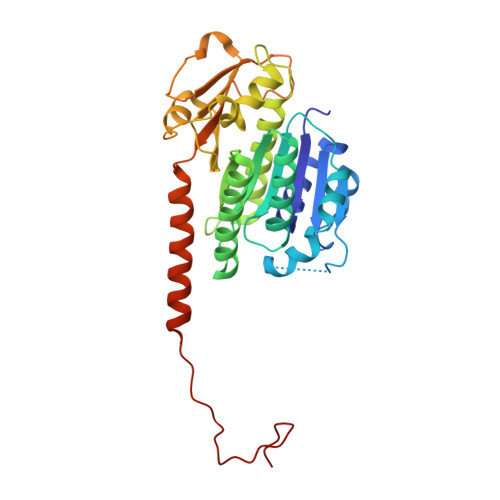
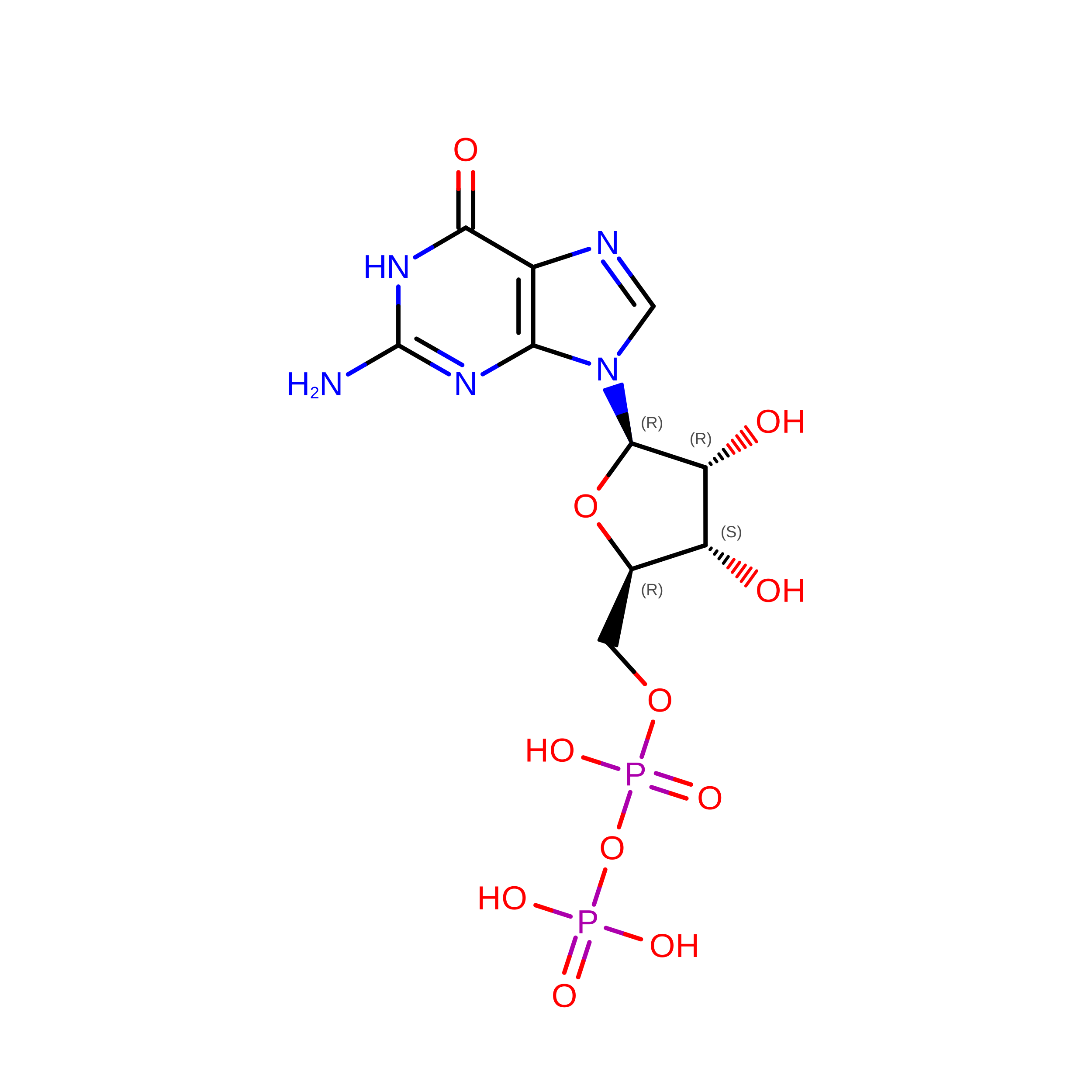
Structure of the phage tubulin PhuZ-GDP


Experimental Data Snapshot

  • Method: X-RAY DIFFRACTION
  • Resolution: 1.67 Å
  • R-Value Free: 
    0.232 (Depositor), 0.225 (DCC) 
  • R-Value Work: 
    0.186 (Depositor), 0.178 (DCC) 
  • R-Value Observed: 
    0.188 (Depositor) 

Starting Model: experimental
View more details

wwPDB Validation 3D Report Full Report

Validation slider image for 3R4V

Ligand Structure Quality Assessment 


This is version 1.3 of the entry. See complete history

Literature

A phage tubulin assembles dynamic filaments by an atypical mechanism to center viral DNA within the host cell.

Kraemer, J.A.Erb, M.L.Waddling, C.A.Montabana, E.A.Zehr, E.A.Wang, H.Nguyen, K.Pham, D.S.Agard, D.A.Pogliano, J.

(2012) Cell 149: 1488-1499

  • DOI: https://doi.org/10.1016/j.cell.2012.04.034
  • Primary Citation Related Structures: 
    3R4V, 3RB8

  • PubMed Abstract: 

    Tubulins are essential for the reproduction of many eukaryotic viruses, but historically, bacteriophage were assumed not to require a cytoskeleton. Here, we identify a tubulin-like protein, PhuZ, from bacteriophage 201φ2-1 and show that it forms filaments in vivo and in vitro. The PhuZ structure has a conserved tubulin fold, with an unusual, extended C terminus that we demonstrate to be critical for polymerization in vitro and in vivo. Longitudinal packing in the crystal lattice mimics packing observed by EM of in-vitro-formed filaments, indicating how interactions between the C terminus and the following monomer drive polymerization. PhuZ forms a filamentous array that is required for positioning phage DNA within the bacterial cell. Correct positioning to the cell center and optimal phage reproduction only occur when the PhuZ filament is dynamic. Thus, we show that PhuZ assembles a spindle-like array that functions analogously to the microtubule-based spindles of eukaryotes.


  • Organizational Affiliation
    • Department of Biochemistry and Biophysics and the Howard Hughes Medical Institute, University of California, San Francisco, San Francisco, CA 94158, USA.

Macromolecule Content 

  • Total Structure Weight: 35.13 kDa 
  • Atom Count: 2,831 
  • Modeled Residue Count: 311 
  • Deposited Residue Count: 315 
  • Unique protein chains: 1

Macromolecules

Find similar proteins by:|  3D Structure
Entity ID: 1
MoleculeChains  Sequence LengthOrganismDetailsImage
Putative uncharacterized protein315Pseudomonas phage 201phi2-1Mutation(s): 0 
EC: 3.6.5
UniProt
Find proteins for B3FK34 (Pseudomonas phage 201phi2-1)
Explore B3FK34 
Go to UniProtKB:  B3FK34
Entity Groups
Sequence Clusters30% Identity50% Identity70% Identity90% Identity95% Identity100% Identity
UniProt GroupB3FK34
Sequence Annotations
Expand
Reference Sequence

Small Molecules

Experimental Data & Validation

Experimental Data

  • Method: X-RAY DIFFRACTION
  • Resolution: 1.67 Å
  • R-Value Free:  0.232 (Depositor), 0.225 (DCC) 
  • R-Value Work:  0.186 (Depositor), 0.178 (DCC) 
  • R-Value Observed: 0.188 (Depositor) 
Space Group: P 21 21 21
Unit Cell:
Length ( Å )Angle ( ˚ )
a = 47.065α = 90
b = 75.935β = 90
c = 92.798γ = 90
Software Package:
Software NamePurpose
Blu-Icedata collection
SOLVEphasing
PHENIXrefinement
MOSFLMdata reduction
SCALAdata scaling

Structure Validation

View Full Validation Report


Ligand Structure Quality Assessment 


Entry History 

Deposition Data

Revision History  (Full details and data files)

  • Version 1.0: 2012-07-04
    Type: Initial release
  • Version 1.1: 2013-01-23
    Changes: Database references
  • Version 1.2: 2024-02-21
    Changes: Data collection, Database references, Derived calculations
  • Version 1.3: 2024-04-03
    Changes: Refinement description