3QYT | pdb_00003qyt

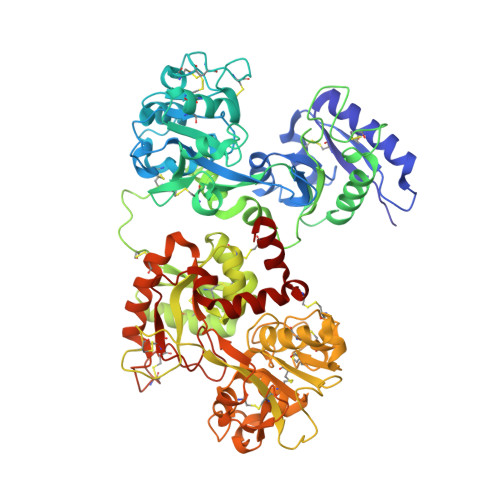
Diferric bound human serum transferrin


Experimental Data Snapshot

  • Method: X-RAY DIFFRACTION
  • Resolution: 2.80 Å
  • R-Value Free: 
    0.275 (Depositor), 0.267 (DCC) 
  • R-Value Work: 
    0.206 (Depositor), 0.198 (DCC) 
  • R-Value Observed: 
    0.210 (Depositor) 

Starting Models: experimental
View more details

wwPDB Validation 3D Report Full Report

Validation slider image for 3QYT

Ligand Structure Quality Assessment 


This is version 1.6 of the entry. See complete history

Literature

Iron and bismuth bound human serum transferrin reveals a partially-opened conformation in the N-lobe

Yang, N.Zhang, H.Wang, M.Hao, Q.Sun, H.

(2012) Sci Rep 2: 999-999

  • DOI: https://doi.org/10.1038/srep00999
  • Primary Citation Related Structures: 
    3QYT, 4H0W

  • PubMed Abstract: 

    Human serum transferrin (hTF) binds Fe(III) tightly but reversibly, and delivers it to cells via a receptor-mediated endocytosis process. The metal-binding and release result in significant conformational changes of the protein. Here, we report the crystal structures of diferric-hTF (Fe(N)Fe(C)-hTF) and bismuth-bound hTF (Bi(N)Fe(C)-hTF) at 2.8 and 2.4 Å resolutions respectively. Notably, the N-lobes of both structures exhibit unique "partially-opened" conformations between those of the apo-hTF and holo-hTF. Fe(III) and Bi(III) in the N-lobe coordinate to, besides anions, only two (Tyr95 and Tyr188) and one (Tyr188) tyrosine residues, respectively, in contrast to four residues in the holo-hTF. The C-lobe of both structures are fully closed with iron coordinating to four residues and a carbonate. The structures of hTF observed here represent key conformers captured in the dynamic nature of the transferrin family proteins and provide a structural basis for understanding the mechanism of metal uptake and release in transferrin families.


  • Organizational Affiliation
    • Department of Chemistry, the University of Hong Kong, Pokfulam Road, Hong Kong, PR China.

Macromolecule Content 

  • Total Structure Weight: 76.05 kDa 
  • Atom Count: 5,316 
  • Modeled Residue Count: 679 
  • Deposited Residue Count: 679 
  • Unique protein chains: 1

Macromolecules

Find similar proteins by:|  3D Structure
Entity ID: 1
MoleculeChains  Sequence LengthOrganismDetailsImage
Serotransferrin679Homo sapiensMutation(s): 0 
UniProt & NIH Common Fund Data Resources
Find proteins for P02787 (Homo sapiens)
Explore P02787 
Go to UniProtKB:  P02787
PHAROS:  P02787
GTEx:  ENSG00000091513 
Entity Groups
Sequence Clusters30% Identity50% Identity70% Identity90% Identity95% Identity100% Identity
UniProt GroupP02787
Glycosylation
Glycosylation Sites: 2Go to GlyGen: P02787-1
Sequence Annotations
Expand
Reference Sequence

Small Molecules

Ligands 4 Unique
IDChains Name / Formula / InChI Key2D Diagram3D Interactions
NAG

Query on NAG


Download:Ideal Coordinates CCD File
F [auth A],
G [auth A]
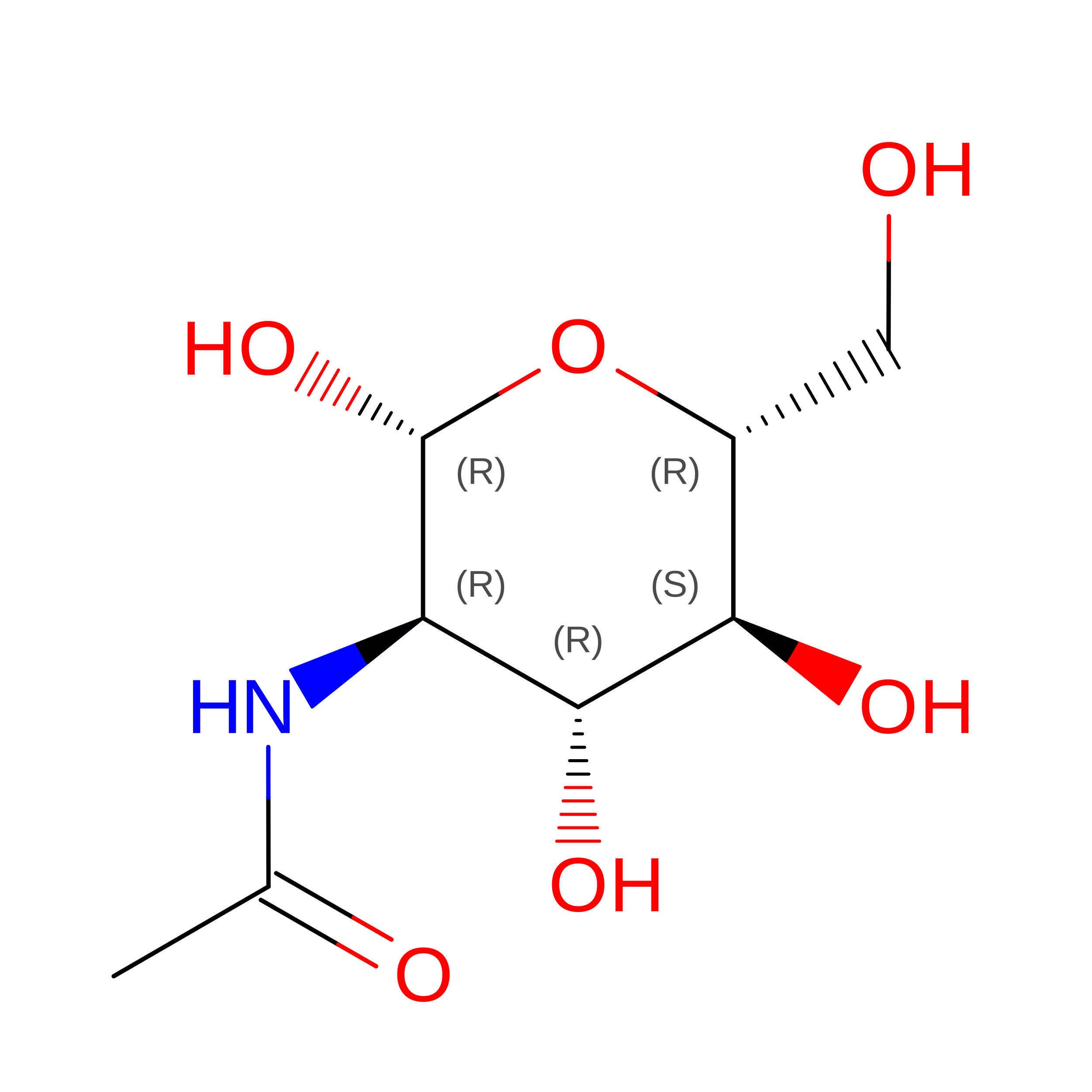
2-acetamido-2-deoxy-beta-D-glucopyranose
C8 H15 N O6
OVRNDRQMDRJTHS-FMDGEEDCSA-N
SO4

Query on SO4


Download:Ideal Coordinates CCD File
H [auth A]SULFATE ION
O4 S
QAOWNCQODCNURD-UHFFFAOYSA-L
CO3

Query on CO3


Download:Ideal Coordinates CCD File
C [auth A],
E [auth A]
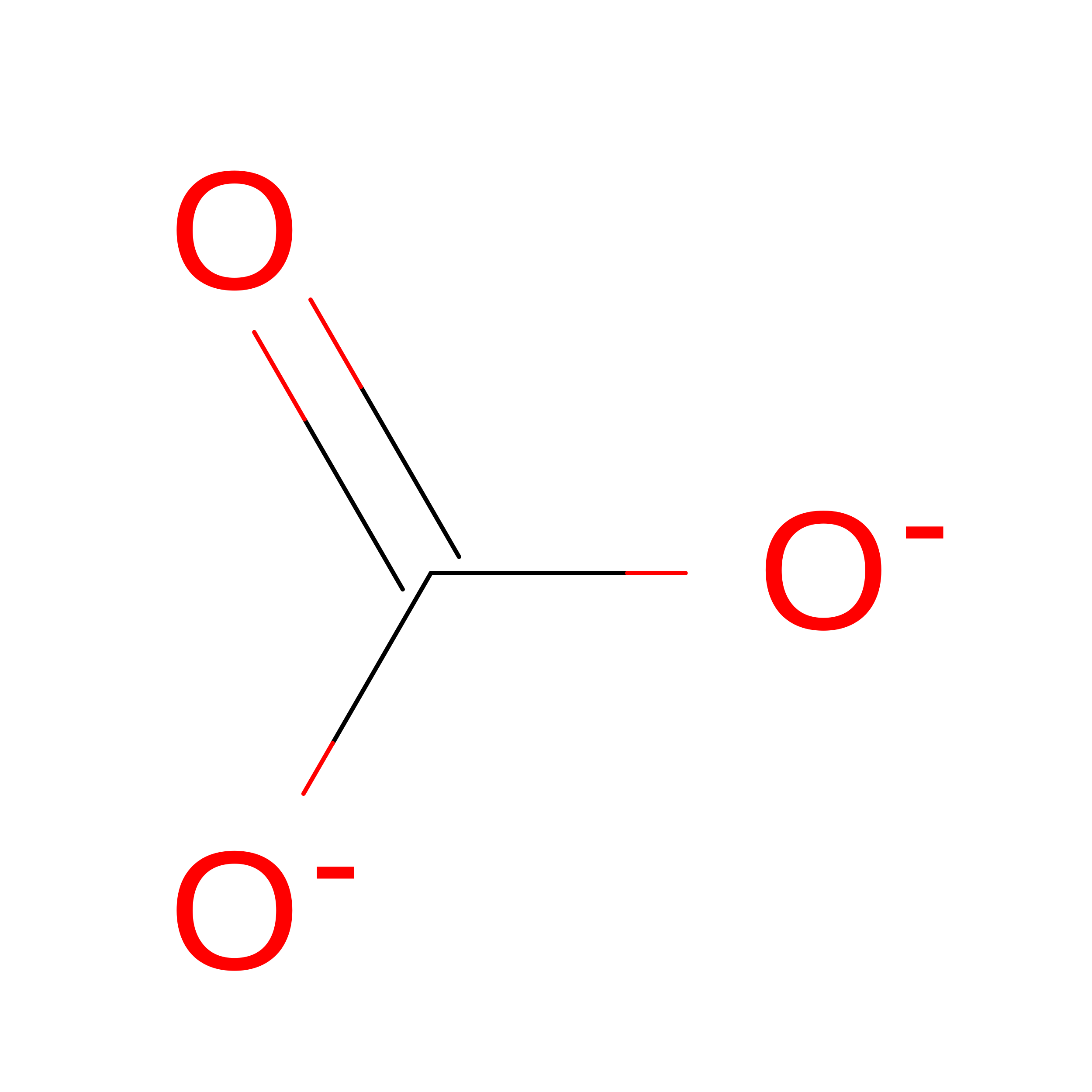
CARBONATE ION
C O3
BVKZGUZCCUSVTD-UHFFFAOYSA-L
FE

Query on FE


Download:Ideal Coordinates CCD File
B [auth A],
D [auth A]
FE (III) ION
Fe
VTLYFUHAOXGGBS-UHFFFAOYSA-N

Experimental Data & Validation

Experimental Data

  • Method: X-RAY DIFFRACTION
  • Resolution: 2.80 Å
  • R-Value Free:  0.275 (Depositor), 0.267 (DCC) 
  • R-Value Work:  0.206 (Depositor), 0.198 (DCC) 
  • R-Value Observed: 0.210 (Depositor) 
Space Group: P 21 21 21
Unit Cell:
Length ( Å )Angle ( ˚ )
a = 73.845α = 90
b = 90.435β = 90
c = 112.299γ = 90
Software Package:
Software NamePurpose
DENZOdata reduction
SCALEPACKdata scaling
REFMACrefinement
PDB_EXTRACTdata extraction
PHASERphasing

Structure Validation

View Full Validation Report


Ligand Structure Quality Assessment 


Entry History 

Deposition Data

Revision History  (Full details and data files)

  • Version 1.0: 2012-03-14
    Type: Initial release
  • Version 1.1: 2012-12-26
    Changes: Database references, Other, Structure summary
  • Version 1.2: 2013-06-19
    Changes: Database references
  • Version 1.3: 2017-11-08
    Changes: Refinement description
  • Version 1.4: 2020-07-29
    Type: Remediation
    Reason: Carbohydrate remediation
    Changes: Data collection, Derived calculations, Structure summary
  • Version 1.5: 2023-11-01
    Changes: Data collection, Database references, Refinement description, Structure summary
  • Version 1.6: 2024-11-20
    Changes: Structure summary