Download Mendeley
Design and characterization of epitope-scaffold immunogens that present the motavizumab epitope from respiratory syncytial virus.
McLellan, J.S., Correia, B.E., Chen, M., Yang, Y., Graham, B.S., Schief, W.R., Kwong, P.D.(2011) J Mol Biol 409: 853-866
- PubMed: 21549714 Search on PubMedSearch on PubMed Central
- DOI: https://doi.org/10.1016/j.jmb.2011.04.044
- Primary Citation Related Structures:
3QWO - PubMed Abstract:
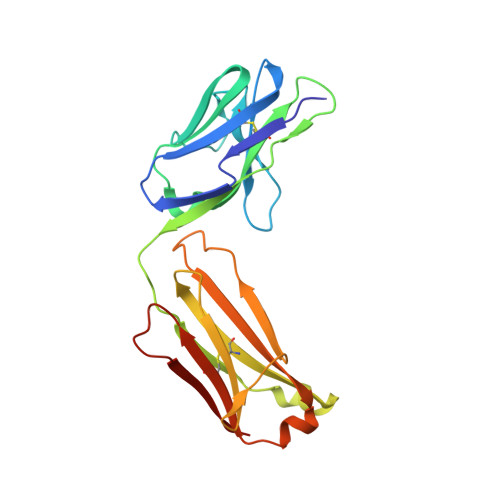
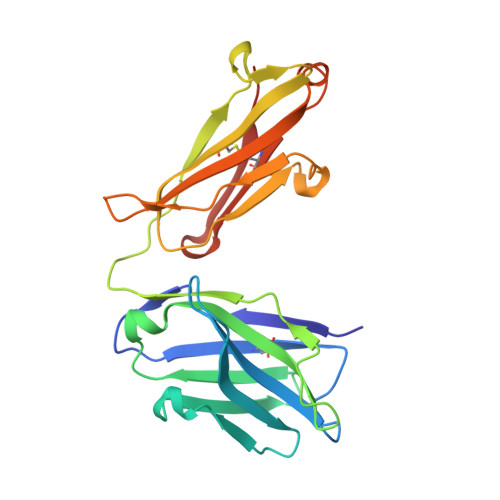
Respiratory syncytial virus (RSV) is a major cause of respiratory tract infections in infants, but an effective vaccine has not yet been developed. An ideal vaccine would elicit protective antibodies while avoiding virus-specific T-cell responses, which have been implicated in vaccine-enhanced disease with previous RSV vaccines. We propose that heterologous proteins designed to present RSV-neutralizing antibody epitopes and to elicit cognate antibodies have the potential to fulfill these vaccine requirements, as they can be fashioned to be free of viral T-cell epitopes. Here we present the design and characterization of three epitope-scaffolds that present the epitope of motavizumab, a potent neutralizing antibody that binds to a helix-loop-helix motif in the RSV fusion glycoprotein. Two of the epitope-scaffolds could be purified, and one epitope-scaffold based on a Staphylococcus aureus protein A domain bound motavizumab with kinetic and thermodynamic properties consistent with the free epitope-scaffold being stabilized in a conformation that closely resembled the motavizumab-bound state. This epitope-scaffold was well folded as assessed by circular dichroism and isothermal titration calorimetry, and its crystal structure (determined in complex with motavizumab to 1.9 Å resolution) was similar to the computationally designed model, with all hydrogen-bond interactions critical for binding to motavizumab preserved. Immunization of mice with this epitope-scaffold failed to elicit neutralizing antibodies but did elicit sera with F binding activity. The elicitation of F binding antibodies suggests that some of the design criteria for eliciting protective antibodies without virus-specific T-cell responses are being met, but additional optimization of these novel immunogens is required.
- Vaccine Research Center, National Institute of Allergy and Infectious Diseases, National Institutes of Health, Bethesda, MD 20892, USA. mclellanja@mail.nih.gov
Organizational Affiliation: