3QW5 | pdb_00003qw5

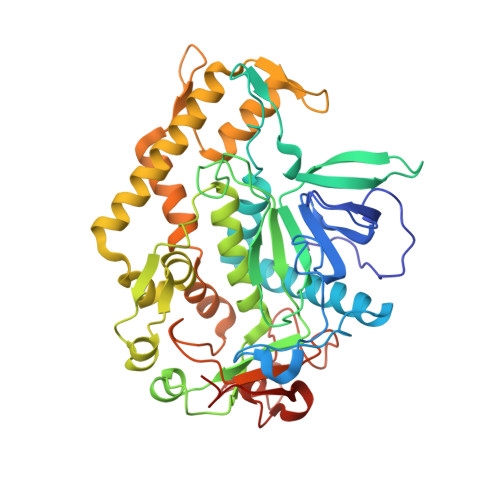
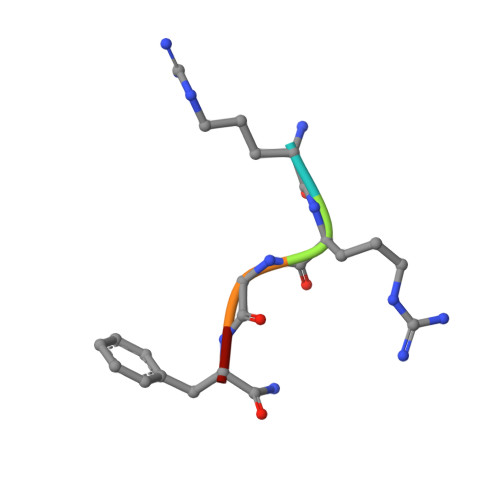
Crystal structure of the protease domain of Botulinum Neurotoxin Serotype A with a peptide inhibitor RRGF


Experimental Data Snapshot

  • Method: X-RAY DIFFRACTION
  • Resolution: 1.60 Å
  • R-Value Free: 
    0.232 (Depositor), 0.224 (DCC) 
  • R-Value Work: 
    0.213 (Depositor), 0.206 (DCC) 
  • R-Value Observed: 
    0.213 (Depositor) 

Starting Model: experimental
View more details

wwPDB Validation 3D Report Full Report

Validation slider image for 3QW5

This is version 1.5 of the entry. See complete history

Literature

Peptide inhibitors of botulinum neurotoxin serotype A: design, inhibition, cocrystal structures, structure-activity relationship and pharmacophore modeling.

Kumar, G.Kumaran, D.Ahmed, S.A.Swaminathan, S.

(2012) Acta Crystallogr D Biol Crystallogr 68: 511-520

  • DOI: https://doi.org/10.1107/S0907444912003551
  • Primary Citation Related Structures: 
    3QW5, 3QW6, 3QW7, 3QW8

  • PubMed Abstract: 

    Clostridium botulinum neurotoxins are classified as Category A bioterrorism agents by the Centers for Disease Control and Prevention (CDC). The seven serotypes (A-G) of the botulinum neurotoxin, the causative agent of the disease botulism, block neurotransmitter release by specifically cleaving one of the three SNARE (soluble N-ethylmaleimide-sensitive factor attachment protein receptor) proteins and induce flaccid paralysis. Using a structure-based drug-design approach, a number of peptide inhibitors were designed and their inhibitory activity against botulinum serotype A (BoNT/A) protease was determined. The most potent peptide, RRGF, inhibited BoNT/A protease with an IC(50) of 0.9 µM and a K(i) of 358 nM. High-resolution crystal structures of various peptide inhibitors in complex with the BoNT/A protease domain were also determined. Based on the inhibitory activities and the atomic interactions deduced from the cocrystal structures, the structure-activity relationship was analyzed and a pharmacophore model was developed. Unlike the currently available models, this pharmacophore model is based on a number of enzyme-inhibitor peptide cocrystal structures and improved the existing models significantly, incorporating new features.


  • Organizational Affiliation
    • Biology Department, Brookhaven National Laboratory, Upton, NY 11973, USA.

Macromolecule Content 

  • Total Structure Weight: 50.3 kDa 
  • Atom Count: 3,748 
  • Modeled Residue Count: 428 
  • Deposited Residue Count: 435 
  • Unique protein chains: 2

Macromolecules

Find similar proteins by:|  3D Structure
Entity ID: 1
MoleculeChains  Sequence LengthOrganismDetailsImage
Botulinum neurotoxin type A430Clostridium botulinum A str. HallMutation(s): 0 
Gene Names: botACBO0806CLC_0862
EC: 3.4.24.69
UniProt
Find proteins for P0DPI1 (Clostridium botulinum (strain Hall / ATCC 3502 / NCTC 13319 / Type A))
Explore P0DPI1 
Go to UniProtKB:  P0DPI1
Entity Groups
Sequence Clusters30% Identity50% Identity70% Identity90% Identity95% Identity100% Identity
UniProt GroupP0DPI1
Sequence Annotations
Expand
Reference Sequence
Find similar proteins by:  Sequence   |   3D Structure  
Entity ID: 2
MoleculeChains  Sequence LengthOrganismDetailsImage
inhibitory peptide RRGF5N/AMutation(s): 0 

Experimental Data & Validation

Experimental Data

  • Method: X-RAY DIFFRACTION
  • Resolution: 1.60 Å
  • R-Value Free:  0.232 (Depositor), 0.224 (DCC) 
  • R-Value Work:  0.213 (Depositor), 0.206 (DCC) 
  • R-Value Observed: 0.213 (Depositor) 
Space Group: P 1 21 1
Unit Cell:
Length ( Å )Angle ( ˚ )
a = 50.669α = 90
b = 66.27β = 98.32
c = 64.568γ = 90
Software Package:
Software NamePurpose
CBASSdata collection
MOLREPphasing
CNSrefinement
HKL-2000data reduction
HKL-2000data scaling

Structure Validation

View Full Validation Report


Entry History 

Deposition Data

Revision History  (Full details and data files)

  • Version 1.0: 2012-02-08
    Type: Initial release
  • Version 1.1: 2012-04-25
    Changes: Database references
  • Version 1.2: 2012-09-19
    Changes: Atomic model
  • Version 1.3: 2013-01-23
    Changes: Database references
  • Version 1.4: 2023-09-13
    Changes: Data collection, Database references, Derived calculations, Refinement description
  • Version 1.5: 2024-11-20
    Changes: Structure summary