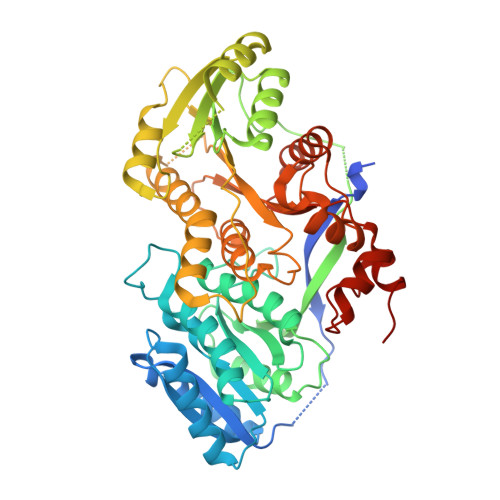
3QP9 | pdb_00003qp9

The Structure of a C2-type Ketoreductase from a Modular Polyketide Synthase


Experimental Data Snapshot

  • Method: X-RAY DIFFRACTION
  • Resolution: 1.88 Å
  • R-Value Free: 
    0.276 (Depositor), 0.283 (DCC) 
  • R-Value Work: 
    0.227 (Depositor) 
  • R-Value Observed: 
    0.229 (Depositor) 

Starting Model: experimental
View more details

wwPDB Validation 3D Report Full Report

Validation slider image for 3QP9

This is version 1.2 of the entry. See complete history

Literature

Structural and functional analysis of c2-type ketoreductases from modular polyketide synthases.

Zheng, J.Keatinge-Clay, A.T.

(2011) J Mol Biology 410: 105-117

  • DOI: https://doi.org/10.1016/j.jmb.2011.04.065
  • Primary Citation Related Structures: 
    3QP9

  • PubMed Abstract: 

    The process by which α-stereocenters of polyketide intermediates are set by modular polyketide synthases (PKSs) when condensation is not immediately followed by reduction is mysterious. However, the reductase-incompetent ketoreductase (KR) from the third module of 6-deoxyerythronolide B synthase has been proposed to operate as a racemase, aiding in the epimerization process that reverses the orientation of the α-methyl group of the polyketide intermediate generated by the ketosynthase to the configuration observed in the 6-deoxyerythronolide B final product. To learn more about the epimerization process, the structure of the C2-type KR from the third module of the pikromycin synthase, analogous to the KR from the third module of 6-deoxyerythronolide B synthase, was determined to 1.88 Å resolution. This first structural analysis of this KR-type reveals differences from reductase-competent KRs such as that the site NADPH binds to reductase-competent KRs is occluded by side chains and the putative catalytic tyrosine possesses more degrees of freedom. The active-site geometry may enable C2-type KRs to align the thioester and β-keto groups of a polyketide intermediate to reduce the pK(a) of the α-proton and accelerate its abstraction. Results from in vivo assays of engineered PKSs support that C2-type KRs cooperate with epimer-specific ketosynthases to set the configurations of substituent-bearing α-carbons.


  • Organizational Affiliation
    • Department of Chemistry and Biochemistry, University of Texas at Austin, Austin, TX 78712, USA.

Macromolecule Content 

  • Total Structure Weight: 214.02 kDa 
  • Atom Count: 13,673 
  • Modeled Residue Count: 1,852 
  • Deposited Residue Count: 2,100 
  • Unique protein chains: 1

Macromolecules

Find similar proteins by:|  3D Structure
Entity ID: 1
MoleculeChains  Sequence LengthOrganismDetailsImage
Type I polyketide synthase PikAII
A, B, C, D
525Streptomyces venezuelaeMutation(s): 0 
Gene Names: pikAII
EC: 1.1.1.100 (PDB Primary Data), 2.3.1.239 (UniProt), 2.3.1.240 (UniProt)
UniProt
Find proteins for Q9ZGI4 (Streptomyces venezuelae)
Explore Q9ZGI4 
Go to UniProtKB:  Q9ZGI4
Entity Groups
Sequence Clusters30% Identity50% Identity70% Identity90% Identity95% Identity100% Identity
UniProt GroupQ9ZGI4
Sequence Annotations
Expand
Reference Sequence

Experimental Data & Validation

Experimental Data

  • Method: X-RAY DIFFRACTION
  • Resolution: 1.88 Å
  • R-Value Free:  0.276 (Depositor), 0.283 (DCC) 
  • R-Value Work:  0.227 (Depositor) 
  • R-Value Observed: 0.229 (Depositor) 
Space Group: P 1 21 1
Unit Cell:
Length ( Å )Angle ( ˚ )
a = 79.636α = 90
b = 150.088β = 105.12
c = 86.868γ = 90
Software Package:
Software NamePurpose
ADSCdata collection
PHASESphasing
REFMACrefinement
HKL-2000data reduction
SCALEPACKdata scaling

Structure Validation

View Full Validation Report


Entry History 

Deposition Data

Revision History  (Full details and data files)

  • Version 1.0: 2011-05-11
    Type: Initial release
  • Version 1.1: 2011-07-13
    Changes: Version format compliance
  • Version 1.2: 2023-09-13
    Changes: Data collection, Database references, Refinement description