3Q9J | pdb_00003q9j

AIIFL segment derived from Alzheimer's Amyloid-Beta displayed on 42-membered macrocycle scaffold


Experimental Data Snapshot

  • Method: X-RAY DIFFRACTION
  • Resolution: 2.55 Å
  • R-Value Free: 
    0.223 (Depositor), 0.213 (DCC) 
  • R-Value Work: 
    0.176 (Depositor), 0.176 (DCC) 
  • R-Value Observed: 
    0.180 (Depositor) 

wwPDB Validation 3D Report Full Report

Validation slider image for 3Q9J

This is version 2.0 of the entry. See complete history

Literature

Characteristics of Amyloid-Related Oligomers Revealed by Crystal Structures of Macrocyclic beta-Sheet Mimics.

Liu, C.Sawaya, M.R.Cheng, P.N.Zheng, J.Nowick, J.S.Eisenberg, D.

(2011) J Am Chem Soc 133: 6736-6744

  • DOI: https://doi.org/10.1021/ja200222n
  • Primary Citation Related Structures: 
    3Q9G, 3Q9H, 3Q9I, 3Q9J

  • PubMed Abstract: 

    Protein amyloid oligomers have been strongly linked to amyloid diseases and can be intermediates to amyloid fibers. β-Sheets have been identified in amyloid oligomers. However, because of their transient and highly polymorphic properties, the details of their self-association remain elusive. Here we explore oligomer structure using a model system: macrocyclic peptides. Key amyloidogenic sequences from Aβ and tau were incorporated into macrocycles, thereby restraining them to β-strands, but limiting the growth of the oligomers so they may crystallize and cannot fibrillate. We determined the atomic structures for four such oligomers, and all four reveal tetrameric interfaces in which β-sheet dimers pair together by highly complementary, dry interfaces, analogous to steric zippers found in fibers, suggesting a common structure for amyloid oligomers and fibers. In amyloid fibers, the axes of the paired sheets are either parallel or antiparallel, whereas the oligomeric interfaces display a variety of sheet-to-sheet pairing angles, offering a structural explanation for the heterogeneity of amyloid oligomers.


  • Organizational Affiliation
    • UCLA-DOE Institute for Genomics and Proteomics, University of California, Los Angeles, California 90095, USA.

Macromolecule Content 

  • Total Structure Weight: 11.59 kDa 
  • Atom Count: 864 
  • Modeled Residue Count: 80 
  • Deposited Residue Count: 80 
  • Unique protein chains: 1

Macromolecules

Find similar proteins by:  Sequence   |   3D Structure  
Entity ID: 1
MoleculeChains  Sequence LengthOrganismDetailsImage
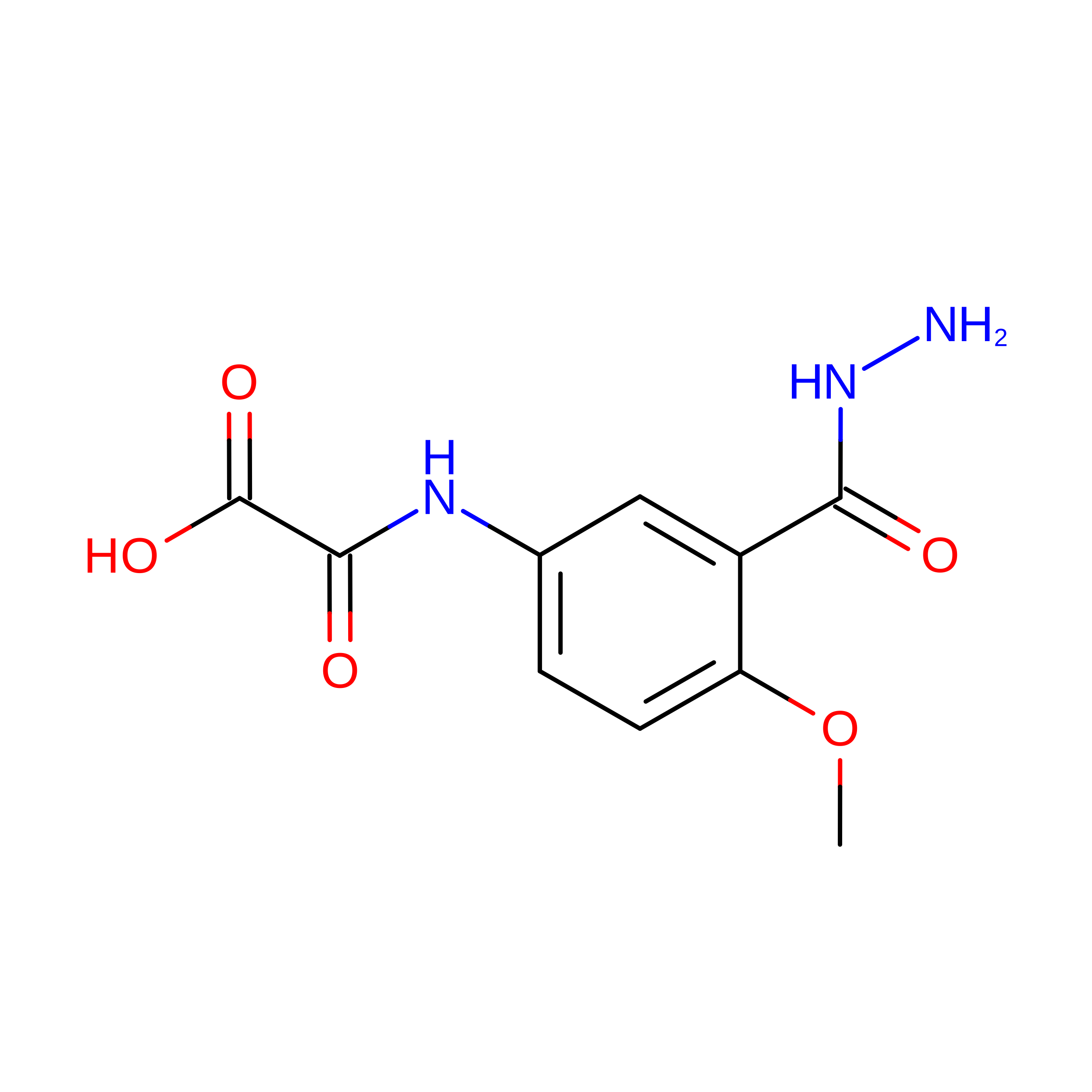
Cyclic pseudo-peptide AIIFL(ORN)(HAO)YK(ORN)
A, B, C, D, E
A, B, C, D, E, F, G, H
10N/AMutation(s): 0 

Small Molecules

Ligands 3 Unique
IDChains Name / Formula / InChI Key2D Diagram3D Interactions
GOL

Query on GOL


Download:Ideal Coordinates CCD File
K [auth B],
V [auth G],
W [auth H]
GLYCEROL
C3 H8 O3
PEDCQBHIVMGVHV-UHFFFAOYSA-N
ZN

Query on ZN


Download:Ideal Coordinates CCD File
I [auth A]
J [auth A]
L [auth B]
M [auth B]
Q [auth E]
I [auth A],
J [auth A],
L [auth B],
M [auth B],
Q [auth E],
R [auth E],
T [auth F],
U [auth F]
ZINC ION
Zn
PTFCDOFLOPIGGS-UHFFFAOYSA-N
CL

Query on CL


Download:Ideal Coordinates CCD File
N [auth C],
O [auth D],
P [auth E],
S [auth F]
CHLORIDE ION
Cl
VEXZGXHMUGYJMC-UHFFFAOYSA-M
Modified Residues  1 Unique
IDChains TypeFormula2D DiagramParent
HAO
Query on HAO
A, B, C, D, E
A, B, C, D, E, F, G, H
PEPTIDE-LIKEC10 H11 N3 O5

--

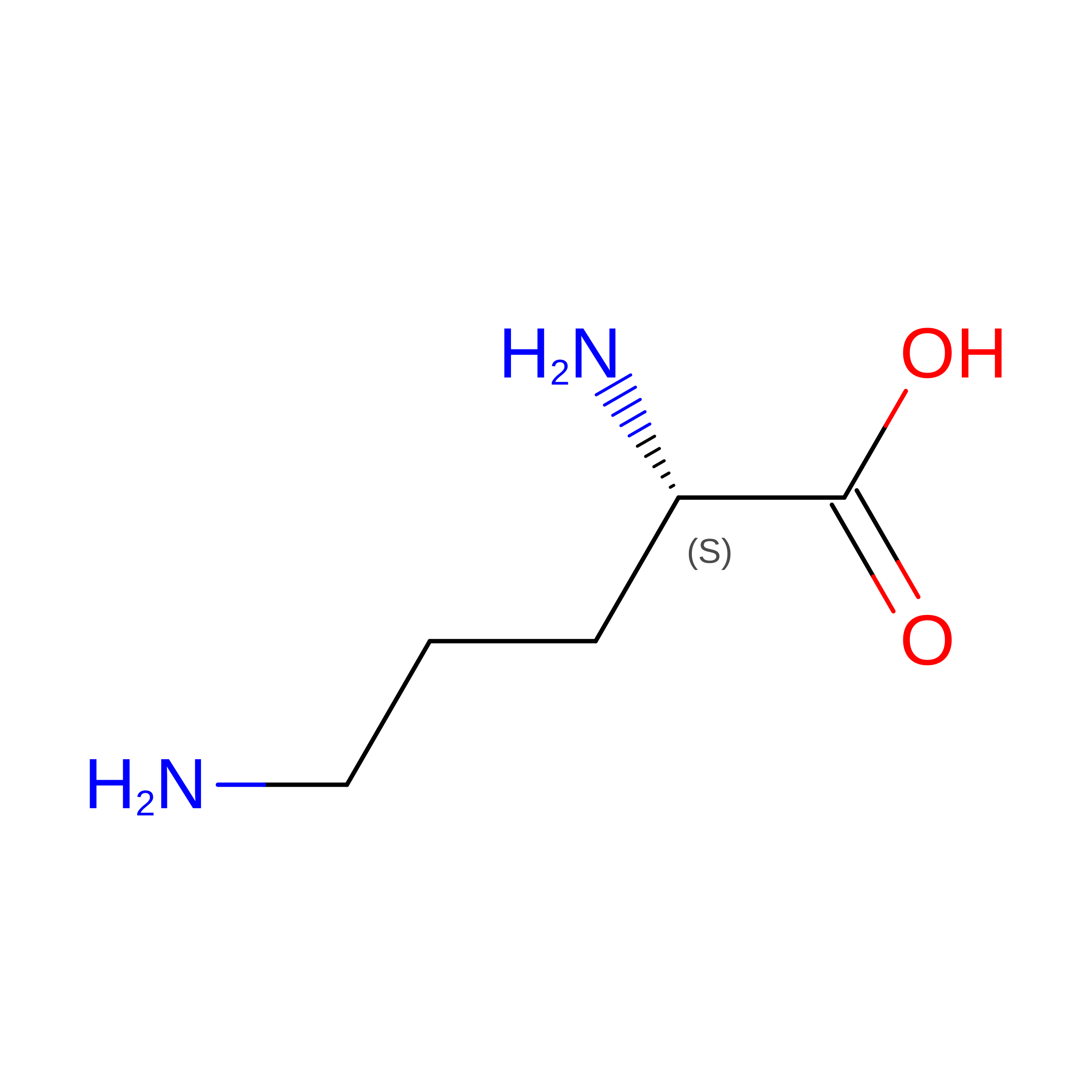
ORN
Query on ORN
A, B, C, D, E
A, B, C, D, E, F, G, H
L-PEPTIDE LINKINGC5 H12 N2 O2ALA

Experimental Data & Validation

Experimental Data

  • Method: X-RAY DIFFRACTION
  • Resolution: 2.55 Å
  • R-Value Free:  0.223 (Depositor), 0.213 (DCC) 
  • R-Value Work:  0.176 (Depositor), 0.176 (DCC) 
  • R-Value Observed: 0.180 (Depositor) 
Space Group: P 31
Unit Cell:
Length ( Å )Angle ( ˚ )
a = 41.78α = 90
b = 41.78β = 90
c = 63.06γ = 120
Software Package:
Software NamePurpose
XSCALEdata scaling
BUSTER-TNTrefinement
PDB_EXTRACTdata extraction
ADSCdata collection
XDSdata reduction
SHELXEmodel building
BUSTERrefinement

Structure Validation

View Full Validation Report


Entry History 

Deposition Data

Revision History  (Full details and data files)

  • Version 1.0: 2011-06-08
    Type: Initial release
  • Version 1.1: 2011-07-13
    Changes: Version format compliance
  • Version 2.0: 2023-11-15
    Changes: Advisory, Atomic model, Data collection, Database references, Derived calculations