3Q4W | pdb_00003q4w

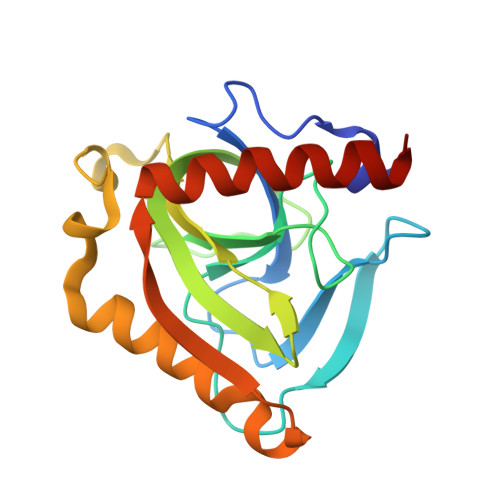
The structure of archaeal inorganic pyrophosphatase in complex with substrate


Experimental Data Snapshot

  • Method: X-RAY DIFFRACTION
  • R-Value Free: 
    0.148 (DCC) 
  • R-Value Work: 
    0.117 (DCC) 

Starting Model: experimental
View more details

wwPDB Validation 3D Report Full Report

Validation slider image for 3Q4W

This is version 1.5 of the entry. See complete history

Literature

Inorganic pyrophosphatase crystals from Thermococcus thioreducens for X-ray and neutron diffraction.

Hughes, R.C.Coates, L.Blakeley, M.P.Tomanicek, S.J.Langan, P.Kovalevsky, A.Y.Garcia-Ruiz, J.M.Ng, J.D.

(2012) Acta Crystallogr Sect F Struct Biol Cryst Commun 68: 1482-1487

  • DOI: https://doi.org/10.1107/S1744309112032447
  • Primary Citation Related Structures: 
    3Q3L, 3Q46, 3Q4W

  • PubMed Abstract: 

    Inorganic pyrophosphatase (IPPase) from the archaeon Thermococcus thioreducens was cloned, overexpressed in Escherichia coli, purified and crystallized in restricted geometry, resulting in large crystal volumes exceeding 5 mm3. IPPase is thermally stable and is able to resist denaturation at temperatures above 348 K. Owing to the high temperature tolerance of the enzyme, the protein was amenable to room-temperature manipulation at the level of protein preparation, crystallization and X-ray and neutron diffraction analyses. A complete synchrotron X-ray diffraction data set to 1.85 Å resolution was collected at room temperature from a single crystal of IPPase (monoclinic space group C2, unit-cell parameters a=106.11, b=95.46, c=113.68 Å, α=γ=90.0, β=98.12°). As large-volume crystals of IPPase can be obtained, preliminary neutron diffraction tests were undertaken. Consequently, Laue diffraction images were obtained, with reflections observed to 2.1 Å resolution with I/σ(I) greater than 2.5. The preliminary crystallographic results reported here set in place future structure-function and mechanism studies of IPPase.


  • Organizational Affiliation
    • Department of Biological Sciences and Laboratory for Structural Biology, University of Alabama in Huntsville, Huntsville, AL 35899, USA.

Macromolecule Content 

  • Total Structure Weight: 21.28 kDa 
  • Atom Count: 1,872 
  • Modeled Residue Count: 175 
  • Deposited Residue Count: 178 
  • Unique protein chains: 1

Macromolecules

Find similar proteins by:|  3D Structure
Entity ID: 1
MoleculeChains  Sequence LengthOrganismDetailsImage
Tt-IPPase178Thermococcus thioreducensMutation(s): 0 
Gene Names: Tt-IPPase
EC: 3.6.1.1
UniProt
Find proteins for H2L2L6 (Thermococcus thioreducens)
Explore H2L2L6 
Go to UniProtKB:  H2L2L6
Entity Groups
Sequence Clusters30% Identity50% Identity70% Identity90% Identity95% Identity100% Identity
UniProt GroupH2L2L6
Sequence Annotations
Expand
Reference Sequence

Small Molecules

Ligands 4 Unique
IDChains Name / Formula / InChI Key2D Diagram3D Interactions
POP

Query on POP


Download:Ideal Coordinates CCD File
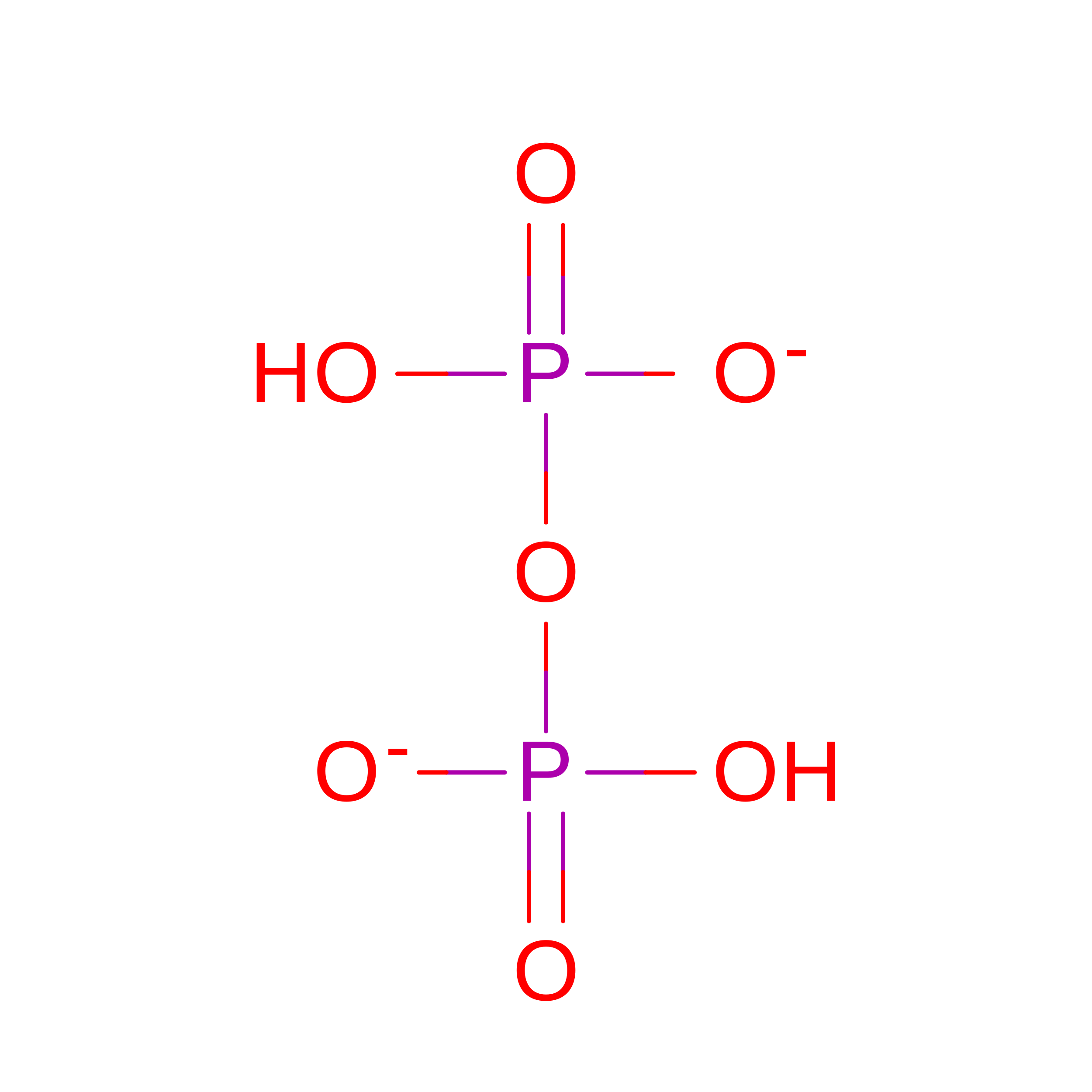
D [auth A]PYROPHOSPHATE 2-
H2 O7 P2
XPPKVPWEQAFLFU-UHFFFAOYSA-L
BR

Query on BR


Download:Ideal Coordinates CCD File
E [auth A]BROMIDE ION
Br
CPELXLSAUQHCOX-UHFFFAOYSA-M
CA

Query on CA


Download:Ideal Coordinates CCD File
B [auth A],
C [auth A],
G [auth A]
CALCIUM ION
Ca
BHPQYMZQTOCNFJ-UHFFFAOYSA-N
NA

Query on NA


Download:Ideal Coordinates CCD File
F [auth A]SODIUM ION
Na
FKNQFGJONOIPTF-UHFFFAOYSA-N

Experimental Data & Validation

Experimental Data

  • Method: X-RAY DIFFRACTION
  • R-Value Free:  0.148 (DCC) 
  • R-Value Work:  0.117 (DCC) 
Space Group: H 3 2
Unit Cell:
Length ( Å )Angle ( ˚ )
a = 100.046α = 90
b = 100.046β = 90
c = 98.711γ = 120
Software Package:
Software NamePurpose
DENZOdata reduction
SCALEPACKdata scaling
MOLREPphasing
PHENIXrefinement
PDB_EXTRACTdata extraction
HKL-2000data collection

Structure Validation

View Full Validation Report


Entry History 

Deposition Data

Revision History  (Full details and data files)

  • Version 1.0: 2012-01-04
    Type: Initial release
  • Version 1.1: 2012-01-11
    Changes: Data collection, Experimental preparation
  • Version 1.2: 2012-02-29
    Changes: Database references
  • Version 1.3: 2014-09-17
    Changes: Database references
  • Version 1.4: 2018-01-24
    Changes: Advisory, Structure summary
  • Version 1.5: 2023-09-13
    Changes: Advisory, Data collection, Database references, Derived calculations, Refinement description