3Q1M | pdb_00003q1m

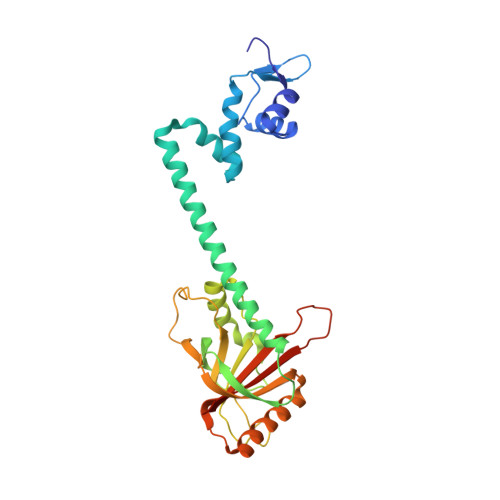
Crystal Structure of BmrR Dimer bound to DNA and the ligand 4-amino-quinaldine


Experimental Data Snapshot

  • Method: X-RAY DIFFRACTION
  • Resolution: 3.20 Å
  • R-Value Free: 
    0.272 (Depositor), 0.282 (DCC) 
  • R-Value Work: 
    0.229 (Depositor), 0.242 (DCC) 
  • R-Value Observed: 
    0.231 (Depositor) 

wwPDB Validation 3D Report Full Report

Validation slider image for 3Q1M

Ligand Structure Quality Assessment 


This is version 1.4 of the entry. See complete history

Literature

Structural contributions to multidrug recognition in the multidrug resistance (MDR) gene regulator, BmrR.

Bachas, S.Eginton, C.Gunio, D.Wade, H.

(2011) Proc Natl Acad Sci U S A 108: 11046-11051

  • DOI: https://doi.org/10.1073/pnas.1104850108
  • Primary Citation Related Structures: 
    3Q1M, 3Q2Y, 3Q3D, 3Q5P, 3Q5R, 3Q5S

  • PubMed Abstract: 

    Current views of multidrug (MD) recognition focus on large drug-binding cavities with flexible elements. However, MD recognition in BmrR is supported by a small, rigid drug-binding pocket. Here, a detailed description of MD binding by the noncanonical BmrR protein is offered through the combined use of X-ray and solution studies. Low shape complementarity, suboptimal packing, and efficient burial of a diverse set of ligands is facilitated by an aromatic docking platform formed by a set of conformationally fixed aromatic residues, hydrophobic pincer pair that locks the different drug structures on the adaptable platform surface, and a trio of acidic residues that enables cation selectivity without much regard to ligand structure. Within the binding pocket is a set of BmrR-derived H-bonding donor and acceptors that solvate a wide range of ligand polar substituent arrangements in a manner analogous to aqueous solvent. Energetic analyses of MD binding by BmrR are consistent with structural data. A common binding orientation for the different BmrR ligands is in line with promiscuous allosteric regulation.


  • Organizational Affiliation
    • Department of Biophysics and Biophysical Chemistry, Johns Hopkins School of Medicine, Baltimore, MD 21205, USA.

Macromolecule Content 

  • Total Structure Weight: 40.69 kDa 
  • Atom Count: 2,661 
  • Modeled Residue Count: 299 
  • Deposited Residue Count: 307 
  • Unique protein chains: 1
  • Unique nucleic acid chains: 1

Macromolecules


Find similar proteins by:|  3D Structure
Entity ID: 1
MoleculeChains  Sequence LengthOrganismDetailsImage
Multidrug-efflux transporter 1 regulator284Bacillus subtilisMutation(s): 0 
Gene Names: bmrRbmr1RBSU24020
UniProt
Find proteins for P39075 (Bacillus subtilis (strain 168))
Explore P39075 
Go to UniProtKB:  P39075
Entity Groups
Sequence Clusters30% Identity50% Identity70% Identity90% Identity95% Identity100% Identity
UniProt GroupP39075
Sequence Annotations
Expand
Reference Sequence
Find similar nucleic acids by:  Sequence
Entity ID: 2
MoleculeChains LengthOrganismImage
23 bp promoter DNA23N/A
Sequence Annotations
Expand
Reference Sequence

Small Molecules

Ligands 1 Unique
IDChains Name / Formula / InChI Key2D Diagram3D Interactions
M4A

Query on M4A


Download:Ideal Coordinates CCD File
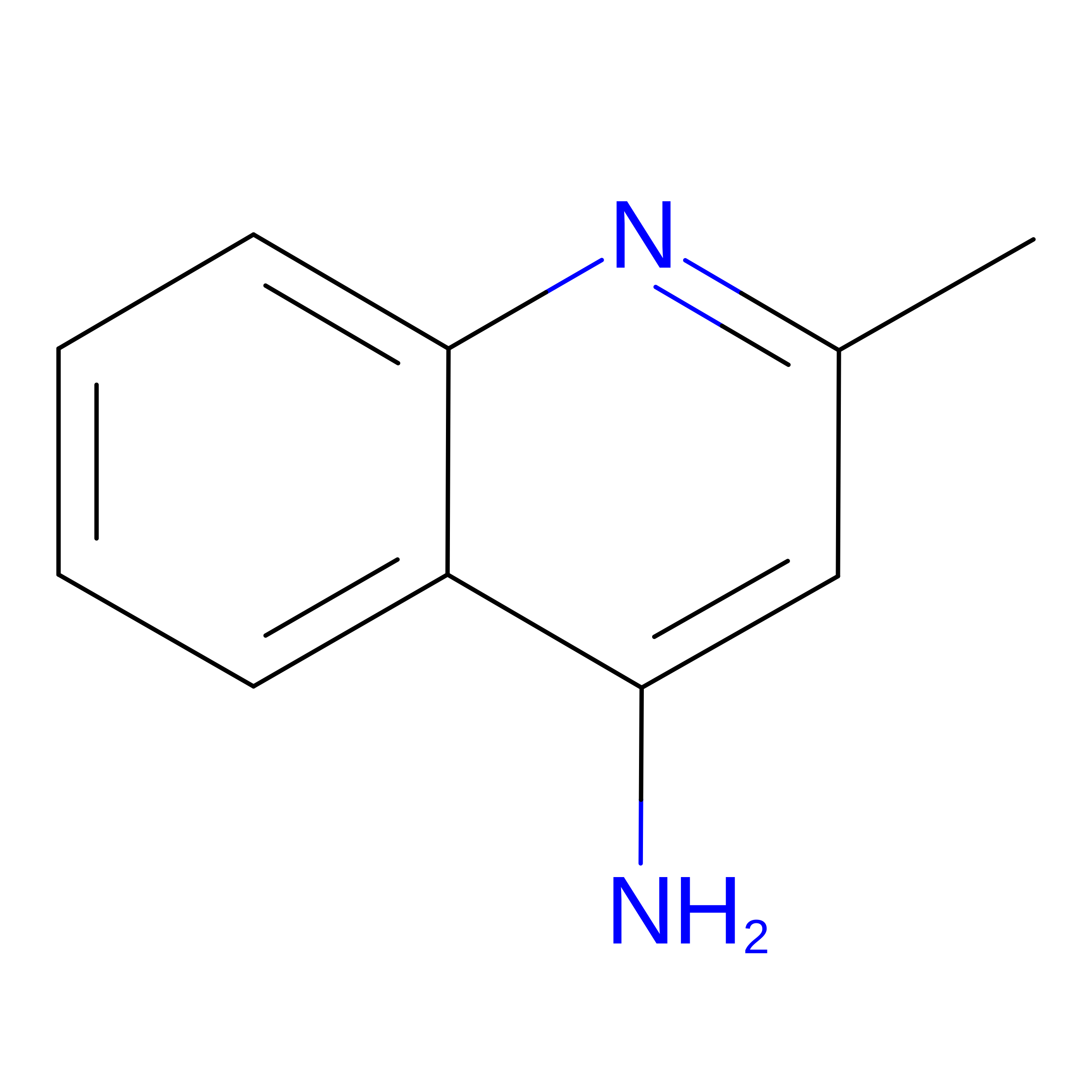
C [auth A]2-methylquinolin-4-amine
C10 H10 N2
COCFIBRMFPWUDW-UHFFFAOYSA-N

Experimental Data & Validation

Experimental Data

  • Method: X-RAY DIFFRACTION
  • Resolution: 3.20 Å
  • R-Value Free:  0.272 (Depositor), 0.282 (DCC) 
  • R-Value Work:  0.229 (Depositor), 0.242 (DCC) 
  • R-Value Observed: 0.231 (Depositor) 
Space Group: P 43 2 2
Unit Cell:
Length ( Å )Angle ( ˚ )
a = 106.525α = 90
b = 106.525β = 90
c = 146.469γ = 90
Software Package:
Software NamePurpose
MAR345dtbdata collection
CNSrefinement
HKL-2000data reduction
HKL-2000data scaling

Structure Validation

View Full Validation Report


Ligand Structure Quality Assessment 


Entry History 

Deposition Data

Revision History  (Full details and data files)

  • Version 1.0: 2011-06-15
    Type: Initial release
  • Version 1.1: 2011-07-13
    Changes: Version format compliance
  • Version 1.2: 2011-07-20
    Changes: Database references
  • Version 1.3: 2017-11-08
    Changes: Refinement description
  • Version 1.4: 2024-02-21
    Changes: Data collection, Database references, Derived calculations