3Q16 | pdb_00003q16

Linkage between the Bacterial Acid Stress and Stringent Responses: The Structure of the Inducible Lysine Decarboxylase


Experimental Data Snapshot

  • Method: X-RAY DIFFRACTION
  • Resolution: 4.10 Å
  • R-Value Free: 
    0.304 (Depositor), 0.305 (DCC) 
  • R-Value Work: 
    0.276 (Depositor), 0.278 (DCC) 
  • R-Value Observed: 
    0.278 (Depositor) 

Starting Model: experimental
View more details

wwPDB Validation 3D Report Full Report

Validation slider image for 3Q16

This is version 1.3 of the entry. See complete history

Literature

Linkage between the bacterial acid stress and stringent responses: the structure of the inducible lysine decarboxylase.

Kanjee, U.Gutsche, I.Alexopoulos, E.Zhao, B.El Bakkouri, M.Thibault, G.Liu, K.Ramachandran, S.Snider, J.Pai, E.F.Houry, W.A.

(2011) EMBO J 30: 931-944

  • DOI: https://doi.org/10.1038/emboj.2011.5
  • Primary Citation Related Structures: 
    3N75, 3Q16

  • PubMed Abstract: 

    The Escherichia coli inducible lysine decarboxylase, LdcI/CadA, together with the inner-membrane lysine-cadaverine antiporter, CadB, provide cells with protection against mild acidic conditions (pH∼5). To gain a better understanding of the molecular processes underlying the acid stress response, the X-ray crystal structure of LdcI was determined. The structure revealed that the protein is an oligomer of five dimers that associate to form a decamer. Surprisingly, LdcI was found to co-crystallize with the stringent response effector molecule ppGpp, also known as the alarmone, with 10 ppGpp molecules in the decamer. ppGpp is known to mediate the stringent response, which occurs in response to nutrient deprivation. The alarmone strongly inhibited LdcI enzymatic activity. This inhibition is important for modulating the consumption of lysine in cells during acid stress under nutrient limiting conditions. Hence, our data provide direct evidence for a link between the bacterial acid stress and stringent responses.


  • Organizational Affiliation
    • Department of Biochemistry, University of Toronto, Toronto, Ontario, Canada.

Macromolecule Content 

  • Total Structure Weight: 407.93 kDa 
  • Atom Count: 28,537 
  • Modeled Residue Count: 3,555 
  • Deposited Residue Count: 3,575 
  • Unique protein chains: 1

Macromolecules

Find similar proteins by:|  3D Structure
Entity ID: 1
MoleculeChains  Sequence LengthOrganismDetailsImage
Lysine decarboxylase, inducible
A, B, C, D, E
715Escherichia coli K-12Mutation(s): 0 
Gene Names: cadAldcI
EC: 4.1.1.18
UniProt
Find proteins for P0A9H3 (Escherichia coli (strain K12))
Explore P0A9H3 
Go to UniProtKB:  P0A9H3
Entity Groups
Sequence Clusters30% Identity50% Identity70% Identity90% Identity95% Identity100% Identity
UniProt GroupP0A9H3
Sequence Annotations
Expand
Reference Sequence

Small Molecules

Modified Residues  1 Unique
IDChains TypeFormula2D DiagramParent
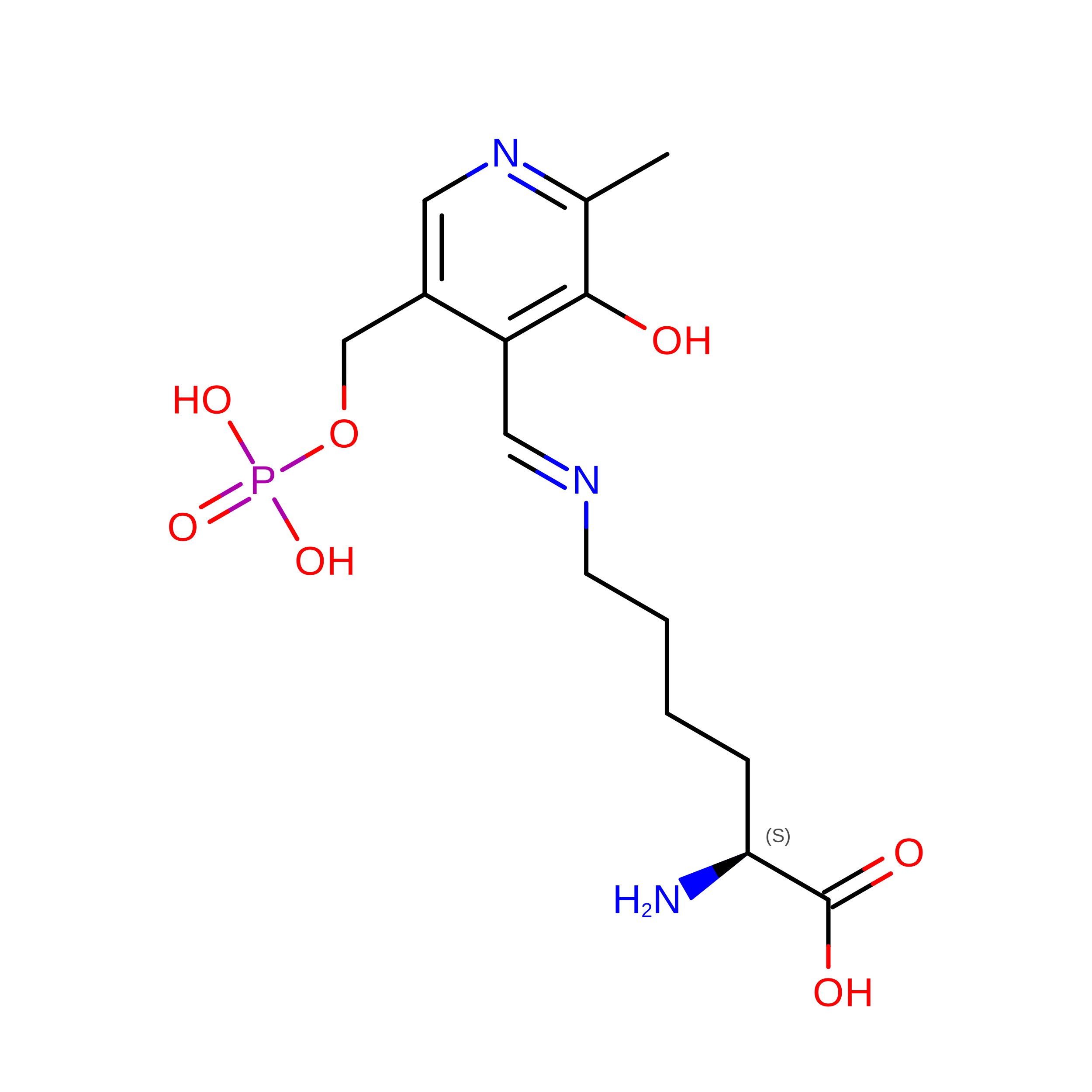
LLP
Query on LLP
A, B, C, D, E
L-PEPTIDE LINKINGC14 H22 N3 O7 PLYS

Experimental Data & Validation

Experimental Data

  • Method: X-RAY DIFFRACTION
  • Resolution: 4.10 Å
  • R-Value Free:  0.304 (Depositor), 0.305 (DCC) 
  • R-Value Work:  0.276 (Depositor), 0.278 (DCC) 
  • R-Value Observed: 0.278 (Depositor) 
Space Group: C 1 2 1
Unit Cell:
Length ( Å )Angle ( ˚ )
a = 270.29α = 90
b = 181.29β = 125.06
c = 169.93γ = 90
Software Package:
Software NamePurpose
REFMACrefinement
MxDCdata collection
MOSFLMdata reduction
SCALAdata scaling
REFMACphasing

Structure Validation

View Full Validation Report


Entry History 

Deposition Data

Revision History  (Full details and data files)

  • Version 1.0: 2011-02-16
    Type: Initial release
  • Version 1.1: 2011-07-13
    Changes: Version format compliance
  • Version 1.2: 2023-09-13
    Changes: Data collection, Database references, Derived calculations, Refinement description
  • Version 1.3: 2023-12-06
    Changes: Data collection