3PKI | pdb_00003pki

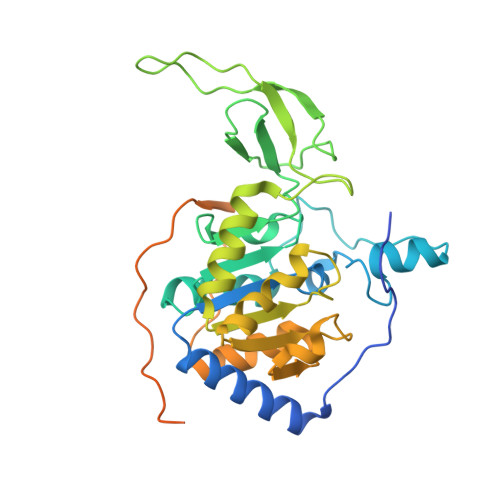
Human SIRT6 crystal structure in complex with ADP ribose


Experimental Data Snapshot

  • Method: X-RAY DIFFRACTION
  • Resolution: 2.04 Å
  • R-Value Free: 
    0.213 (Depositor), 0.208 (DCC) 
  • R-Value Work: 
    0.183 (Depositor) 
  • R-Value Observed: 
    0.184 (Depositor) 

Starting Model: experimental
View more details

wwPDB Validation 3D Report Full Report

Validation slider image for 3PKI

Ligand Structure Quality Assessment 


This is version 1.4 of the entry. See complete history

Literature

Structure and biochemical functions of SIRT6.

Pan, P.W.Feldman, J.L.Devries, M.K.Dong, A.Edwards, A.M.Denu, J.M.

(2011) J Biological Chem 286: 14575-14587

  • DOI: https://doi.org/10.1074/jbc.M111.218990
  • Primary Citation Related Structures: 
    3K35, 3PKI, 3PKJ

  • PubMed Abstract: 

    SIRT6 is a member of the evolutionarily conserved sirtuin family of NAD(+)-dependent protein deacetylases and functions in genomic stability and transcriptional control of glucose metabolism. Early reports suggested that SIRT6 performs ADP-ribosylation, whereas more recent studies have suggested that SIRT6 functions mainly as a histone deacetylase. Thus, the molecular functions of SIRT6 remain uncertain. Here, we perform biochemical, kinetic, and structural studies to provide new mechanistic insight into the functions of SIRT6. Utilizing three different assays, we provide biochemical and kinetic evidence that SIRT6-dependent histone deacetylation produces O-acetyl-ADP-ribose but at a rate ∼1,000 times slower than other highly active sirtuins. To understand the molecular basis for such low deacetylase activity, we solved the first crystal structures of this class IV sirtuin in complex with ADP-ribose and the non-hydrolyzable analog of O-acetyl-ADP-ribose, 2'-N-acetyl-ADP-ribose. The structures revealed unique features of human SIRT6, including a splayed zinc-binding domain and the absence of a helix bundle that in other sirtuin structures connects the zinc-binding motif and Rossmann fold domain. SIRT6 also lacks the conserved, highly flexible, NAD(+)-binding loop and instead contains a stable single helix. These differences led us to hypothesize that SIRT6, unlike all other studied sirtuins, would be able to bind NAD(+) in the absence of an acetylated substrate. Indeed, we found that SIRT6 binds NAD(+) with relatively high affinity (K(d) = 27 ± 1 μM) in the absence of an acetylated substrate. Isothermal titration calorimetry and tryptophan fluorescence binding assays suggested that ADP-ribose and NAD(+) induce different structural perturbations and that NADH does not bind to SIRT6. Collectively, these new insights imply a unique activating mechanism and/or the possibility that SIRT6 could act as an NAD(+) metabolite sensor.


  • Organizational Affiliation
    • Structural Genomics Consortium, University of Toronto, Toronto, Ontario M5G 1L7, Canada.

Macromolecule Content 

  • Total Structure Weight: 240.6 kDa 
  • Atom Count: 14,193 
  • Modeled Residue Count: 1,671 
  • Deposited Residue Count: 2,130 
  • Unique protein chains: 1

Macromolecules

Find similar proteins by:|  3D Structure
Entity ID: 1
MoleculeChains  Sequence LengthOrganismDetailsImage
NAD-dependent deacetylase sirtuin-6
A, B, C, D, E
A, B, C, D, E, F
355Homo sapiensMutation(s): 1 
Gene Names: SIRT6SIR2L6
EC: 3.5.1 (PDB Primary Data), 2.4.2 (UniProt), 2.3.1 (UniProt), 2.3.1.286 (UniProt)
UniProt & NIH Common Fund Data Resources
Find proteins for Q8N6T7 (Homo sapiens)
Explore Q8N6T7 
Go to UniProtKB:  Q8N6T7
PHAROS:  Q8N6T7
GTEx:  ENSG00000077463 
Entity Groups
Sequence Clusters30% Identity50% Identity70% Identity90% Identity95% Identity100% Identity
UniProt GroupQ8N6T7
Sequence Annotations
Expand
Reference Sequence

Small Molecules

Ligands 4 Unique
IDChains Name / Formula / InChI Key2D Diagram3D Interactions
AR6

Query on AR6


Download:Ideal Coordinates CCD File
BA [auth C]
GB [auth F]
J [auth A]
OA [auth D]
Q [auth B]
BA [auth C],
GB [auth F],
J [auth A],
OA [auth D],
Q [auth B],
WA [auth E]
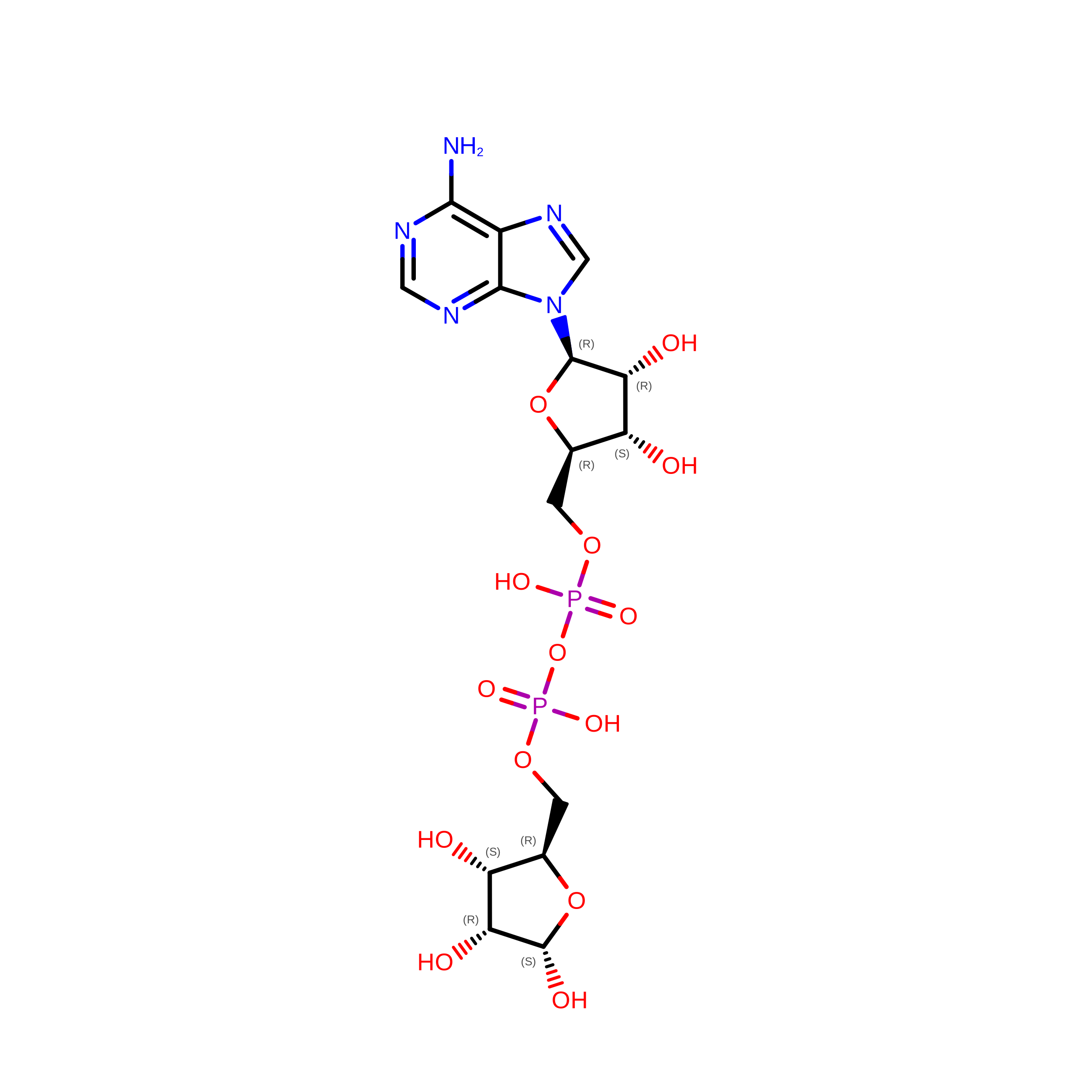
[(2R,3S,4R,5R)-5-(6-AMINOPURIN-9-YL)-3,4-DIHYDROXY-OXOLAN-2-YL]METHYL[HYDROXY-[[(2R,3S,4R,5S)-3,4,5-TRIHYDROXYOXOLAN-2-YL]METHOXY]PHOSPHORYL] HYDROGEN PHOSPHATE
C15 H23 N5 O14 P2
SRNWOUGRCWSEMX-ZQSHOCFMSA-N
SO4

Query on SO4


Download:Ideal Coordinates CCD File
AB [auth E]
BB [auth E]
CA [auth C]
CB [auth E]
DA [auth C]
AB [auth E],
BB [auth E],
CA [auth C],
CB [auth E],
DA [auth C],
EA [auth C],
FA [auth C],
HB [auth F],
IB [auth F],
K [auth A],
L [auth A],
M [auth A],
N [auth A],
O [auth A],
PA [auth D],
QA [auth D],
RA [auth D],
S [auth B],
U [auth B],
W [auth B],
XA [auth E],
YA [auth E],
ZA [auth E]
SULFATE ION
O4 S
QAOWNCQODCNURD-UHFFFAOYSA-L
ZN

Query on ZN


Download:Ideal Coordinates CCD File
AA [auth C]
FB [auth F]
H [auth A]
NA [auth D]
P [auth B]
AA [auth C],
FB [auth F],
H [auth A],
NA [auth D],
P [auth B],
VA [auth E]
ZINC ION
Zn
PTFCDOFLOPIGGS-UHFFFAOYSA-N
UNX

Query on UNX


Download:Ideal Coordinates CCD File
DB [auth E]
EB [auth E]
G [auth A]
GA [auth C]
HA [auth C]
DB [auth E],
EB [auth E],
G [auth A],
GA [auth C],
HA [auth C],
I [auth A],
IA [auth C],
JA [auth C],
JB [auth F],
KA [auth C],
KB [auth F],
LA [auth C],
LB [auth F],
MA [auth C],
MB [auth F],
NB [auth F],
OB [auth F],
R [auth B],
SA [auth D],
T [auth B],
TA [auth D],
UA [auth D],
V [auth B],
X [auth B],
Y [auth B],
Z [auth B]
UNKNOWN ATOM OR ION
X

Experimental Data & Validation

Experimental Data

  • Method: X-RAY DIFFRACTION
  • Resolution: 2.04 Å
  • R-Value Free:  0.213 (Depositor), 0.208 (DCC) 
  • R-Value Work:  0.183 (Depositor) 
  • R-Value Observed: 0.184 (Depositor) 
Space Group: P 1
Unit Cell:
Length ( Å )Angle ( ˚ )
a = 77.367α = 118.09
b = 90.2β = 91.39
c = 90.18γ = 115.8
Software Package:
Software NamePurpose
SBC-Collectdata collection
MOLREPphasing
BUSTERrefinement
HKL-3000data reduction
HKL-3000data scaling

Structure Validation

View Full Validation Report


Ligand Structure Quality Assessment 


Entry History 

Revision History  (Full details and data files)

  • Version 1.0: 2011-01-26
    Type: Initial release
  • Version 1.1: 2011-07-13
    Changes: Version format compliance
  • Version 1.2: 2017-02-01
    Changes: Database references
  • Version 1.3: 2017-11-08
    Changes: Refinement description
  • Version 1.4: 2023-09-06
    Changes: Data collection, Database references, Derived calculations, Refinement description, Structure summary