3P86 | pdb_00003p86

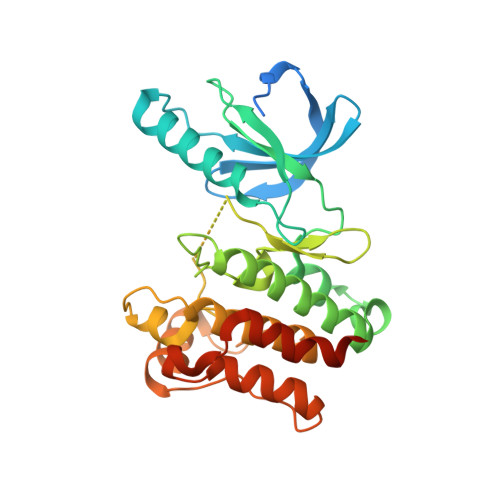
Crystal structure of CTR1 kinase domain mutant D676N in complex with staurosporine


Experimental Data Snapshot

  • Method: X-RAY DIFFRACTION
  • Resolution: 2.50 Å
  • R-Value Free: 
    0.232 (Depositor), 0.229 (DCC) 
  • R-Value Work: 
    0.195 (Depositor), 0.197 (DCC) 
  • R-Value Observed: 
    0.197 (Depositor) 

Starting Model: experimental
View more details

wwPDB Validation 3D Report Full Report

Validation slider image for 3P86

Ligand Structure Quality Assessment 


This is version 1.2 of the entry. See complete history

Literature

Protein kinase domain of CTR1 from Arabidopsis thaliana promotes ethylene receptor cross talk.

Mayerhofer, H.Panneerselvam, S.Mueller-Dieckmann, J.

(2012) J Mol Biology 415: 768-779

  • DOI: https://doi.org/10.1016/j.jmb.2011.11.046
  • Primary Citation Related Structures: 
    3P86, 3PPZ

  • PubMed Abstract: 

    Ethylene controls many aspects of plant growth and development. Signaling by the gaseous phytohormone is initiated by disulfide-linked membrane-bound receptors, and the formation of heteromeric receptor clusters contributes to the broad range of ethylene responsiveness. In Arabidopsis thaliana, the TCS-like ethylene receptors interact with the cytosolic serine/threonine kinase constitutive triple response 1 (CTR1), a proposed mitogen-activated protein kinase kinase kinase. In the absence of the hormone, the receptor and therefore CTR1 are active. Hence, ethylene acts as an inverse agonist of its signaling pathway. The three-dimensional structures of the active, triphosphorylated and the unphosphorylated, inactive kinase domain of CTR1 in complex with staurosporine illustrate the conformational rearrangements that form the basis of activity regulation. Additionally, in analytical ultracentrifugation experiments, active kinase domains form back-to-back dimers, while inactive and activation loop variants are monomers. Together with a front-to-front activation interface, the active protein kinase dimers thereby engage in interactions that promote CTR1-mediated cross talk between ethylene receptor clusters. This model provides a structural foundation for the observed high sensitivity of plants to ethylene.


  • Organizational Affiliation
    • EMBL Hamburg Outstation, Hamburg, Germany.

Macromolecule Content 

  • Total Structure Weight: 70.9 kDa 
  • Atom Count: 4,034 
  • Modeled Residue Count: 489 
  • Deposited Residue Count: 618 
  • Unique protein chains: 1

Macromolecules

Find similar proteins by:|  3D Structure
Entity ID: 1
MoleculeChains  Sequence LengthOrganismDetailsImage
Serine/threonine-protein kinase CTR1
A, B
309Arabidopsis thalianaMutation(s): 1 
Gene Names: At5g03730CTR1F17C15_150
EC: 2.7.11.1
UniProt
Find proteins for Q05609 (Arabidopsis thaliana)
Explore Q05609 
Go to UniProtKB:  Q05609
Entity Groups
Sequence Clusters30% Identity50% Identity70% Identity90% Identity95% Identity100% Identity
UniProt GroupQ05609
Sequence Annotations
Expand
Reference Sequence

Small Molecules

Ligands 1 Unique
IDChains Name / Formula / InChI Key2D Diagram3D Interactions
STU

Query on STU


Download:Ideal Coordinates CCD File
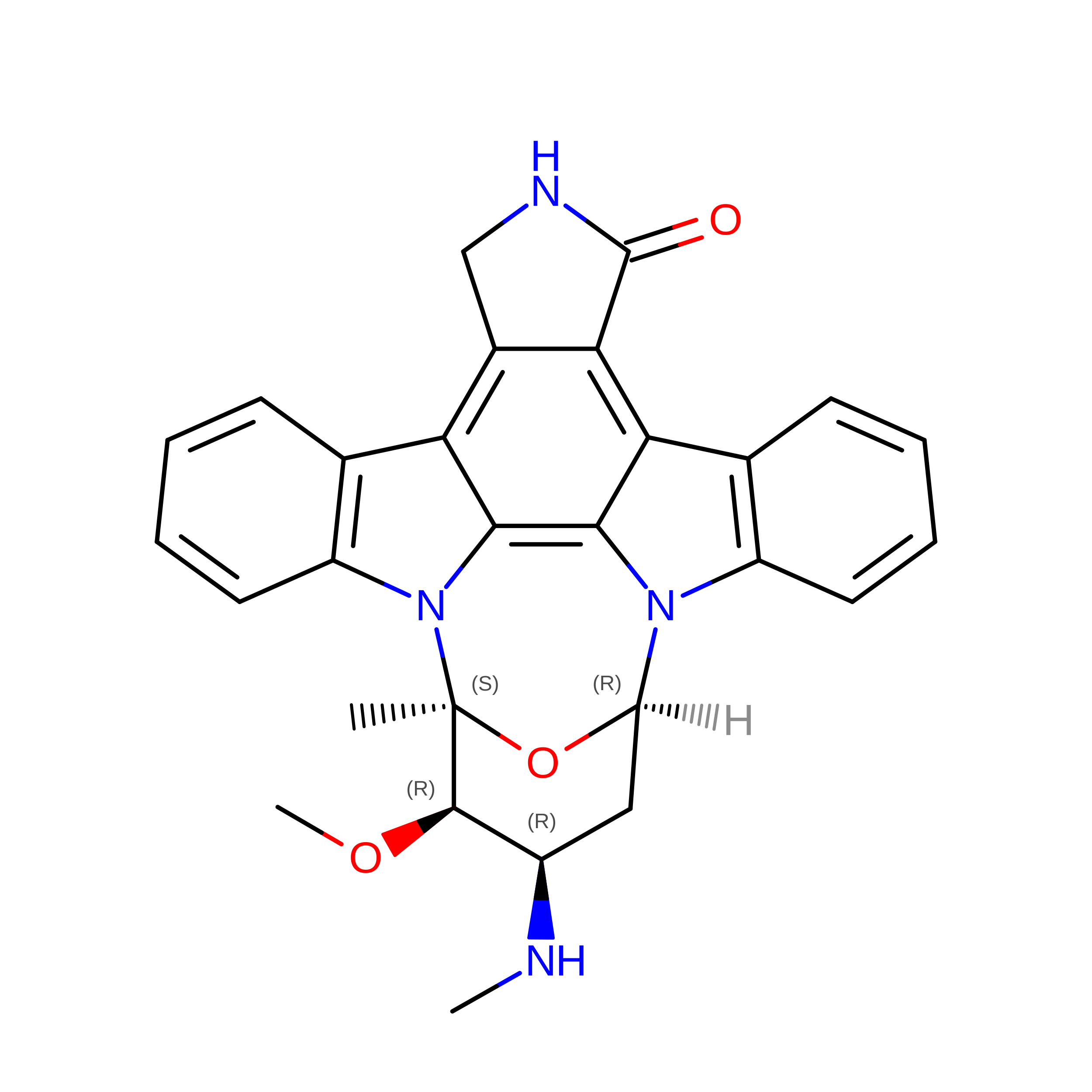
C [auth A]STAUROSPORINE
C28 H26 N4 O3
HKSZLNNOFSGOKW-FYTWVXJKSA-N

Experimental Data & Validation

Experimental Data

  • Method: X-RAY DIFFRACTION
  • Resolution: 2.50 Å
  • R-Value Free:  0.232 (Depositor), 0.229 (DCC) 
  • R-Value Work:  0.195 (Depositor), 0.197 (DCC) 
  • R-Value Observed: 0.197 (Depositor) 
Space Group: P 42 21 2
Unit Cell:
Length ( Å )Angle ( ˚ )
a = 122.334α = 90
b = 122.334β = 90
c = 95.011γ = 90
Software Package:
Software NamePurpose
EDNAdata collection
PHASERphasing
PHENIXrefinement
XDSdata reduction
SCALAdata scaling

Structure Validation

View Full Validation Report


Ligand Structure Quality Assessment 


Entry History 

Deposition Data

Revision History  (Full details and data files)

  • Version 1.0: 2011-10-26
    Type: Initial release
  • Version 1.1: 2018-08-15
    Changes: Data collection, Database references, Structure summary
  • Version 1.2: 2023-11-01
    Changes: Data collection, Database references, Derived calculations, Refinement description