3OWO | pdb_00003owo

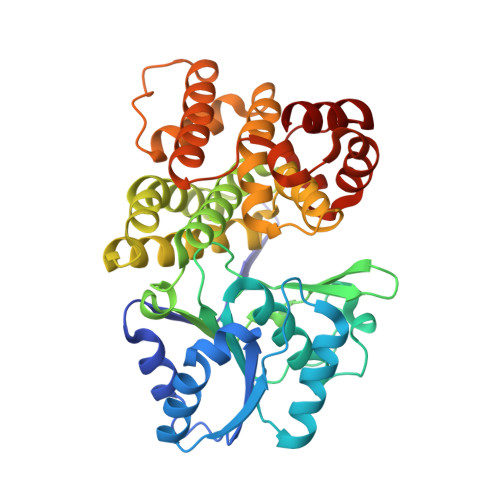
Structures of iron-dependent alcohol dehydrogenase 2 from Zymomonas mobilis ZM4 with and without NAD cofactor


Experimental Data Snapshot

  • Method: X-RAY DIFFRACTION
  • Resolution: 2.07 Å
  • R-Value Free: 
    0.253 (Depositor), 0.257 (DCC) 
  • R-Value Work: 
    0.202 (Depositor), 0.206 (DCC) 
  • R-Value Observed: 
    0.202 (Depositor) 

Starting Model: experimental
View more details

wwPDB Validation 3D Report Full Report

Validation slider image for 3OWO

This is version 1.3 of the entry. See complete history

Literature

Structures of iron-dependent alcohol dehydrogenase 2 from Zymomonas mobilis ZM4 with and without NAD+ cofactor

Moon, J.H.Lee, H.J.Park, S.Y.Song, J.M.Park, M.Y.Park, H.M.Sun, J.Park, J.H.Kim, B.Y.Kim, J.S.

(2011) J Mol Biology 407: 413-424

  • DOI: https://doi.org/10.1016/j.jmb.2011.01.045
  • Primary Citation Related Structures: 
    3OWO, 3OX4

  • PubMed Abstract: 

    The ethanologenic bacterium Zymomonas mobilis ZM4 is of special interest because it has a high ethanol yield. This is made possible by the two alcohol dehydrogenases (ADHs) present in Z. mobilis ZM4 (zmADHs), which shift the equilibrium of the reaction toward the synthesis of ethanol. They are metal-dependent enzymes: zinc for zmADH1 and iron for zmADH2. However, zmADH2 is inactivated by oxygen, thus implicating zmADH2 as the component of the cytosolic respiratory system in Z. mobilis. Here, we show crystal structures of zmADH2 in the form of an apo-enzyme and an NAD+–cofactor complex. The overall folding of the monomeric structure is very similar to those of other functionally related ADHs with structural variations around the probable substrate and NAD+ cofactor binding region. A dimeric structure is formed by the limited interactions between the two subunits with the bound NAD+ at the cleft formed along the domain interface. The catalytic iron ion binds near to the nicotinamide ring of NAD+, which is likely to restrict and locate the ethanol to the active site together with the oxidized Cys residue and several nonpolar bulky residues. The structures of the zmADH2 from the proficient ethanologenic bacterium Z. mobilis, with and without NAD+ cofactor, and modeling ethanol in the active site imply that there is a typical metal-dependent catalytic mechanism.


  • Organizational Affiliation
    • Department of Chemistry and Institute of Basic Sciences, Chonnam National University, 300, Yongbong-dong, Buk-gu, Gwangju 500-757, Korea.

Macromolecule Content 

  • Total Structure Weight: 160.97 kDa 
  • Atom Count: 11,939 
  • Modeled Residue Count: 1,527 
  • Deposited Residue Count: 1,532 
  • Unique protein chains: 1

Macromolecules

Find similar proteins by:|  3D Structure
Entity ID: 1
MoleculeChains  Sequence LengthOrganismDetailsImage
Alcohol dehydrogenase 2
A, B, C, D
383Zymomonas mobilisMutation(s): 0 
Gene Names: adhBZMO1596
EC: 1.1.1.1
UniProt
Find proteins for P0DJA2 (Zymomonas mobilis subsp. mobilis (strain ATCC 31821 / ZM4 / CP4))
Explore P0DJA2 
Go to UniProtKB:  P0DJA2
Entity Groups
Sequence Clusters30% Identity50% Identity70% Identity90% Identity95% Identity100% Identity
UniProt GroupP0DJA2
Sequence Annotations
Expand
Reference Sequence

Experimental Data & Validation

Experimental Data

  • Method: X-RAY DIFFRACTION
  • Resolution: 2.07 Å
  • R-Value Free:  0.253 (Depositor), 0.257 (DCC) 
  • R-Value Work:  0.202 (Depositor), 0.206 (DCC) 
  • R-Value Observed: 0.202 (Depositor) 
Space Group: P 1 21 1
Unit Cell:
Length ( Å )Angle ( ˚ )
a = 60.917α = 90
b = 87.51β = 94.7
c = 124.708γ = 90
Software Package:
Software NamePurpose
HKL-2000data collection
PHASESphasing
CNSrefinement
HKL-2000data reduction
HKL-2000data scaling

Structure Validation

View Full Validation Report


Entry History 

Deposition Data

Revision History  (Full details and data files)

  • Version 1.0: 2011-02-16
    Type: Initial release
  • Version 1.1: 2011-07-13
    Changes: Version format compliance
  • Version 1.2: 2014-03-26
    Changes: Database references
  • Version 1.3: 2023-11-01
    Changes: Data collection, Database references, Derived calculations, Refinement description